
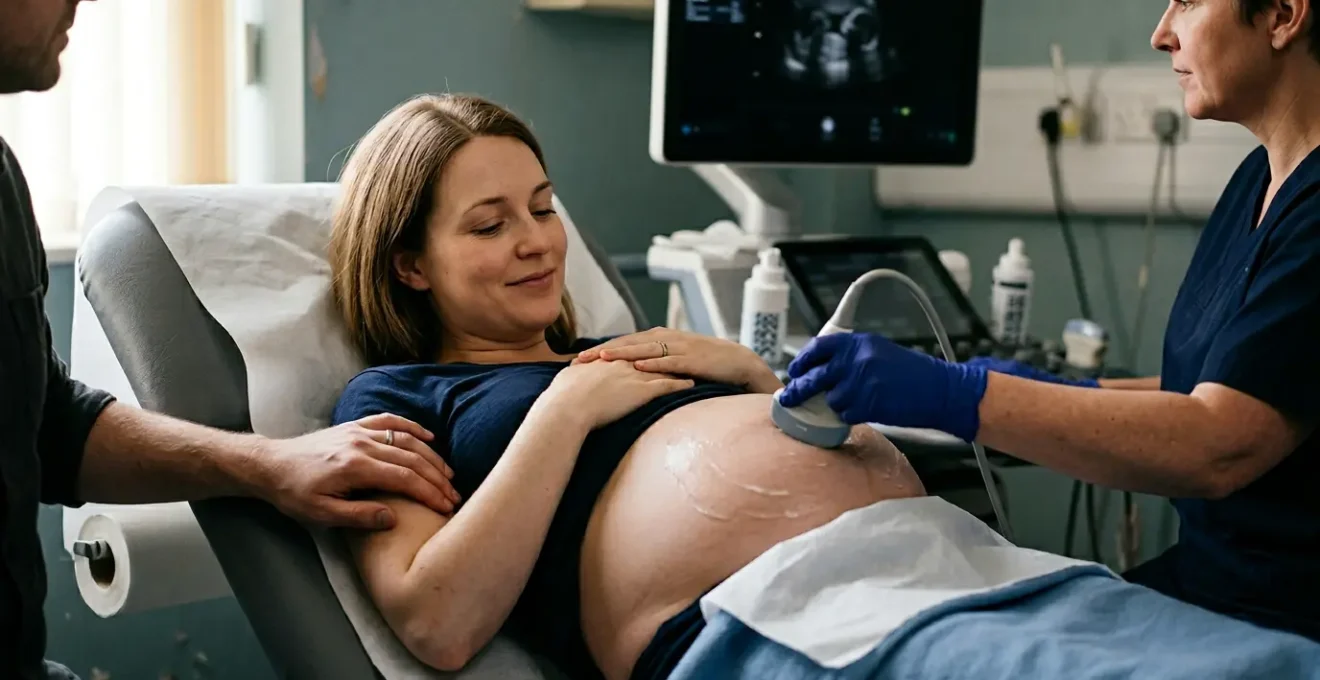
In summary:
- NHS pregnancy screenings are designed not just to date your pregnancy, but to provide vital information about your baby’s development and your own health.
- A “high chance” result from the combined test is not a diagnosis; it’s the start of a supportive conversation and a clear pathway for further, more accurate testing.
- The 20-week anomaly scan is a detailed structural check, but has limitations. Understanding what sonographers are looking for helps manage expectations.
- Changes in your baby’s movement pattern are a critical signal. You should always call your maternity unit immediately, no matter the time of day.
- A short, clear, and flexible birth plan written in collaborative language is far more effective in an NHS setting than a long list of demands.
From the moment you see that positive line, a whirlwind of questions begins. As you navigate the first few weeks of pregnancy, your thoughts quickly turn to the care you’ll receive and the milestones ahead. In the UK, this journey is mapped out by the NHS, with a series of routine scans and screenings designed to monitor the health of both you and your baby. You’ve likely heard friends talk about the “12-week scan” or the “20-week scan,” and while it’s common knowledge that these appointments check on the baby, the specifics can feel shrouded in clinical mystery.
As a sonographer, I spend my days in the quiet, darkened rooms where these milestones unfold. I see the flicker of a first heartbeat and trace the curve of a tiny spine. I also see the anxiety and anticipation on parents’ faces. My role is to look “behind the screen”—to translate the grayscale images and clinical data into meaningful information. The standard advice often just covers *what* the tests are, but rarely explains *why* we do them, *what* we’re really looking for, and most importantly, *what the results actually mean for you*.
The purpose of this guide is to bridge that gap. I want to take you inside the consultation room and empower you with the understanding you need to navigate your NHS antenatal care with confidence. We’ll decode the terminology, clarify the purpose of each key test, and provide practical advice on how to have the most productive conversations with your midwives and doctors. This isn’t just about seeing your baby; it’s about becoming an informed and active partner in your own pregnancy journey.
This article will walk you through the key screenings offered on the NHS. From understanding what a “high chance” result really means to writing a birth plan that staff will actually use, you’ll gain an insider’s perspective to help you feel more prepared and in control.
Summary: A Sonographer’s Guide to NHS Pregnancy Screenings
- The Combined Test: What Does “High Chance” Actually Mean?
- The Anomaly Scan: What Exactly Is the Sonographer Looking For?
- Kicks Count: Why a Change in Movement Is an Emergency?
- The GTT (Glucose Tolerance Test): Who Needs It and How to Prepare?
- Fundal Height: Why Does the Midwife Measure Your Bump with a Tape?
- Herd Immunity: Why Your Child’s Vaccine Protects Vulnerable Kids?
- The Cheese Debate: Which Soft Cheeses Are Safe to Eat in the UK?
- How to Write a Birth Plan That NHS Staff Will Actually Read?
The Combined Test: What Does “High Chance” Actually Mean?
The first major screening you’ll be offered, typically between 10 and 14 weeks, is the combined test. It’s not just about getting that first picture for the fridge; its primary purpose is to screen for Down’s syndrome, Edwards’ syndrome, and Patau’s syndrome. The test combines a blood sample from you with an ultrasound measurement of the nuchal translucency (a fluid-filled space at the back of the baby’s neck). These results, along with your age, are fed into an algorithm to calculate a “chance” score.
Here is the single most important thing to understand: screening is not diagnosis. The result you receive is a statistical probability, not a certainty. In the NHS, a “high chance” result is anything more than 1 in 150. This can sound terrifying, but it simply means that out of 150 women with the same results, one will have a baby with the condition. It does not mean your baby has the condition. It means you have crossed a statistical line where you are now offered further, more definitive testing.
If you receive a high chance result, the NHS offers a clear pathway. The next step is usually a more advanced screening test called NIPT (Non-Invasive Prenatal Testing), which is a simple blood test that is much more accurate. Only if NIPT also comes back as high chance would you be offered invasive diagnostic tests, which carry a small risk. The table below outlines the options you would discuss with your midwife.
| Test Type | What It Is | Timing | Accuracy | Miscarriage Risk | NHS Availability |
|---|---|---|---|---|---|
| NIPT | Blood test analyzing fetal DNA | After higher chance result | Screening test, more accurate than combined test | None (non-invasive) | Free for higher chance results (1:2 to 1:150) |
| CVS | Sample from placenta via needle | 11-14 weeks (can be later) | Diagnostic – definite answer | About 1 in 200 (0.5%) | Free via NHS |
| Amniocentesis | Sample of amniotic fluid via needle | From 15 weeks onwards | Diagnostic – definite answer | About 1 in 200 (0.5%) | Free via NHS |
This result is the start of a conversation, not the end. To help you prepare for that conversation and feel in control, it’s vital to know what to ask.
Your checklist: Questions to ask your midwife after a higher chance result
- What is my individual chance based on my full profile and specific risk factors?
- What is the exact NIPT pathway in this Trust, and how long will I wait for results?
- Can you explain the difference between screening and diagnostic tests in my situation?
- What support services like ARC (Antenatal Results and Choices) can I access immediately?
- If I choose CVS or amniocentesis, what is the miscarriage risk specific to your unit?
Ultimately, a “high chance” result simply opens a door to more information, giving you choices and control over your next steps.
The Anomaly Scan: What Exactly Is the Sonographer Looking For?
The 20-week anomaly scan is a much longer and more detailed examination than your first scan. While you’re excited to potentially find out the sex, my focus is on a systematic, head-to-toe check of your baby’s anatomy. My goal is to assess the baby’s physical development and look for a specific list of 11 physical conditions that can be reliably identified on ultrasound at this stage. This is a methodical process, and the room is often quiet as I concentrate on getting clear views of each part of your baby.
This comprehensive check involves examining the baby’s bones, heart, brain, spinal cord, face, kidneys, and abdomen. We are methodically working through a checklist to ensure everything is developing as expected. It’s a complex task, as the baby is often moving, and getting a clear image of every structure can take time and patience.
The specific conditions the NHS Fetal Anomaly Screening Programme (FASP) looks for include:
- Anencephaly (a serious brain development condition)
- Open spina bifida (spinal cord not properly formed)
- Cleft lip
- Diaphragmatic hernia (organs in the wrong position)
- Gastroschisis and Exomphalos (abdominal wall defects)
- Serious cardiac anomalies (heart structure problems)
- Bilateral renal agenesis (both kidneys missing)
- Lethal skeletal dysplasia (bone development issues)
- Edwards’ syndrome (T18) and Patau’s syndrome (T13)
It’s important to have realistic expectations. The scan is very good, but it’s not perfect. NHS detection rates show that while around 90% of babies with spina bifida are detected, the rate for serious heart defects is closer to 50%. Some conditions are simply not visible on a scan. If we do find something, or can’t get a clear view, you’ll be told on the day and a clear plan will be made for follow-up, usually with a specialist fetal medicine team.
This scan provides a wealth of information and reassurance for the vast majority of parents, but its primary purpose is as a crucial clinical screening tool.
Kicks Count: Why a Change in Movement Is an Emergency?
As you move into the third trimester, your baby’s movements become a vital indicator of their wellbeing. The old advice to “count 10 kicks a day” is outdated and potentially dangerous. The new, evidence-based guidance from the NHS and charities like Kicks Count is to get to know your baby’s *own unique pattern* of movement. There is no set number of movements that is normal; what matters is what’s normal for *your* baby. A change in this pattern—a reduction in strength or frequency—is a sign that the baby may be in distress and needs to be checked immediately.
This is not something to be taken lightly. A reduction in movement can be the first, and sometimes only, sign that a baby is unwell. The statistics are sobering, with Kicks Count emphasizing that 7 babies are stillborn every day in the UK. Acting quickly on any change in movement can be life-saving. The fear of “being a nuisance” must be set aside. Your maternity unit has a 24/7 triage line for this exact reason, and they want you to call. Every single time.
Of mothers who have lost a baby to stillbirth in the third trimester, 50% reported a perceived gradual decline in fetal movement several days prior to the death of their baby.
– Count the Kicks Research, Count the Kicks FAQ – Evidence-based stillbirth prevention program
If you call, you’ll be asked to come in for monitoring. Here’s what to expect:
- You’ll be asked about your baby’s normal pattern and what has changed.
- You will be asked to come to the hospital for assessment. Do not delay.
- At the hospital, a monitor (CTG) will be strapped to your bump to record the baby’s heartbeat for at least 20-40 minutes.
- A midwife or doctor will review the trace and decide if further checks, like an ultrasound, are needed.
Never, ever go to sleep ignoring a change in movement. Don’t rely on home dopplers or sugary drinks to try and make the baby move. Your first and only action should be to call your midwife or maternity unit.
Trust your instincts. If something feels different, make the call. It is always the right thing to do.
The GTT (Glucose Tolerance Test): Who Needs It and How to Prepare?
The Oral Glucose Tolerance Test, or GTT, is a screening for gestational diabetes (GD), a type of diabetes that can develop during pregnancy. Not everyone is offered it. You’ll typically be recommended for the test if you have certain risk factors, such as a family history of diabetes, a high BMI, having had a large baby previously, or being of South Asian, Black, or Middle Eastern ethnic background. If you’re deemed to be at risk, the NHS offers the OGTT between 24 to 28 weeks pregnant.
Let’s be honest: the GTT isn’t the most pleasant experience. It involves fasting, drinking a very sweet glucose drink (often a specific volume of Lucozade or a drink called Polycal), and then waiting for two hours before a final blood test. The purpose is to see how your body processes the sugar load. While it’s a bit of an ordeal, identifying and managing gestational diabetes is crucial for preventing complications for both you and your baby, such as the baby growing too large.
As a sonographer, I see many women who have been through the GTT, and a little preparation can make the day much more bearable. Think of it as a mandatory, boring, but very important day at the hospital. Here’s a survival guide:
- Fast Correctly: You’ll need to fast from the night before (usually from midnight). You can drink water, but no food, juice, or other drinks.
- Pack for the Aftermath: You will be hungry and possibly feel a bit queasy after the test. Pack a healthy snack and a drink for the moment you’re given the all-clear.
- Bring Entertainment: Two hours is a long time to wait in a hospital corridor. A book, tablet with headphones, or a fully charged phone is essential.
- Wear Comfortable Clothes: Choose something with sleeves that are easy to roll up, as you’ll have blood taken at least twice.
- Plan Your Journey Home: Some people feel a bit lightheaded or unwell after the test. If possible, arrange for someone to pick you up or plan an easy journey home.
While it might feel like an inconvenience, the GTT is a powerful tool to ensure you and your baby stay healthy for the remainder of your pregnancy.
Fundal Height: Why Does the Midwife Measure Your Bump with a Tape?
From around 24 weeks, you’ll notice your midwife getting out a simple tape measure at every appointment. This seemingly low-tech procedure is the measurement of your fundal height. The midwife measures the distance from the top of your pubic bone (symphysis pubis) to the top of your uterus (the fundus). In a singleton pregnancy, the measurement in centimetres should roughly correspond to the number of weeks you are pregnant, plus or minus 2-3 cm. This data is plotted on a customised growth chart in your notes.
The purpose of this measurement is not to get a precise reading of the baby’s size, but to track a trend. A single measurement is just a snapshot, but a series of measurements plotted on your chart shows us the baby’s pattern of growth. We are looking for consistent, steady growth along the curve established for you. A sudden flattening of the curve could indicate a growth issue (Fetal Growth Restriction), while a sharp increase could suggest too much amniotic fluid or a large-for-gestational-age baby.
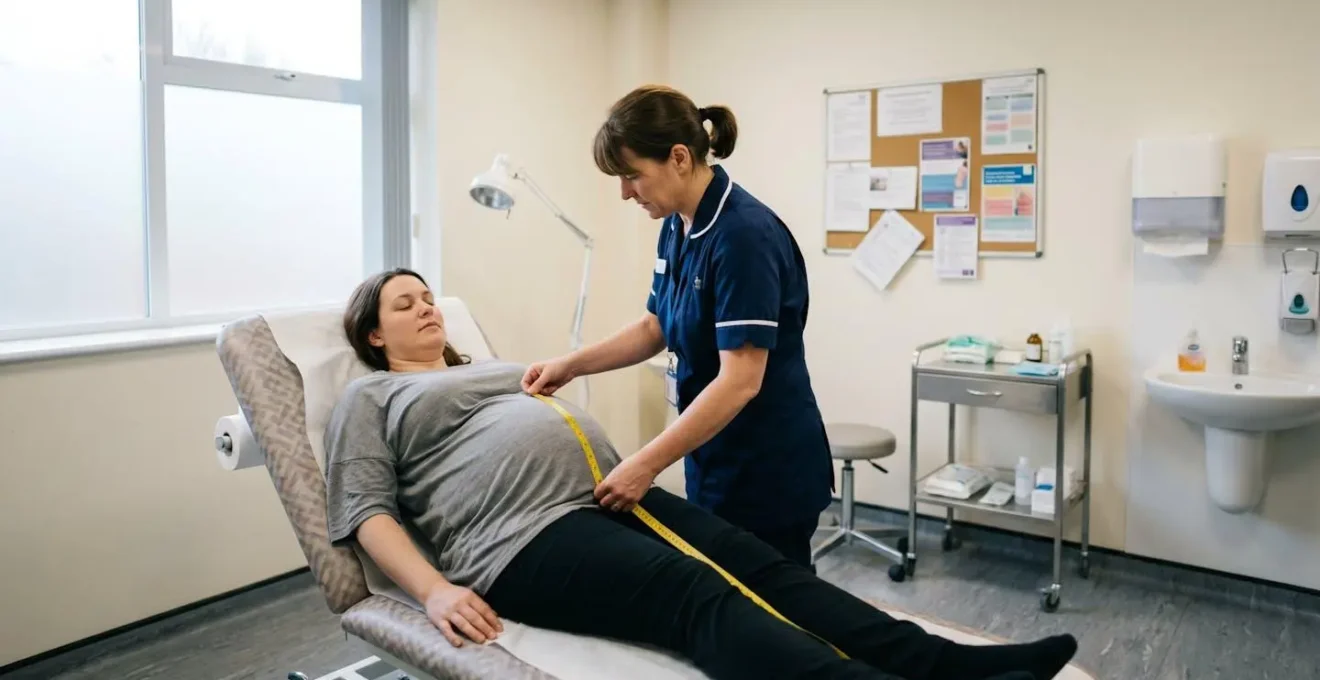
However, it’s crucial to understand that this is a screening tool, not a diagnostic one, and its accuracy can be affected by many factors. If your measurement is ever “off,” try not to panic. It’s often due to a simple reason:
- Baby’s Position: If the baby is lying sideways (transverse) or is engaged deep in your pelvis, it can significantly alter the measurement.
- Your Bladder: A full bladder can push the uterus up and add a centimetre or two. It’s always best to have an empty bladder before being measured.
- Observer Variation: Different midwives might measure slightly differently. This is why tracking the trend over time is more important than a single reading.
- Your BMI: It can be more challenging to feel the top of the uterus accurately in women with a higher BMI.
- Amount of Amniotic Fluid: More or less fluid than average will affect the size of your bump.
If a measurement falls outside the expected range or the growth trend changes, your midwife will refer you for an ultrasound scan. The scan is the next step to get a much more accurate assessment of the baby’s size and wellbeing.
So, when you see that tape measure, know that it’s a simple but clever way of keeping an eye on your baby’s progress, one centimetre at a time.
Herd Immunity: Why Your Child’s Vaccine Protects Vulnerable Kids?
While most of this guide focuses on your pregnancy, your journey as a parent involves thinking about your child’s health long after birth. The NHS vaccination schedule is a cornerstone of this, and one of the most important but misunderstood concepts behind it is herd immunity. It’s the idea that when a high percentage of the population is vaccinated, it becomes difficult for infectious diseases to spread. This creates a protective bubble around everyone, including those who are most vulnerable.
This protection is vital for specific groups who cannot be vaccinated. This includes newborn babies who are too young for their first jabs, children undergoing chemotherapy whose immune systems are compromised, or people with specific medical conditions. They rely entirely on the “herd” around them being immune to keep them safe from potentially deadly diseases like measles or whooping cough. When vaccination rates drop, this protective bubble develops holes, and the disease can rush in, always finding the most vulnerable individuals first.
We don’t have to look far for a real-world example of what happens when herd immunity fails. This isn’t a theoretical problem; it has had devastating consequences right here in the UK.
UK Case Study: The 2012-2013 Swansea Measles Outbreak
The 2012-2013 measles outbreak in Swansea, Wales, was a direct result of a drop in MMR vaccine uptake a decade earlier, following the now-discredited Wakefield study. With vaccination rates in the area falling below the crucial threshold, the disease was able to spread rapidly. The outbreak affected over 1,200 people, led to 88 hospitalizations, and tragically, one death. This stark example demonstrates how falling vaccination rates directly lead to community outbreaks, with severe consequences for those who get sick.
Choosing to vaccinate your child according to the NHS schedule is therefore a profound act of community care. You are not just protecting your own child; you are contributing to a wall of immunity that shields your friends’ newborns, the child down the street with leukaemia, and elderly relatives. It’s a collective responsibility with life-saving implications.
Every single vaccination is a vote for community health and a brick in the wall that protects the most vulnerable among us.
The Cheese Debate: Which Soft Cheeses Are Safe to Eat in the UK?
Navigating the “do’s and don’ts” of pregnancy food can feel like a minefield, and nowhere is the confusion more common than the cheese counter. The official NHS advice is to avoid certain soft, mould-ripened or blue-veined cheeses due to the risk of listeria, a type of bacteria that can be harmful in pregnancy. However, the rule isn’t as simple as “no soft cheese,” and with a little knowledge, you can still enjoy many of your favourites safely.
The absolute key to this debate is a single word: pasteurised. Listeria is killed by the process of pasteurisation (heating milk to a high temperature). Therefore, if a soft cheese is made with pasteurised milk, it is considered safe to eat. In the UK, the vast majority of supermarket own-brand soft cheeses (like cream cheese, Boursin, cottage cheese, and most feta and mozzarella) are pasteurised. The risk comes primarily from artisan or imported continental cheeses, which are more likely to be made with unpasteurised milk.
This means your new pregnancy skill is learning to read cheese labels like a detective. Here’s your cheat sheet for the UK supermarket aisle:
- Look for the P-Word: The packaging must explicitly state “made with pasteurised milk”. It will usually be on the front or in the ingredients list. If it just says “milk,” be cautious.
- Supermarket Brands Are Your Friend: Own-brand soft cheeses from major UK supermarkets (Tesco, Sainsbury’s, Asda, etc.) are almost universally made with pasteurised milk for this very reason.
- Cook It to Be Safe: Any cheese, even one made with unpasteurised milk (like a traditional Brie or Camembert), is safe if cooked until piping hot all the way through. The heat kills any potential listeria. So, a deep-fried Camembert or baked Brie is back on the menu.
- All Hard Cheeses Are Safe: All hard cheeses like cheddar, Parmesan, and Gruyère are safe to eat, even if made with unpasteurised milk. Their low moisture content makes it very difficult for bacteria like listeria to grow.
Key takeaways
- A “high chance” result from the combined test is a statistical threshold for more testing, not a diagnosis.
- A change in your baby’s unique pattern of movement is always a reason to call your maternity unit immediately.
- A short, clear birth plan using collaborative, “NHS-friendly” language is far more effective than a long list of demands.
So, don’t despair and banish all cheese. Simply become a savvy label-reader and you can navigate the cheese board with confidence.
How to Write a Birth Plan That NHS Staff Will Actually Read?
As you approach your due date, you’ll be encouraged to think about and write a birth plan. This is a fantastic opportunity to consider your preferences for labour and delivery. However, there’s a common misconception that a birth plan is a rigid script to be followed. In the dynamic environment of an NHS labour ward, a long, demanding list can unfortunately be counterproductive. The secret to a birth plan that staff will actually read and find useful is to keep it short, clear, flexible, and written in collaborative language.
Think of it less as a “plan” and more as a “list of preferences.” A single A4 page is ideal. Use bullet points. Start with the most important things at the top. Acknowledge that things can change and that you’re open to the guidance of the clinical team. A midwife who feels you see her as a partner in your care is far more likely to champion your preferences. The tone is everything. Instead of “I will not have continuous monitoring,” try “I would prefer intermittent monitoring unless there is a medical reason for continuous.”
Using “NHS-friendly” language shows that you have done your research and understand the clinical context. It builds trust and demonstrates that you are an informed and engaged participant. Here are some examples of phrases that work well in an NHS setting:
- ‘We’d like to try for a water birth, but are open to guidance from the midwife on the day.’
- ‘My preference is for expectant management of the third stage, but I’m happy to discuss active management if there are concerns about bleeding.’
- ‘I would like to use the birthing pool for pain relief and am aware I may need to get out for examinations.’
- ‘We would like delayed cord clamping, provided the baby is well.’
- ‘My birth partner would like to be the one to cut the cord, if the situation allows.’
- ‘I plan to breastfeed and would appreciate immediate skin-to-skin contact to help with this, unless the baby needs medical attention.’
- ‘We consent to the Vitamin K injection for the baby after birth.’
By framing your preferences in this way, you move from a place of demand to a place of discussion. You show the team that you are prepared, informed, and ready to work with them to have the best and safest birth possible on the day.