
Every interaction, every game, every conversation shapes a child’s developing brain. From the moment a newborn focuses on a high-contrast image to the day a school-age child tackles their first chapter book, development and education form an intricate dance of biology, environment and experience. Understanding how children learn—and how we can support that learning—empowers parents and caregivers to create rich, nurturing environments where curiosity thrives and skills flourish.
This comprehensive resource explores the full spectrum of child development and education, from early sensory stimulation in infancy through school preparation and beyond. Whether you’re wondering about the science behind baby talk, searching for play-based learning activities, evaluating educational philosophies, or creating an optimal learning space at home, this guide provides practical insights grounded in developmental research and real-world application.
The infant brain is a remarkable construction site, building approximately one million neural connections per second during the first years of life. This extraordinary growth period makes early stimulation not just beneficial, but foundational for all future learning.
Parentese—that instinctive, melodic, high-pitched speech pattern adults naturally adopt with babies—isn’t just charming; it’s neurologically significant. The exaggerated intonation and slower pace help infants distinguish individual sounds, laying the groundwork for language acquisition. Unlike generic baby talk with nonsense words, parentese uses real vocabulary delivered in an engaging, sing-song manner that captures and holds infant attention.
Visual development follows a predictable trajectory that parents can support strategically. Newborns see best at approximately 8-12 inches (the distance to a caregiver’s face during feeding) and respond most strongly to high-contrast patterns. Black and white books and images aren’t merely aesthetic choices—they provide optimal visual stimulation for developing eyes and help strengthen the neural pathways responsible for visual processing.
Similarly, mirror play serves multiple developmental purposes. When babies gaze at their reflection, they’re not just entertained—they’re building self-awareness, practicing facial recognition and exploring cause-and-effect relationships. These early interactions with their own image contribute to emerging social cognition and identity formation.
Play is children’s primary occupation and their most powerful learning tool. What might look like simple amusement is actually sophisticated skill-building in disguise.
Block play introduces fundamental concepts of physics, geometry and mathematics without a single worksheet. As children stack, balance and construct, they’re experimenting with gravity, symmetry and spatial relationships. A tower that topples teaches stability; arranging blocks by size introduces seriation and comparison. These hands-on experiences create mental models that later support formal mathematical thinking.
Puzzles offer a natural progression of cognitive challenge, from simple peg puzzles requiring hand-eye coordination to complex jigsaws demanding problem-solving strategies. This puzzle progression mirrors brain development, with each level stretching cognitive abilities appropriately.
The sophisticated hand movements required for writing don’t emerge overnight—they’re built through months of preparatory activities. Dough gym (manipulating playdough or clay) strengthens the small muscles of the hand. Scissor skills develop the tripod grasp and bilateral coordination. Pegging clothes onto a line or board refines the pincer grasp essential for pencil control.
These activities share a common thread: they’re purposeful, engaging and developmentally appropriate. A three-year-old squeezing playdough is unknowingly preparing for the endurance needed to write their name a year later.
Everyday moments offer rich opportunities for hands-on science. A bathtub becomes a physics laboratory during sink-or-float experiments. Sound lotto games (matching sounds to sources) sharpen auditory processing—a critical skill for phonics and reading comprehension. These multisensory experiences don’t just teach isolated facts; they cultivate scientific thinking: observation, hypothesis, experimentation and conclusion.
The most powerful learning often happens not during structured lessons but within the rhythms of everyday life. When parents adopt a learning mindset, ordinary moments transform into educational opportunities.
Dialogic reading reimagines storytime from passive listening to active conversation. Instead of simply reading words, adults ask open-ended questions, expand on children’s comments and connect stories to real experiences. This approach builds vocabulary, comprehension and critical thinking simultaneously.
Everyday mathematics surrounds children: counting stairs as they climb, sorting socks by color or size, setting the table with one-to-one correspondence. These informal encounters with numbers, patterns and quantities build number sense—an intuitive understanding of mathematical relationships that formal instruction later builds upon.
Pattern spotting in nature—alternating flower colors, symmetrical leaves, sequences of shapes in architecture—trains the brain to recognize order and predict what comes next. This skill underpins everything from reading to music to scientific reasoning.
Perhaps most importantly, the “I Wonder” game shifts the adult role from answer-provider to co-investigator. When children ask questions, responding with “That’s interesting—what do you think?” or “I wonder how we could find out?” nurtures curiosity, critical thinking and intellectual confidence. Following a child’s passionate interests—whether dinosaurs, trains, insects or princesses—allows for deep learning within a motivating context.
Academic skills represent only one dimension of development. Emotional awareness and adaptive mindsets prove equally vital for lifelong success and wellbeing.
The feelings wheel expands emotional vocabulary beyond basic labels like “happy” and “sad.” When children can identify and name nuanced emotions—frustrated versus disappointed, excited versus content—they gain power over those feelings. This emotional granularity supports self-regulation, empathy and effective communication.
The concept of growth mindset—understanding that abilities develop through effort rather than being fixed traits—fundamentally shapes how children approach challenges. Praising effort (“You worked really hard on that puzzle”) rather than intelligence (“You’re so smart”) encourages persistence and resilience. Children with growth mindsets view mistakes as learning opportunities rather than evidence of inadequacy.
The simple addition of “yet” transforms self-perception. “I can’t do it” becomes “I can’t do it yet”—a small linguistic shift with profound psychological impact. This “not yet” concept normalizes the learning process and frames current limitations as temporary states rather than permanent conditions.
Reading is an unnatural act for the brain—unlike speech, which emerges instinctively, reading requires explicit instruction and practice. However, the foundations for literacy begin years before formal schooling.
Nursery rhymes may seem like simple entertainment, but they’re actually sophisticated phonological tools. Rhyming draws attention to sound patterns within words, building phonemic awareness—the understanding that words are composed of individual sounds. This awareness is the strongest predictor of future reading success.
The debate between phonics (teaching letter-sound relationships systematically) and whole-word approaches (recognizing entire words visually) has largely been settled by research: most children benefit from explicit phonics instruction combined with meaningful reading experiences. Understanding how children actually learn to read helps parents support this complex process appropriately.
Early literacy encompasses more than reading itself. Name recognition—finding their coat peg, identifying their drawer—gives children a personal entry point to print. These meaningful encounters with written language motivate engagement and demonstrate that print carries purpose.
School readiness extends far beyond knowing letters and numbers. It encompasses self-care skills, emotional regulation, social competence and curiosity.
Academically, readiness involves pre-literacy skills (recognizing letters, understanding print directionality), numeracy foundations (counting, comparing quantities) and fine motor control (using scissors, holding a pencil). However, equally important are the abilities to follow multi-step directions, work independently for short periods, ask for help appropriately and manage transitions.
Socially, children thrive when they can navigate peer interactions, share resources, take turns and resolve minor conflicts. These skills aren’t innate—they develop through practice, modeling and coaching. Parents support social readiness by creating opportunities for peer play, naming emotions and conflicts as they arise, and offering strategies for problem-solving.
The transition to school itself benefits from preparation. Pre-visits (looking at photos of the school online or visiting in person) reduce anxiety by replacing the unknown with the familiar. Visual thinking exercises (“What’s happening in this picture?”) strengthen observation and inference skills used constantly in classroom learning.
Multiple evidence-based educational approaches exist, each with distinct principles and methods. Understanding these philosophies helps parents make informed decisions about early education settings.
Montessori education emphasizes independence, hands-on learning with specially designed materials, mixed-age classrooms and child-directed activity within structured limits. Waldorf/Steiner approaches prioritize imagination, natural materials, artistic expression and delayed introduction of technology and formal academics. Reggio Emilia philosophy views children as capable researchers, using project-based learning, documentation and the environment as “third teacher.”
No single approach suits every child or family. Some children thrive with Montessori’s independence; others need more structured guidance. Some families align with Waldorf’s technology limits; others view digital literacy as essential. Understanding the core principles behind each methodology allows for informed selection or thoughtful integration of elements from multiple approaches.
Physical environments profoundly influence concentration, independence and learning engagement. Thoughtful modifications can transform any space into an effective learning zone.
The clean desk principle recognizes that visual clutter consumes cognitive resources. Reducing unnecessary items in a child’s workspace improves focus and task completion. Similarly, headphones and dividers help create focus within shared spaces, particularly valuable in busy households or for children sensitive to sensory input.
A learning wall displaying maps, timelines, current projects and proud achievements serves multiple purposes: it makes learning visible, creates easy reference points and celebrates progress. Book rotation—periodically changing which books are easily accessible—maintains freshness and prevents overwhelm, reigniting interest in previously overlooked titles.
For pre-readers, picture labels on storage containers enable independent tidying. This simple modification builds autonomy, reinforces print awareness and reduces friction around cleanup routines.
Despite our best efforts, some children struggle with specific skills or concepts. Distinguishing between normal developmental variation and genuine difficulty requiring intervention is crucial.
Gap analysis—systematically identifying which prerequisite skills might be missing—often reveals that apparent learning difficulties actually stem from missed foundational concepts rather than inherent disability. A child struggling with subtraction might simply need more practice with number bonds; a reluctant reader might need additional phonics work.
Tutors can provide valuable targeted support when children need additional practice, alternative explanations or confidence-building. Signs that tutoring might help include persistent frustration, growing skill gaps compared to peers or loss of confidence in specific subjects.
For families considering selective education, understanding when to begin preparation for entrance exams (such as the 11 Plus) involves balancing adequate preparation with preserving childhood and preventing burnout. Early preparation doesn’t mean starting formal tutoring at age six—it means ensuring strong foundational skills and broad general knowledge.
Understanding child development and education empowers you to support your child’s unique learning journey with confidence and purpose. Whether you’re stimulating an infant’s developing brain, creating play-based learning opportunities, fostering literacy, or preparing for school transitions, remember that you are your child’s first and most influential teacher. The everyday moments you share—conversations during car rides, observations during walks, questions asked and wondered about together—form the foundation upon which all future learning builds.
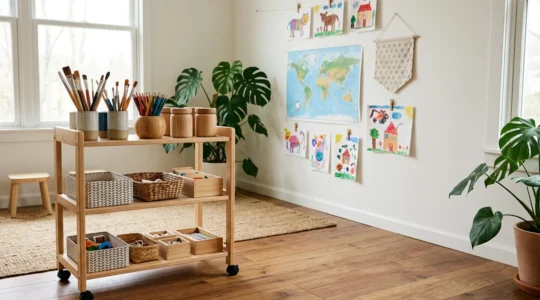
The key to successful home education is not replicating a school classroom, but creating a dynamic learning ecosystem that invites curiosity and autonomy. Focus on flexible, mobile stations like art carts and nature tables rather than rigid, dedicated rooms. Prioritize…
Read more
Hiring a tutor isn’t just a reaction to bad grades; it’s a powerful diagnostic tool for understanding your child’s unique learning needs. Distinguish temporary knowledge gaps from deeper learning or emotional challenges. Recognize that the right support might be a…
Read more
The critical choice isn’t picking the ‘best’ educational label, but becoming the architect of your child’s learning environment. The most effective approach borrows key principles—like Montessori’s independence, Waldorf’s connection to nature, and Reggio Emilia’s collaborative spirit—to create a bespoke ecosystem…
Read more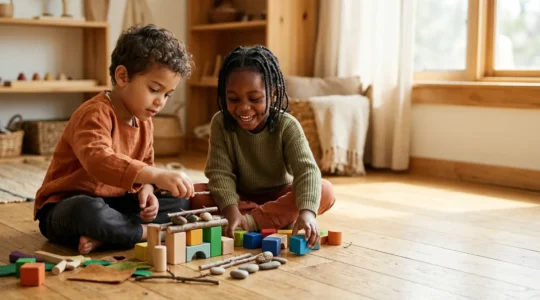
You don’t need a lab coat or a degree to teach your preschooler STEM; the key is simply to nurture the curiosity they already have. STEM for young children isn’t about formal lessons, but about playful exploration and asking “What…
Read more
To prepare a child for reading, forget flashcards and rote memorisation; the real work lies in building the brain’s foundational wiring for language through play, rhythm, and conversation. The UK’s focus on phonics works because it teaches children to decode…
Read more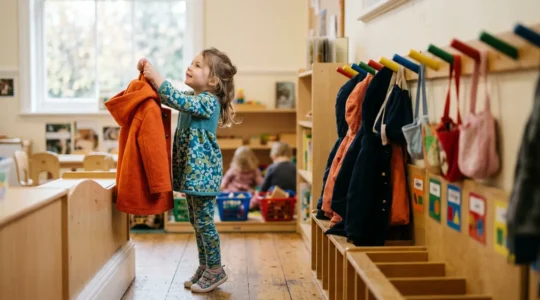
True school readiness is less about knowing the alphabet and more about fostering the practical, everyday independence that builds a child’s confidence and frees them up to learn. Key self-care skills like dressing and toilet independence reduce anxiety and allow…
Read more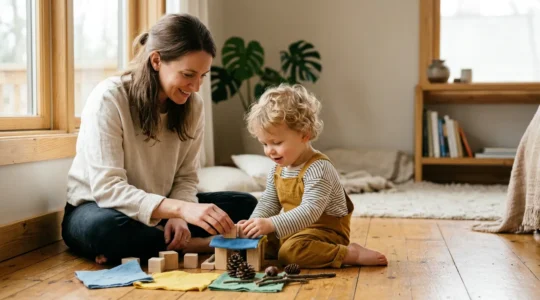
Stimulating your child’s brain isn’t about adding ’educational’ tasks; it’s about transforming your role from a teacher into a curious co-explorer. This approach focuses on building foundational skills like executive function and emotional literacy through joyful, everyday interactions. It prioritizes…
Read more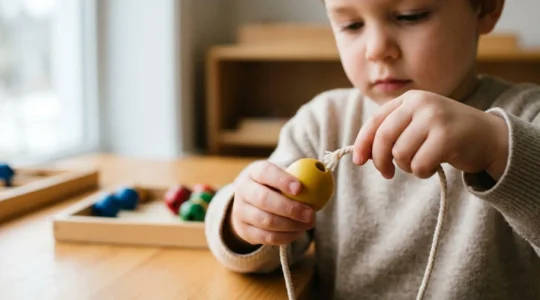
If you’re worried about your child’s struggles with buttons or holding a pencil, the solution isn’t just more practice—it’s smarter practice. As a pediatric occupational therapist, I’ll show you how to reframe simple, fun activities into a targeted “Hand Gym”…
Read more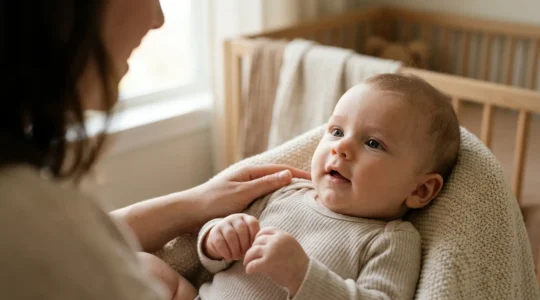
The most powerful cognitive-boosting tools for your baby are not found in an ‘educational toy’ catalog; they are found in your simple, responsive, and loving daily interactions. Scientific research shows that conversational turns, even with a pre-verbal baby, are a…
Read more