

The most powerful cognitive-boosting tools for your baby are not found in an ‘educational toy’ catalog; they are found in your simple, responsive, and loving daily interactions.
- Scientific research shows that conversational turns, even with a pre-verbal baby, are a direct predictor of brain development and language skills.
- Activities like peek-a-boo and exploring a basket of household items build a stronger cognitive foundation than any blinking, plastic toy.
Recommendation: Instead of searching for the next ‘smart’ product, focus on mastering the simple, science-backed interactions outlined in this guide to build a responsive and stimulating environment for your child.
In the modern landscape of parenting, you are likely bombarded with advertisements. Apps that promise to teach your toddler to code, subscription boxes filled with “Montessori-aligned” toys, and a dizzying array of gadgets designed to create a “genius baby.” The underlying message is clear and anxiety-inducing: if you aren’t actively curating and purchasing these experiences, you’re letting your child fall behind. This pressure can lead to a cycle of buying, clutter, and a nagging feeling of inadequacy, all while potentially overstimulating your child.
But what if the most potent fuel for your baby’s developing brain isn’t a product at all? What if the key to building a robust cognitive foundation—the very architecture for all future learning—lies not in what you buy, but in how you interact? As a child development psychologist, my goal is to help you cut through the marketing noise. The truth is, decades of research in neuroscience and psychology point to a simple, yet profound, conclusion: responsive, engaged caregiving is the single most powerful driver of early cognitive development.
This article will serve as your guide to reclaiming that power. We are going to move beyond the myth that stimulation must be purchased. Instead, we will explore the science behind why simple, everyday activities are a cognitive goldmine. We’ll delve into the “why” behind the high-pitched “baby talk,” the magic of a simple game of peek-a-boo, and the surprising neural benefits of a wooden spoon. By understanding the developmental purpose of these interactions, you can provide rich, meaningful stimulation that fosters deep learning without overwhelming your baby or your budget.
This guide unpacks the essential, science-backed methods that genuinely support your baby’s brain development. Below is a summary of the simple yet powerful principles we will explore to help you foster a stimulating, not overwhelming, environment.
Summary : Your Guide to Nurturing a Bright Mind Through Simple Play
- Parentese: Why High-Pitched Talking Helps Brain Development?
- Black and White Books: Why High Contrast Stimulates Newborn Vision?
- Object Permanence: Why Peek-a-Boo Is a Cognitive Workout?
- Treasure Baskets: How Household Items Build Neural Connections?
- Mirror Play: How Looking in a Mirror Builds Self-Awareness?
- Regression: When Should You Worry About Lost Skills?
- Front-Facing Shelves: Why Seeing Covers Increases Reading?
- Educational Toys: How to Choose Toys That Grow with Your Child?
Parentese: Why High-Pitched Talking Helps Brain Development?
That high-pitched, sing-song voice you instinctively use when talking to a baby isn’t just a cute habit; it’s a neurologically powerful tool known as “parentese.” Unlike regular baby talk, which often involves nonsensical sounds and grammatically incorrect sentences, parentese uses real words and correct grammar but alters the pitch, tempo, and exaggeration. It’s slower, higher-pitched, and filled with melodic ups and downs. This specific acoustic signature is universally captivating for the infant brain. It acts as a spotlight, signaling to the baby, “This information is for you. Pay attention.”
The back-and-forth interaction that parentese encourages is called a “serve and return” exchange. When you speak in parentese and pause, you give your baby a chance to “return the serve” with a coo, a gurgle, or a smile. By responding enthusiastically to their contribution, you are reinforcing a fundamental communication loop. This simple turn-taking is the bedrock of social interaction and language acquisition. It teaches your baby that their voice matters and that communication is a dialogue, not a monologue. The quantity of these conversational turns is a strong predictor of future verbal abilities.
The results of fostering this interactive environment are profound. A landmark University of Washington study coached parents on using parentese and tracked their babies’ development. The findings were striking: at 18 months, the children of coached parents produced words at almost twice the rate of children in the control group. As lead researcher Patricia Kuhl explains, parentese is more than just language input; it’s a social catalyst for the brain.
We now think parentese works because it’s a social hook for the baby brain — its high pitch and slower tempo are socially engaging and invite the baby to respond.
– Patricia Kuhl, University of Washington Institute for Learning & Brain Sciences
Therefore, the most advanced language-learning tool you can acquire costs nothing. It’s the conscious use of your own voice to engage, respond, and connect with your baby, laying the neural groundwork for a lifetime of communication.
Black and White Books: Why High Contrast Stimulates Newborn Vision?
A newborn’s world is a soft-focus blur. Their vision is still developing, with the ability to see clearly limited to about 8-12 inches—roughly the distance to a caregiver’s face during a feeding. The cones in their retina, which are responsible for perceiving color, are not yet fully mature. However, the rods, which detect light and shadow, are more developed. This is why high-contrast images, particularly bold black and white patterns, are so captivating for a newborn.
Presenting your baby with simple, stark black and white shapes and lines provides them with clear, decipherable visual information. Unlike a colorful, detailed picture that might appear as a confusing gray mush, a high-contrast image gives their developing eyes something to lock onto. This isn’t just about keeping them entertained; it’s a fundamental visual workout. Following the lines of a pattern or staring intently at a shape helps strengthen their eye muscles and encourages the development of visual tracking.
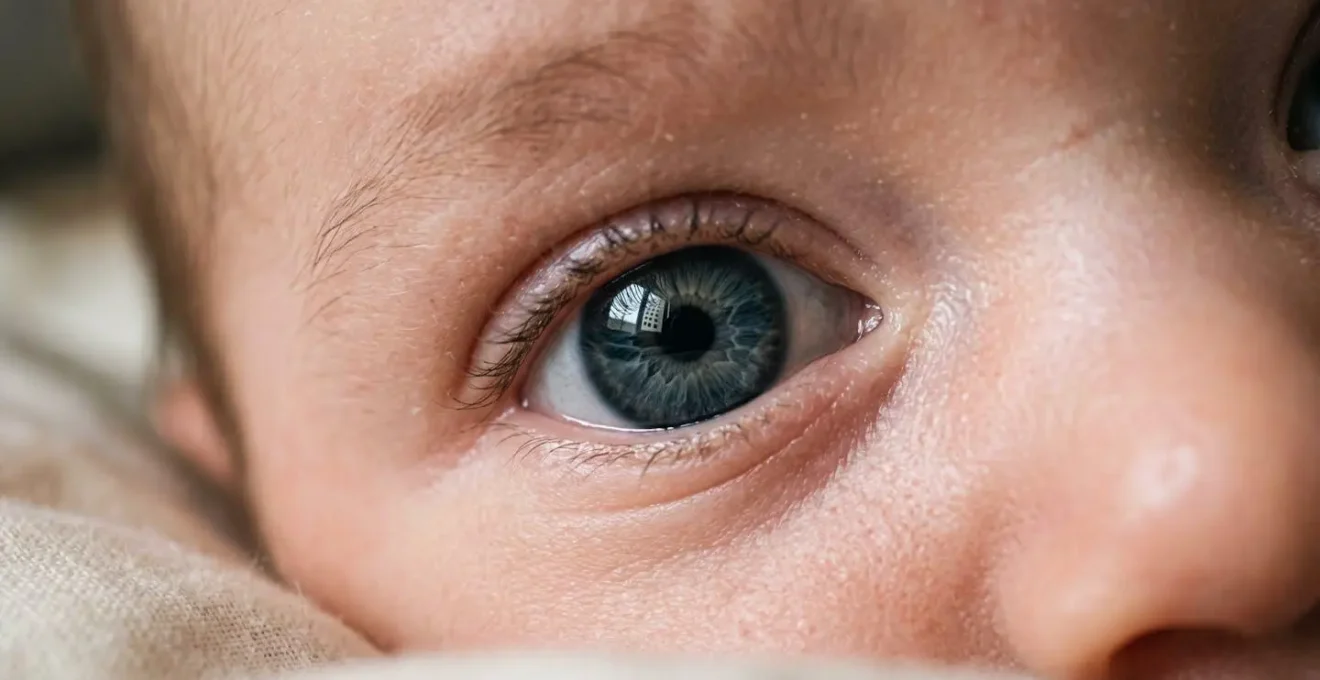
This focused engagement is a direct stimulant for the visual cortex of the brain. Each time your baby focuses on a high-contrast image, you are helping them build the neural pathways necessary for visual perception. As researchers at Lovevery note, this simple activity has a profound impact on how a baby’s brain learns to process the world around them. This foundational skill of receiving and interpreting visual data is essential for everything from recognizing faces to learning to read later in life.
Decades of research show that time spent looking at high-contrast images can contribute to the development of a baby’s visual perception—their brain’s ability to receive, interpret, and respond to visual stimuli.
– Lovevery Child Development Researchers, Lovevery Child Development Blog
You don’t need a library of expensive books. A few high-contrast cards, or even homemade patterns drawn with a black marker on white paper, placed within your baby’s line of sight during tummy time or quiet awake time, provide the perfect level of stimulation to build this critical cognitive foundation.
Object Permanence: Why Peek-a-Boo Is a Cognitive Workout?
To a very young infant, the world operates on a “what you see is what you get” basis. If an object is out of sight, it has effectively ceased to exist. The cognitive leap to understanding that things continue to exist even when they cannot be seen, heard, or touched is known as object permanence. This is one of the most fundamental achievements in a baby’s early development, and the simple game of peek-a-boo is its most effective and joyful teacher.
Each time you hide your face behind your hands and then reappear with a cheerful “Peek-a-boo!”, you are running a delightful little experiment for your baby. Your disappearance creates a moment of mild surprise or confusion, and your reappearance brings resolution and joy. This repeated cycle teaches a profound lesson: things that go away can, and do, come back. This concept is the gateway to understanding cause and effect, and it lays the groundwork for developing memory and representational thought. According to research, babies generally develop this concept around 6 to 9 months of age, and games are the primary way they master it.
Playing peek-a-boo also builds critical social and emotional skills. The game’s predictability helps your baby develop a sense of security and trust. They learn to anticipate your return, which can help mitigate separation anxiety. The shared laughter and eye contact strengthen your bond, reinforcing the “serve and return” interactions that are so vital for healthy brain development. It’s a cognitive workout disguised as a game, proving that meaningful learning doesn’t require any equipment—just you, your baby, and a willingness to be a little silly.
Your Action Plan: Progressive Object Permanence Games
- Classic Peekaboo: Cover your face with your hands, then remove them and say cheerfully ‘Peekaboo!’ to practice the simplest form of object permanence.
- Peekaboo with a Toy: Take one of your baby’s toys, hold it behind you or an object, and then make it appear to introduce object hiding.
- Hiding Toys Under Cloth: While your baby is watching, place several layers of cloth over one of their favorite toys and encourage them to find it.
- Advanced Hiding Games: As your baby learns to crawl, hide a few toys around the room while they watch, then encourage them to find the toys to challenge their developing memory.
By progressively increasing the challenge of these hiding games, you are scaffolding your baby’s learning. You are providing just the right amount of difficulty to stretch their cognitive abilities without causing frustration, building not just their understanding of the world, but their confidence as a capable learner.
Treasure Baskets: How Household Items Build Neural Connections?
In a world saturated with toys that beep, flash, and play music, one of the most powerful tools for infant cognitive development is surprisingly simple: a basket filled with ordinary household objects. The concept of the “Treasure Basket” was pioneered by child psychologist Elinor Goldschmied as a way to engage babies who are able to sit up but are not yet mobile. It is a profound exercise in what she termed heuristic play—the process of learning through hands-on exploration and discovery.
A Treasure Basket is not a toy box. It is a carefully curated collection of safe, non-plastic items from the real world. Think of a metal whisk, a large, smooth seashell, a wooden spoon, a bunch of keys, a silk scarf, and a lemon. Each object offers a unique sensory experience. The baby is free to explore the items at their own pace, without any adult direction or goal. In doing so, they are conducting their own scientific research. They are discovering weight, texture, temperature, sound, and smell. Is this object hard or soft? Warm or cold? Does it make a noise when I shake it? How does it taste? This rich sensory dialogue builds an incredible number of neural connections, far more than a single-purpose plastic toy ever could.
The adult’s role in this process is one of quiet observation and availability. You are not there to show the baby “how to” play, but to provide a safe and supportive presence. This allows the baby to develop focus, concentration, and decision-making skills as they choose which object to explore next. The variety of materials provides a level of stimulation that is deeply engaging for the infant brain.
Case Study: Elinor Goldschmied’s Treasure Basket Innovation
Child psychologist Elinor Goldschmied developed the Treasure Basket approach, creating collections of 80-100 natural and household objects for seated infants. Her research demonstrated that babies could concentrate on this independent, sensory exploration for up to an hour. She found the variety of real-world materials provided far greater stimulation for both infant interest and brain development than conventional toys. The approach emphasizes the adult’s role as responsive but not directive, allowing babies to engage in heuristic play where curiosity and concentration form the basis of all learning and creativity.
By creating a Treasure Basket, you are sending a powerful message to your child: the world is an interesting place, and you are a capable explorer. You are providing an opportunity for deep, self-directed learning that costs nothing and builds a cognitive foundation based on curiosity and sensory experience.
Mirror Play: How Looking in a Mirror Builds Self-Awareness?
One of the most fascinating developmental journeys an infant undertakes is the path to self-recognition. In the beginning, the baby in the mirror is simply another interesting human—a “social other” to be smiled at and babbled with. Over time, through repeated exposure and interaction, a profound cognitive shift occurs: the baby begins to realize that the reflection is, in fact, themselves. This journey is a cornerstone of developing self-awareness, and a simple, unbreakable mirror is the perfect laboratory for this discovery.
Mirror play is a multi-stage process. Initially, your baby is simply intrigued by the face looking back at them. They will coo, smile, and reach for their “mirror friend,” engaging in a “serve and return” interaction with their own image. This phase is crucial for social development, as they practice facial expressions and vocalizations. As they gain motor control, they will begin to notice a connection between their own movements and the movements of the baby in the mirror. When they raise their arm, the other baby does too. This is a powerful lesson in cause and effect.
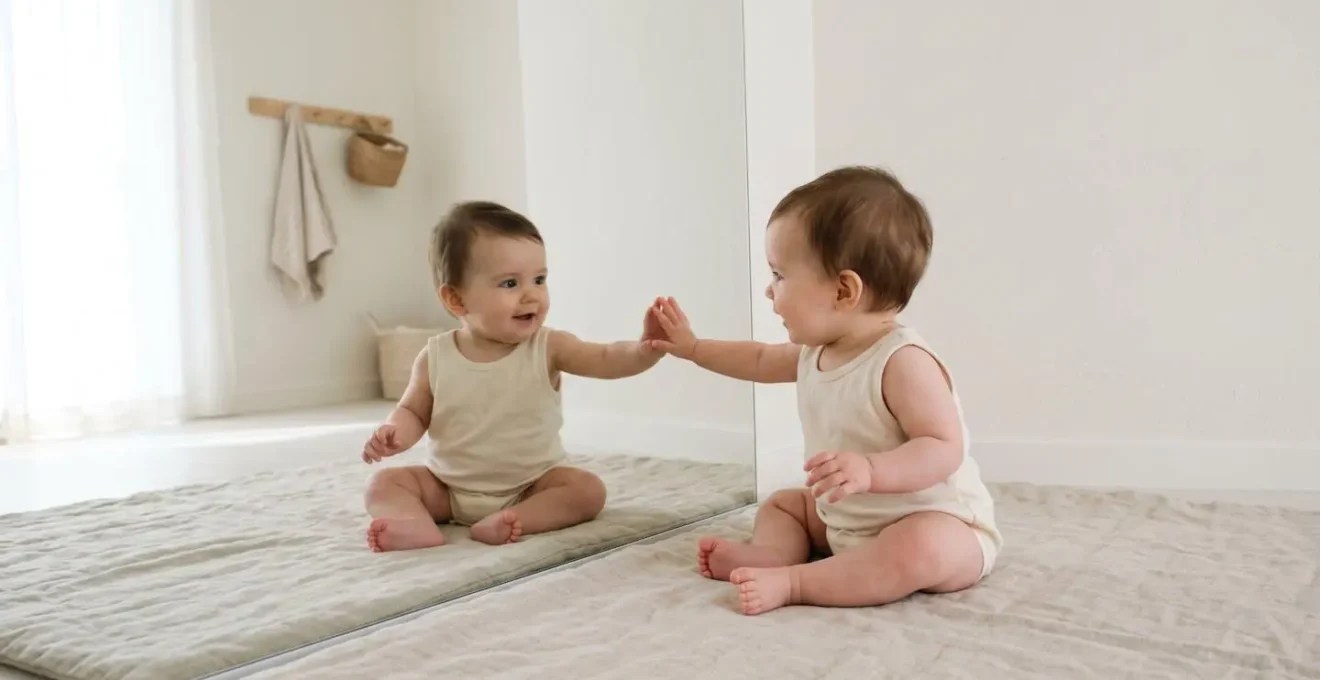
The final stage is the “aha!” moment of self-recognition, which typically emerges between 15 and 24 months. This is often tested by psychologists using the “rouge test,” where a spot of color is discreetly placed on the child’s nose. When they see their reflection, a child who has developed self-awareness will touch their own nose, not the mirror. This indicates they have formed a mental representation of themselves—a self-concept.
Beyond self-recognition, mirror play is a powerful tool for emotional development. You can sit with your baby in front of a mirror and name emotions (“Look at your happy smile!”), parts of the body (“Where is your nose?”), and actions (“You are clapping your hands!”). This provides a rich stream of language directly linked to their own physical being, helping to build their vocabulary and their understanding of themselves as a distinct person in the world.
Regression: When Should You Worry About Lost Skills?
It can be alarming for any parent. Your baby was consistently waving “bye-bye” and now has stopped. Your toddler was using a new word every day and has suddenly gone quiet. This apparent backward slide in development is known as regression, and while it can be a source of significant anxiety, it is often a normal—and even necessary—part of the learning process. The brain does not develop in a straight, linear fashion. It develops in fits and starts, with periods of intense focus on one skill often causing a temporary neglect of another.
Think of the brain as having a limited amount of “developmental energy.” When your baby is channeling all their resources into mastering a major new motor skill, like pulling up to stand or taking their first steps, other skills may be put on the back burner. The cognitive load required to learn to walk is immense. It involves balance, coordination, and intense concentration. During this period, the brain may temporarily deprioritize less critical skills, like babbling or fine motor manipulation. This is not a loss of skill, but a strategic reallocation of resources. In most cases, once the new, more complex skill is integrated, the “lost” skill will return, often stronger than before.
However, it is crucial for parents to be able to distinguish between these typical, temporary fluctuations and a true developmental red flag. While most regressions are benign, a significant and persistent loss of skills across multiple domains can be an indicator of an underlying issue. As a child development psychologist, I advise parents to use a simple framework to assess the situation before raising the alarm. The “3-D Test” can help you decide when to monitor and when to consult a professional.
- Duration: Is the regression temporary (a week or two) and linked to a new skill, illness, or change in routine? Or has it persisted for more than several weeks with no sign of the skill returning?
- Domain: Is the regression isolated to one specific skill (e.g., stopped waving)? Or is there a loss of skills across multiple developmental domains, such as language, motor skills, and social interaction, all at once?
- Demeanor: Is your child’s overall mood and personality the same? Or is the regression accompanied by a significant negative change in their temperament, social engagement, or overall happiness?
If you observe a regression that is long in duration, affects multiple domains, and is coupled with a negative change in demeanor, it is essential to consult your pediatrician or a developmental specialist for a professional assessment. But for the vast majority of cases, a little patience and understanding are all that’s needed. Your child is not broken; they are simply under construction.
Front-Facing Shelves: Why Seeing Covers Increases Reading?
Walk into any well-designed preschool or early childhood center, and you are unlikely to find traditional bookcases with books packed spine-out. Instead, you’ll see low, accessible, front-facing shelves where a limited number of books are displayed with their covers fully visible. This is not just an aesthetic choice; it is a deliberate strategy rooted in a deep understanding of how young, pre-literate children interact with books. For a child who cannot yet read words, the cover is the story.
A book’s cover art is a rich visual text. It contains clues about the characters, the setting, and the emotional tone of the story. When a child can see the cover, they can make a meaningful choice. They might recognize the friendly face of a favorite character or be drawn to the bright colors of a book about trucks. This act of choosing is a crucial step in developing autonomy and fostering a love of reading. It transforms reading from a passive activity directed by an adult into an act of self-directed exploration. As early literacy experts note, this visual decoding is a genuine form of reading.
For a pre-literate child, ‘reading the cover’ is a genuine act of reading. They are decoding images, recalling stories, and making a choice based on that information.
– Early Childhood Literacy Researchers, Reggio Emilia Educational Philosophy
Presenting books with their covers facing forward makes them more inviting and accessible. A wall of book spines can be visually overwhelming and undifferentiated for a young child. A small, curated selection of front-facing covers, on the other hand, acts as an invitation to engage. However, the key to this approach is curation. An overflowing shelf is just as overwhelming as a traditional bookcase. The goal is to create a calm, focused environment that encourages choice without causing visual clutter. A simple rotation strategy is the most effective way to maintain novelty and interest.
To implement this at home, follow a simple book rotation strategy:
- Display only 4-6 books at a time on your front-facing shelf to maintain focus.
- Rotate the displayed books weekly to maintain novelty and renewed interest.
- Store other books out of sight to keep the display area uncluttered.
- Observe which books your child gravitates toward, keeping one familiar favorite while introducing new selections.
- Encourage your child to select their own book from the limited display, fostering autonomy.
This “less is more” approach respects the child’s developing ability to process information and empowers them as a reader, long before they can decipher a single word.
Key takeaways
- The foundation of cognitive development is built on responsive, back-and-forth interactions (“serve and return”), not passive entertainment.
- Simple, real-world objects and activities like peek-a-boo, mirror play, and treasure baskets provide richer, more complex sensory input than most single-purpose electronic toys.
- Your role as a parent is not to be a constant entertainer, but to be a keen observer and a facilitator of your child’s self-directed exploration in a safe and supportive environment.
Educational Toys: How to Choose Toys That Grow with Your Child?
We finally arrive at the elephant in the room: the “educational toy.” The very term implies that some toys educate while others do not, creating a false dichotomy that fuels parental anxiety. As we have seen, the most profoundly educational “toys” are often not toys at all—they are your voice, your face, and a collection of safe household items. However, when you do choose to purchase a toy, the most valuable ones are rarely those labeled “educational.” The best toys are those that are open-ended.
An open-ended toy is one that can be used in many different ways, limited only by the child’s imagination. Think of a set of simple wooden blocks. They can be a tower, a fence for animal figures, a car, food in a play kitchen, or simply objects to be sorted and stacked. A blinking plastic toy that sings the alphabet when a button is pushed, by contrast, is a closed-ended toy. It does one thing. Once the child has mastered pushing the button, the potential for creative engagement is exhausted. The child becomes a passive spectator rather than an active creator.
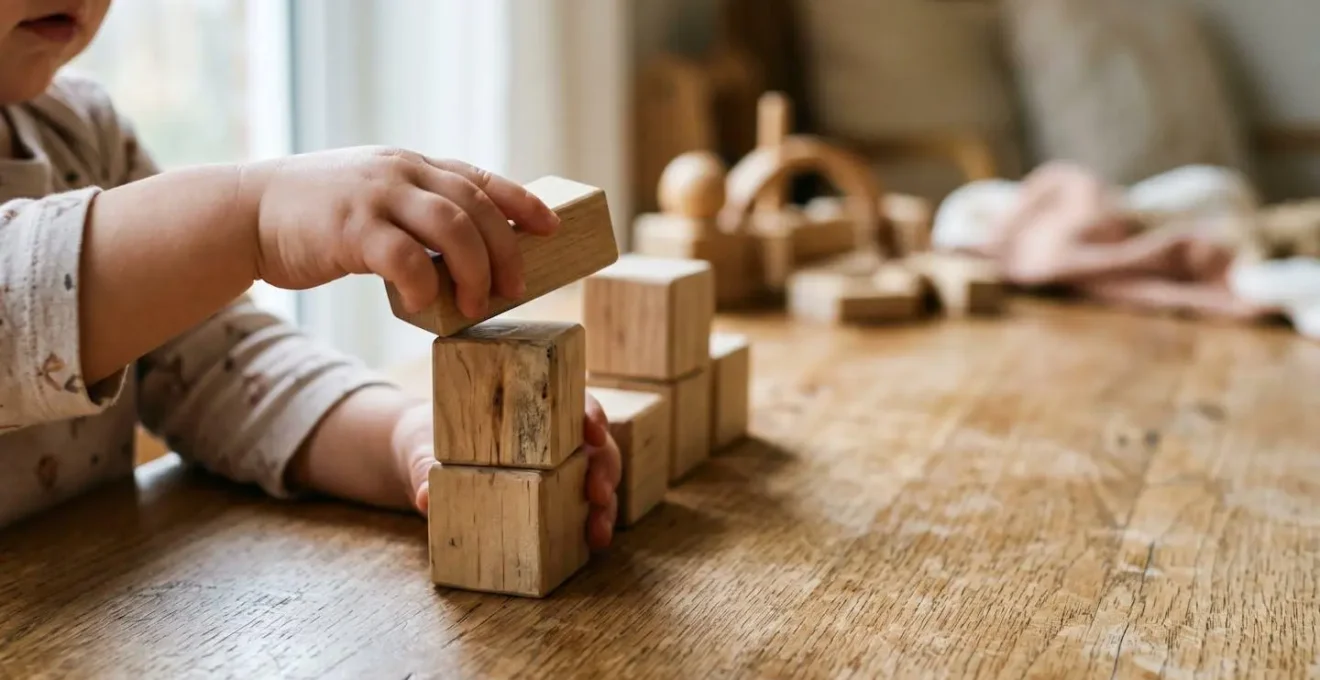
When selecting toys, look for those that do less, so your child can do more. Toys that grow with your child are ones that can be used in simple ways in infancy and in more complex ways as they grow. A set of blocks can be mouthed and banged together by a baby, stacked into towers by a toddler, and used to build elaborate cities by a preschooler. Other examples of powerful open-ended toys include play silks, animal figurines, dolls, art supplies, and natural materials like sand and water. These toys encourage problem-solving, imagination, and creativity.
Ultimately, it is crucial to release the pressure to provide the “perfect” set of educational tools. The focus on products distracts from the most critical component of early learning. As the American Academy of Pediatrics emphasizes, the true catalyst for brain building is the caregiver. Your engagement, your responsiveness, and your shared joy in discovery are the “educational tools” that matter most.
The most powerful ‘educational tool’ is not a toy at all, but a present, responsive, and verbally engaged caregiver.
– Early Childhood Development Experts, American Academy of Pediatrics – Brain Building Research
The next time you feel the urge to click “buy now” on the latest smart toy, pause. Consider if a trip to the park, a “conversation” with your baby, or simply sitting on the floor and exploring a wooden spoon together might be a more powerful investment in their cognitive future.
Start today by putting away the flashcards and simply getting on the floor to play. Observe what captures your child’s interest, respond to their cues, and share in their discoveries. That is where the real learning, and the real magic, begins.