
Your home is more than just a place where your family eats and sleeps. For children, every room, every shelf, and every corner serves as a classroom, a playground, and a training ground for life skills. The way you arrange furniture, organize toys, and design spaces directly influences how your child learns, plays, regulates emotions, and develops independence. Yet many parents approach home design with adult priorities in mind, leaving children to navigate spaces that weren’t built for their height, their needs, or their developing brains.
The emerging field of children’s environmental design recognizes that thoughtful spatial choices can dramatically impact everything from reading habits to emotional resilience, from sleep quality to creative expression. This isn’t about expensive renovations or picture-perfect playrooms. Instead, it’s about understanding how children interact with their physical world and making strategic adjustments that meet them where they are developmentally. Whether you’re setting up a reading nook, rethinking your storage systems, or creating a space for big feelings, the principles remain the same: accessibility, intentionality, and respect for the child’s perspective.
This comprehensive guide explores the key dimensions of creating a home environment that nurtures growth. We’ll examine why these choices matter, what the research tells us, and how you can implement practical solutions regardless of your budget or square footage.
Educational philosophies like Reggio Emilia famously describe the environment as “the third teacher,” alongside parents and educators. This isn’t poetic exaggeration. Children under six absorb an estimated 80% of their learning through environmental interaction rather than direct instruction. When a toddler can see book covers on front-facing shelves rather than spines on traditional bookcases, reading selection increases by nearly 300% according to literacy studies. When toys are sorted into clear, labeled bins rather than dumped in a toy chest, children engage in longer, more focused play sessions.
The Montessori approach takes this further, arguing that environments should be designed to foster independence through accessibility. When coat hooks are mounted at a three-year-old’s shoulder height instead of adult height, children actually hang up their coats. When drinking glasses live on a low shelf instead of a high cupboard, they learn to serve themselves water. These aren’t trivial conveniences; they’re opportunities for building competence, confidence, and executive function skills.
Consider the difference between two playrooms: one with toys jumbled in deep boxes requiring adult excavation, another with shallow trays on low shelves where each item is visible and retrievable. The second child doesn’t just have an easier time cleaning up. They develop categorization skills, decision-making abilities, and spatial awareness simply by interacting with a well-designed storage system. The environment itself is teaching, constantly and silently.
One of the most powerful environmental strategies is zoning: creating distinct areas for different types of activities. This isn’t just about aesthetics; it’s about helping young brains transition between activities and understand behavioral expectations through spatial cues.
A dedicated reading nook signals to children that books deserve special attention. The most effective reading spaces combine comfortable seating (floor cushions often work better than restrictive chairs for young children), appropriate lighting that protects developing eyes, and book displays that showcase covers rather than spines. This visual accessibility matters tremendously. When children can see the dragon on the cover or the colorful illustration, they’re drawn to browse and select books independently, building intrinsic motivation to read.
Art and building activities benefit from contained, accessible spaces. An art cart on wheels can transform any room into a creation station, while clear labeling (using pictures for pre-readers) enables children to gather and return supplies independently. Some families designate a chalkboard-painted table for drawing and creative expression, eliminating the anxiety about mess on good furniture. The key is making creative materials visible and available without requiring constant adult intervention.
As children reach school age, a dedicated study corner becomes crucial for homework focus. This doesn’t require a separate room; a well-lit corner with an appropriately sized desk, organized school supplies, and minimal visual distractions can boost concentration significantly. The environmental cue of sitting in “the homework spot” helps children’s brains shift into focus mode more easily than working at the chaotic kitchen table.
Storage decisions profoundly impact both your sanity and your child’s development. The traditional toy chest, while convenient for quick cleanup, creates what child development specialists call “the dumping problem.” When everything gets thrown into one deep container, children can’t see their options, can’t make intentional choices, and can’t develop organizational thinking.
Clear bins outperform opaque baskets for a simple reason: children need to see what they own to play with it. A study of preschool classrooms found that toys in clear containers were used 60% more frequently than identical toys in solid-colored bins. For home application, this means choosing transparent storage whenever possible and ensuring containers are shallow enough that items don’t get buried.
Rather than one bin for “all toys,” effective systems use micro-categories: one container for Lego, another for train tracks, a third for play food. This granularity isn’t fussy perfectionism. It teaches children categorization, a foundational skill for mathematics and logical thinking. When cleanup time involves decision-making (“Does this block go in the building bin or the puzzle bin?”), it becomes a learning opportunity rather than a chore.
Wall-mounted storage, low open shelving, and picture labels all serve the same purpose: putting children in charge of their belongings. Shoe baskets near the door create a “dump and go” solution that actually works for small children whose fine motor skills aren’t developed enough for shoe racks. Low hooks replace impossible-to-reach coat hangers. These adjustments respect children’s current abilities while giving them authentic responsibility.
Beyond cognitive development, your home environment plays a crucial role in emotional health. Two specific spaces deserve attention in every home with young children.
The calm down corner provides a dedicated retreat for overwhelming feelings. This isn’t a punishment spot or timeout location; it’s a safe space stocked with sensory tools (stress balls, calming bottles, soft textures), breathing exercise cards, and comfort items. When children know they have a place to go when emotions feel too big, they develop healthier coping mechanisms than lashing out or suppressing feelings. The physical existence of this space communicates that all feelings are acceptable and manageable.
Similarly, a “safe place” nook offers a retreat for children who need to withdraw from stimulation. Some children require regular sensory breaks, especially in busy households. A small tent, a reading nook, or even a designated quiet corner gives them permission to self-regulate without explanation or shame. These spaces work best when they’re introduced proactively during calm moments, not reactively during meltdowns.
The tension between safety and independence defines modern parenting. Over-protecting creates learned helplessness; under-protecting creates genuine danger. The solution lies in child-proofing for enrichment: making spaces safe enough for unsupervised exploration while maintaining opportunities for challenge and growth.
Cable management, for instance, isn’t just aesthetic. Exposed wires pose strangulation and electrical risks for curious toddlers. But once cords are secured, children gain freedom to explore rooms independently. Similarly, securing furniture to walls prevents tip-over accidents, which means children can safely pull themselves up, climb, and investigate without constant hovering.
Learning towers exemplify this philosophy perfectly. These sturdy platforms bring toddlers to counter height safely, allowing them to observe cooking, participate in meal prep, and engage with kitchen activities that would otherwise be off-limits. The environmental adaptation (a stable platform) removes one danger (climbing on chairs) while enabling development of practical skills and family participation.
Children’s bodies change dramatically in their first decade. Furniture choices can either accommodate this growth or fight against it, creating ongoing ergonomic problems and unnecessary expenses.
Adjustable desks that grow with children represent a significant upfront investment, but they address a crucial issue: children doing homework hunched over too-low coffee tables or perched on dictionaries at adult desks develop poor posture and reduced focus. Proper ergonomics aren’t a luxury; they directly impact learning capacity and physical development. A desk that adjusts from toddler to teenager height eliminates the need for multiple replacements while ensuring age-appropriate fit.
Similarly, convertible furniture and modular storage systems adapt as needs change. The art cart that holds crayons for a preschooler later organizes a tween’s craft supplies. Front-facing bookshelves that display board books eventually hold chapter books. Bean bags work for reading time in early years and video gaming in later ones. The best children’s furniture isn’t specifically juvenile in design; it’s functionally flexible and built to last through multiple developmental phases.
Even the best-designed spaces fail without systems that maintain them. This is where visual supports transform intention into consistent practice.
Routine cards with pictures guide children through multi-step processes they struggle to remember: brushing teeth, getting dressed, preparing for bed. Rather than nagging, parents can point to the card, shifting the authority from parent to system. A command center in the hallway, with hooks for keys, slots for mail, and a family calendar, creates a central organizing hub that teaches children how households function and where things belong.
For the inevitable accumulation of children’s artwork, two systems help manage the flood: rotating galleries that display current work with dignity (not refrigerator chaos), and art portfolio systems for preserving special pieces. Some families digitize drawings to create space while maintaining memories; others use large portfolios to save physical originals. Either approach treats children’s creative work with respect while preventing household clutter.
Even nature finds a home in well-designed child environments. A nature table provides a dedicated space for displaying found treasures: interesting rocks, autumn leaves, feathers, shells. This simple environmental feature validates children’s collections, connects them to the natural world, and creates opportunities for observation, questioning, and scientific thinking.
The home environment you create for your children will never be perfect, and it doesn’t need to be. What matters is intentionality: making choices that consider how children actually interact with space, what they need at their current developmental stage, and how your physical environment can support the independence and capabilities you want to nurture. Small adjustments, made thoughtfully, compound into significant impacts on learning, emotional regulation, and family harmony.
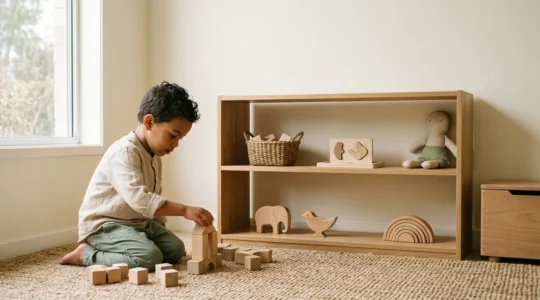
Contrary to popular belief, a room full of toys doesn’t create more play; it creates more overwhelm, and the traditional toy chest is the primary culprit. A cluttered play environment dramatically increases a child’s cognitive load, making it nearly impossible…
Read more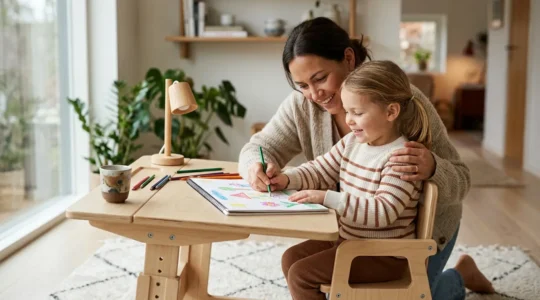
In summary: Ergonomic furniture isn’t a luxury; it’s a health strategy that adapts to your child’s rapid growth, preventing long-term postural problems. Investing in adjustable “grow-with-me” pieces offers significant long-term value, both financially and for your child’s physical development. Safety…
Read more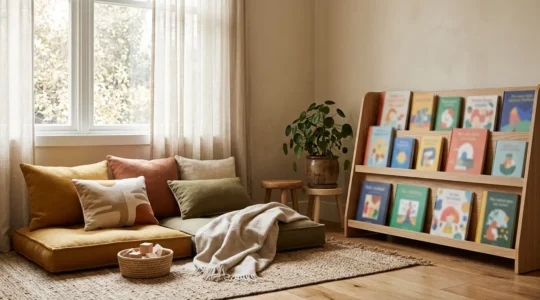
A beautiful reading nook is not enough to create a reader; the secret lies in using child psychology to design an environment that actively reduces distraction and sparks intrinsic motivation. Comfort means supporting focus (e.g., dynamic seating), not just softness….
Read more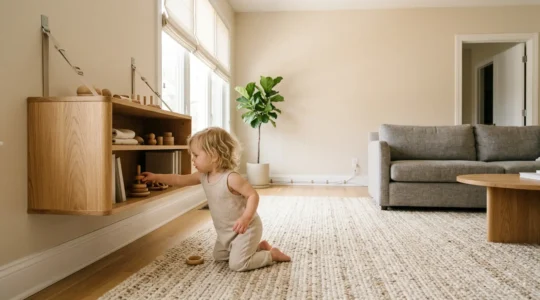
The secret to a peaceful, child-proofed home isn’t more restrictions; it’s a smarter environment designed for exploration. Absolute safety in hazard zones (kitchen, windows) is non-negotiable and must be secured first. The most effective strategy is creating “Yes Spaces” where…
Read more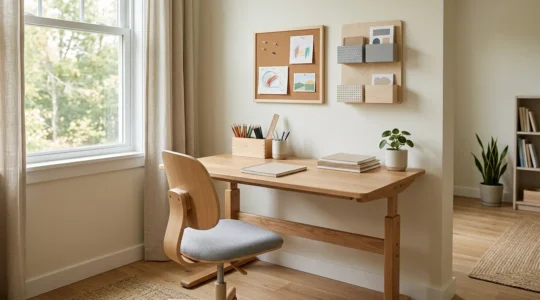
Contrary to popular belief, a ‘fun’ and colorful study corner might be doing more harm than good for your child’s focus. True concentration comes from reducing ‘visual noise’ and cognitive load, not from adding more stimulation. Proper ergonomics and lighting…
Read more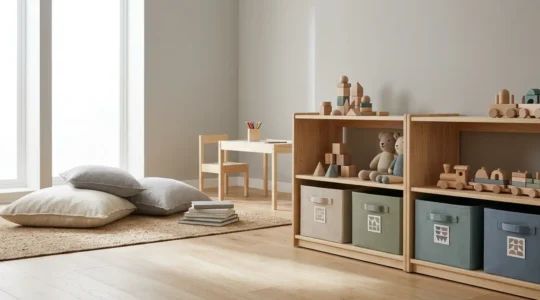
The secret to a functional playroom isn’t more storage bins; it’s designing a developmentally-supportive ‘prepared environment’ that makes play, and cleanup, intuitive for your child. Reducing the number of available toys through rotation dramatically increases a child’s focus and creativity….
Read more