
When a toddler dumps a basket of wooden blocks onto the floor, they’re not making a mess—they’re conducting a physics experiment. When a preschooler transforms a cardboard box into a rocket ship, they’re not wasting time—they’re building the cognitive flexibility that future engineers need. Creative activities and games represent far more than simple entertainment; they are the primary vehicle through which children make sense of their world, develop essential skills, and build the neural connections that will serve them throughout their lives.
The most powerful learning happens when children don’t realize they’re learning at all. Unlike structured academic lessons, creative play allows children to explore concepts at their own pace, make mistakes without judgment, and discover solutions through trial and error. Whether it’s a baby playing peek-a-boo or a school-aged child constructing a bridge from paper, these experiences build cognitive, physical, social, and emotional competencies that no worksheet can replicate.
The connection between play and brain development isn’t just theoretical—it’s neurological. When children engage in creative activities, they build and strengthen neural pathways through repeated practice and novel experiences. A child who regularly manipulates small objects develops not only fine motor control but also the hand-eye coordination necessary for writing, the spatial reasoning used in mathematics, and the focus required for complex tasks.
Creative play develops skills across multiple domains simultaneously. A simple activity like creating a sensory bin filled with rice teaches tactile discrimination through different textures, mathematical concepts like volume and measurement, language development through descriptive vocabulary, and emotional regulation via the calming effect of repetitive actions.
Research consistently shows that children who engage in regular open-ended play demonstrate stronger problem-solving abilities, greater persistence when facing challenges, and more flexible thinking. Perhaps most importantly, creative activities build confidence. When a child successfully threads pasta onto a shoelace or builds a structure that stands upright, they internalize a powerful message: “I am capable. I can figure things out.”
For infants and toddlers, the world is a sensory buffet waiting to be explored. Every texture, sound, and visual pattern provides essential information that helps young brains categorize and understand their environment.
Treasure baskets—collections of safe household items with varied textures, weights, and materials—offer incredible learning potential. A basket might contain a metal whisk, a wooden spoon, a fabric pouch, and a rubber ball. As babies mouth, shake, and manipulate these objects, they’re conducting sophisticated comparative analysis: “This is smooth, that is rough. This makes noise, that is silent.”
Object permanence games like peek-a-boo teach one of the most fundamental cognitive concepts: things continue to exist even when we can’t see them. This seemingly simple game represents a major milestone in brain development, typically emerging around 8-10 months.
Sensory bins extend this exploration for older toddlers and preschoolers. Themed bins might contain rice with hidden toys, pasta for pouring practice, or sand for building. These activities provide calming sensory input, opportunities to practice measuring and pouring, vocabulary development, and scientific observation as children notice how different materials flow, stack, or scatter. The beauty of sensory play lies in its open-ended nature—there’s no wrong way to explore.
Fine motor skills—the ability to control small muscles in the hands and fingers—are essential for countless daily tasks, from buttoning shirts to writing letters. Creative activities provide natural, engaging practice without the frustration of forced drills.
Threading activities might seem deceptively simple, but they require remarkable coordination. Pushing a shoelace through pasta tubes or beads demands visual focus, pincer grip strength, and bilateral coordination (using both hands together for different tasks). Children typically progress from large objects with stiff laces to smaller beads with flexible thread.
The pom-pom rescue—using tweezers or tongs to extract small objects from ice, water, or containers—transforms a therapeutic exercise into an exciting mission. This activity strengthens the same muscles and movements needed for pencil grip, specifically the tripod grasp that allows for controlled writing.
Sticker art deserves more credit than it receives. Peeling a sticker from its backing requires precise finger control, while placing it accurately demands hand-eye coordination and spatial awareness. Mark making—the progression from random scribbles to controlled lines to recognizable letters—represents a critical developmental journey. Rather than rushing children toward letter formation, allowing extensive time for free drawing builds the motor control that makes writing possible.
When children engage in pretend play, they’re doing much more than acting out scenarios—they’re developing theory of mind, the ability to understand that other people have different thoughts, feelings, and perspectives.
Dressing up and role play allows children to literally step into someone else’s shoes. A child playing “doctor” must imagine what a doctor thinks about, how they speak, and what they do. This perspective-taking is foundational for empathy and social success. Studies indicate that children who engage in frequent pretend play show stronger emotional regulation and better peer relationships.
Empathy books—stories that explicitly explore characters’ internal experiences—provide scaffolding for this development. Creating hideaways and secret spaces—whether elaborate canopy tents or simple blanket forts—gives children a sense of autonomy and control. These spaces often become sites for intense imaginative play or quiet regulation when overwhelmed.
Calm-down jars and art therapy techniques bridge the gap between play and emotional regulation. A glitter jar provides a visual metaphor for how strong emotions gradually settle. Clay smashing offers a socially acceptable outlet for physical tension. Music painting—creating art while listening to different musical styles—helps children connect internal emotional states to external expression. These activities teach the crucial skill of managing feelings through creative outlets rather than destructive behaviors.
The best science and engineering education doesn’t happen in a formal lab—it happens when children encounter problems they want to solve and questions they want to answer.
The bridge challenge—can you build a structure from paper that holds a toy car?—introduces fundamental engineering concepts like load-bearing, structural integrity, and material properties. Children quickly discover through experimentation that folded paper is stronger than flat paper, that triangular supports are more stable, and that testing and iteration are essential to success.
Coding without computers teaches the logic of programming through physical movement. When a child gives step-by-step instructions to guide a “robot” parent through an obstacle course, they’re learning sequencing, precision in language, and debugging. Classic experiments like the baking soda volcano teach chemical reactions and cause-and-effect relationships. Building a rain gauge weather station transforms abstract weather reports into concrete, measurable data.
These activities share common characteristics: they’re hands-on and immediately engaging, they allow for hypothesis testing, they connect abstract concepts to visible results, and they normalize failure as part of the learning process. The child who builds a bridge that collapses learns more than the one whose first attempt succeeds.
Art is not a frivolous extra—it’s a fundamental form of communication and cognitive development. Long before children can articulate complex feelings in words, they can express them through color, line, and form.
Visual diaries—encouraging children to draw their day instead of writing about it—validate non-verbal communication and help children process experiences. A child who can’t yet explain why they felt upset might draw a picture that reveals the situation clearly.
Music painting connects auditory and visual processing. Playing different musical styles and inviting children to paint what the music “feels like” develops cross-modal thinking and emotional awareness. Safe place collages—where children cut and arrange images representing comfort and security—create a tangible anchor they can refer to during stressful times.
Family DIY projects like creating sock monsters do double duty: they teach practical skills like basic sewing and measuring while creating bonds through shared accomplishment. The slightly lumpy sock creature becomes precious not because it’s perfect, but because it represents time spent together and skills learned. The goal isn’t to produce gallery-worthy art—it’s to provide children with creative outlets for expression, experimentation, and growth.
Even the most brilliant activities fail if children can’t access materials or feel overwhelmed by clutter. The physical environment significantly impacts how children play and learn.
Toy rotation—keeping only 20-30% of toys accessible while storing the rest—increases engagement dramatically. When children face too many choices, they often become overwhelmed and play superficially with everything. A curated selection allows deeper, more meaningful play. Rotating toys every few weeks makes old favorites feel new again.
Open shelving versus toy chests represents a crucial organizational choice. When toys are dumped into a chest, they become essentially invisible—out of sight, out of mind. Open shelving with toys displayed at child height invites interaction and allows children to independently access what interests them.
Playlist power applies organizational thinking to transitions. Creating specific songs that signal “cleanup time,” “bath time,” or “bedtime” provides predictable cues that reduce resistance. The song becomes a neutral third party—it’s not parent versus child, it’s simply time for the next activity.
Some of the richest learning happens outside the home, during moments that might otherwise feel like “dead time” or obligations to endure.
Car games transform potentially frustrating travel time into connection and learning. Screen-free options like “I Spy,” storytelling chains where each person adds a sentence, or license plate math keep minds active and build family bonds.
Travel journals—providing children with a dedicated notebook for drawing and writing during trips—create lasting memories while developing observation skills. Museum bingo turns potentially overwhelming gallery visits into engaging treasure hunts. Children receive cards with items to spot—”Find something red,” “Find an animal”—which focuses attention and makes art accessible.
Sketchpads at attractions encourage active looking rather than passive photographing. When children must observe carefully enough to draw what they see, they notice details they’d otherwise miss. Park bingo—spotting dogs, squirrels, specific tree types, or playground equipment—applies the same principle to outdoor play, encouraging observation and classification skills.
Creative activities and games aren’t separate from “real learning”—they are the foundation upon which all other learning is built. The toddler pouring rice in a sensory bin is developing the focus needed for writing. The preschooler building a paper bridge is thinking like an engineer. The most effective activities share common elements: they’re hands-on, open-ended, developmentally appropriate, and genuinely engaging. They don’t require expensive materials or elaborate preparation. A cardboard box, household items, and dedicated time often provide more learning value than the latest educational tablet. By understanding the developmental purpose behind these activities, parents and educators can recognize the profound learning happening during what might look like “just play.”
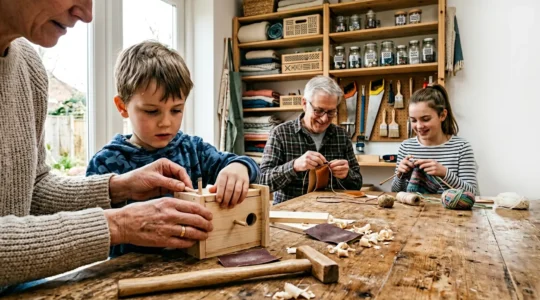
The true value of family DIY isn’t the finished object; it’s using the creative process as a deliberate curriculum for teaching essential life skills. Each project is a hidden lesson in science, engineering, leadership, or emotional intelligence. Reframing mistakes as…
Read more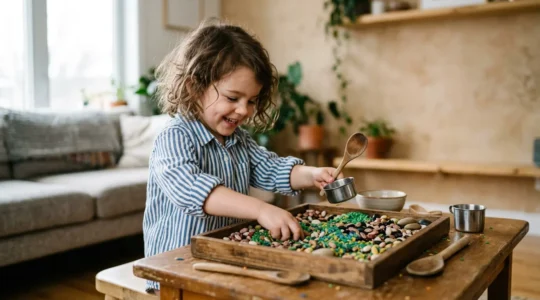
In summary: Sensory play is more than mess; it’s a targeted tool for building specific developmental skills. Activities like Dough Gym and Pom-Pom Rescue directly develop the fine motor control needed for writing. Games involving sound, taste, and water build…
Read more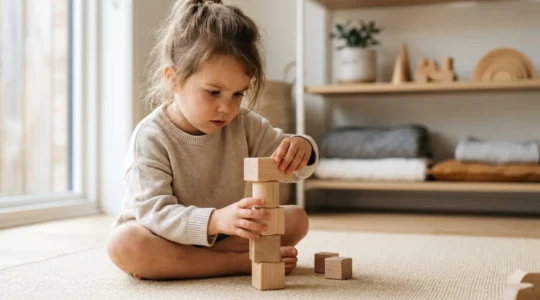
The best educational toys are rarely electronic, often have no batteries, and might already be in your recycling bin. Open-ended materials like blocks and boxes fuel creativity and problem-solving, while structured challenges like puzzles build foundational math and science skills….
Read more