
The best educational toys are rarely electronic, often have no batteries, and might already be in your recycling bin.
- Open-ended materials like blocks and boxes fuel creativity and problem-solving, while structured challenges like puzzles build foundational math and science skills.
- Fewer, better-chosen toys, rotated regularly, lead to deeper, more focused play by reducing cognitive overload and renewing interest.
Recommendation: Focus on the play potential of an object, not its advertised features, to give your child the tools for lifelong learning.
Your home is filled with them: the brightly colored plastic gadgets with flashing lights and cheerful tunes, promised to make your child a genius. Yet, after a few minutes of prescribed fun, they sit ignored in a corner, adding to the clutter. As a parent wanting to make mindful choices, you sense there must be a better way to invest in play—one that nurtures genuine curiosity and skills without relying on batteries and a single “on” switch. You’re right. The constant search for the “best” new educational toy often overlooks a fundamental truth about child development.
The common advice is to find “age-appropriate” or “STEM-focused” toys. While not wrong, this surface-level approach often leads us back to the same aisle of single-purpose, prescriptive toys. The conversation around children’s play is dominated by what the toy can *do*, its features and functions. But what if the key to unlocking a child’s potential isn’t found in the complexity of the toy, but in the simplicity of the materials? What if the most powerful learning tools are not the ones that “do” things for a child, but the ones that invite a child to do everything and anything they can imagine?
As a play therapist, I guide parents to shift their perspective. It’s time to move beyond the toy and focus on the play itself. The true measure of an educational toy is not its ability to entertain, but its capacity to act as a catalyst for cognitive, social, and emotional growth. This guide will unpack the science behind meaningful play. We will explore how simple, open-ended items build the foundational architecture of your child’s brain, and provide a clear framework for choosing toys that will not only be loved but will grow right alongside your child, fostering a lifelong love of learning.
This article provides a complete framework for rethinking your approach to toys. We will delve into the developmental power of different play types and offer practical strategies for creating an environment that fosters deep engagement.
Summary: A Play Therapist’s Framework for Meaningful Toys
- Open-Ended Toys: Why a Cardboard Box Is Better Than a Tablet?
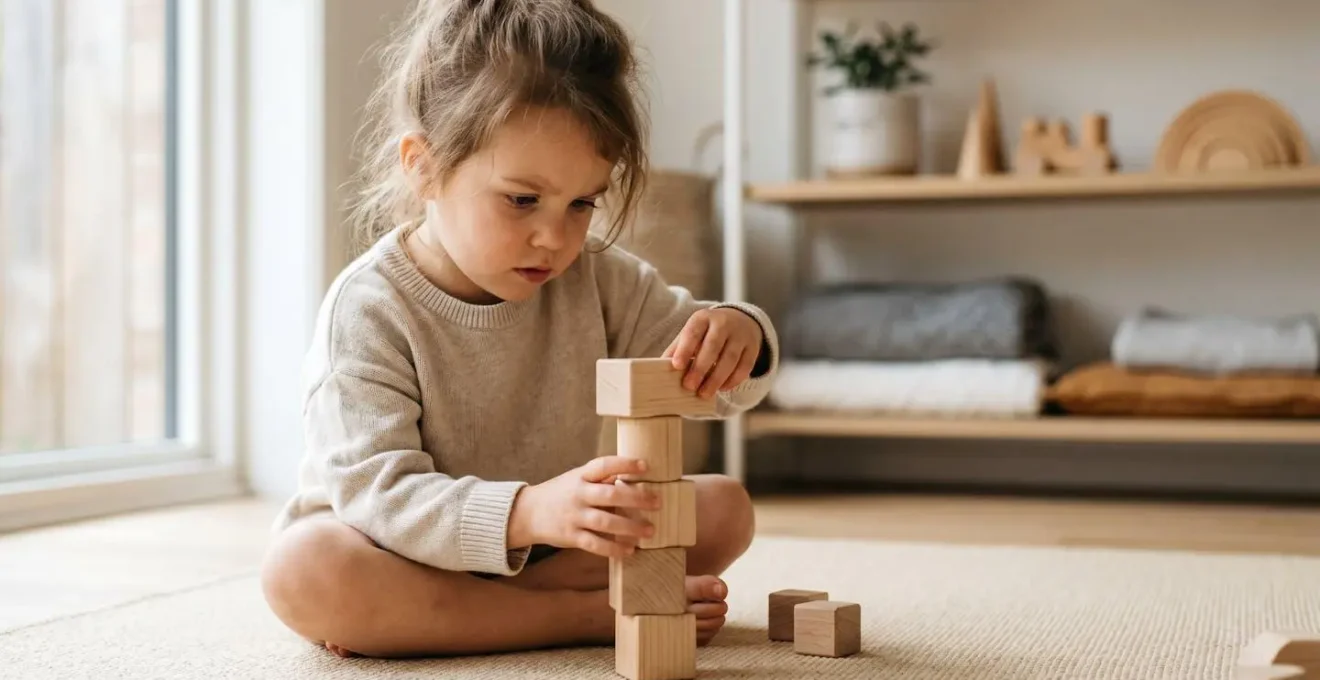
- Block Play: How Simple Bricks Teach Math and Physics?
- Dressing Up: Why Pretend Play Is Crucial for Social Skills?
- Puzzle Progression: Moving from Peg Puzzles to Jigsaws
- Toy Rotation: How Fewer Toys Lead to Deeper Play?
- Toy Rotation: How to Store 80% of Toys to Increase Engagement
- Bridge Challenge: Can You Build a Bridge for a Toy Car with Paper?
- Playroom Design and Storage Solutions: Creating Order from Chaos
Open-Ended Toys: Why a Cardboard Box Is Better Than a Tablet?
A tablet or electronic toy offers a world of “convergent thinking”—there is typically one right answer, one button to press, one level to complete. It tells the child what to do. A cardboard box does the opposite. It says nothing and invites everything. This is the essence of open-ended play, a powerful engine for developing divergent thinking—the ability to generate multiple ideas, solutions, and possibilities from a single starting point. This skill is a cornerstone of creativity and complex problem-solving in later life.
In a world where children ages 5 to 8 average nearly 3.5 hours of screen time daily, the simple, screen-free power of an open-ended object is more critical than ever. The box can be a rocket ship, a castle, a car, or a secret fort. The child is not a passive consumer of content; they are the director, writer, and lead actor in their own story. This active engagement strengthens executive function skills like planning, organization, and flexible thinking.
As the image above beautifully illustrates, the potential is limitless. A simple object is transformed by imagination. This process is not just “fun”; it’s critical cognitive work. As play expert R. Keith Sawyer noted in the American Journal of Play, “open-ended play allows children to explore possibilities, invent scenarios, and create their own rules, which encourages flexible thinking and problem-solving.” When a child transforms a box, they are not just playing; they are building the very cognitive architecture needed to navigate a complex and ever-changing world.
Block Play: How Simple Bricks Teach Math and Physics?
Before a child ever encounters a math worksheet or a physics textbook, they can explore fundamental concepts like gravity, balance, and geometry through one of the most classic open-ended toys: blocks. A set of simple wooden bricks is a hands-on laboratory for understanding the physical world. When a tower crashes, a child learns about structural integrity and gravity. When they build a bridge, they are intuitively experimenting with concepts of tension, compression, and load-bearing.
This isn’t just intuitive; it’s backed by science. The complexity of a child’s block structures is a powerful predictor of later cognitive abilities. Research shows that 3-year-olds’ block-building complexity correlates with spatial skills at age 5 and later STEM success. Spatial reasoning—the ability to think about objects in three dimensions and to visualize transformations—is a critical skill not only in fields like engineering and architecture but also in everyday problem-solving.
Block play also introduces mathematical ideas in a tangible way. A child who discovers that two smaller blocks are the same length as one larger block has just had their first lesson in fractions and equivalence. Sorting blocks by shape and size is an early exercise in classification and data analysis. Creating symmetrical patterns develops an understanding of geometry. These are not abstract lessons; they are discovered truths, learned through the joyful, iterative process of building, testing, and rebuilding. This is how deep, lasting knowledge is constructed—not by being told, but by doing.
Dressing Up: Why Pretend Play Is Crucial for Social Skills?
When a child dons a cape to become a superhero or picks up a toy stethoscope to become a doctor, they are doing far more than just “playing pretend.” They are engaging in a sophisticated cognitive exercise that builds the foundation for all social interaction: developing a Theory of Mind. This is the understanding that other people have thoughts, feelings, and beliefs that are different from one’s own. It is the bedrock of empathy, cooperation, and communication.
Pretend play is a safe space for children to “try on” different perspectives. By acting out roles, they must consider the motivations and emotions of the character they are portraying. What does a firefighter think when the bell rings? How does a patient feel when they are scared? This imaginative work requires them to step outside of their own egocentric view and model the mental states of others. It’s a workout for the social-emotional parts of the brain.
Case Study: Pretend Play as a Foundation for Theory of Mind
Research published in the Review of Philosophy and Psychology demonstrates that pretend play provides clear evidence of a child’s early ability to handle inconsistent representations—a foundational component of Theory of Mind. For example, a child knows a banana is a banana, but they can “pretend” it is a telephone. This capacity to manage multiple, conflicting ideas in their mind (the object’s real identity vs. its pretend identity) emerges around age 2 and directly underlies the later development of empathy and the ability to understand that others can hold false beliefs, a key milestone typically reached around age 4.
This role-playing also allows children to practice navigating complex social scenarios. They negotiate roles (“You be the baby, and I’ll be the mom”), resolve conflicts (“No, it’s my turn to use the magic wand!”), and collaborate toward a shared goal (building a fort for the “kingdom”). These interactions are not trivial; they are real-time lessons in negotiation, compromise, and self-regulation. By exploring these dynamics in a low-stakes play environment, children build a robust toolkit of social skills that will serve them for the rest of their lives.
Puzzle Progression: Moving from Peg Puzzles to Jigsaws
Puzzles are often seen as a quiet, solitary activity, but they are a powerhouse for cognitive development. The journey from a simple peg puzzle with three shapes to a complex 100-piece jigsaw mirrors a child’s growing ability to process information, strategize, and persevere. Each puzzle piece they manipulate is strengthening fine motor skills, hand-eye coordination, and, most importantly, spatial reasoning skills.
The act of turning a piece in their mind to see if it will fit, or recognizing a shape from the empty space on the board, is a direct exercise in mental rotation and spatial visualization. This isn’t just about fun; it’s a measurable brain-building activity. In fact, University of Chicago research found that children who played with puzzles between ages 26-46 months performed better on spatial transformation tasks at 54 months. These skills are a strong predictor of later success in STEM fields.
Moreover, puzzles teach invaluable problem-solving strategies and what psychologists call executive function skills. A child learns to scan for edge pieces first, to sort pieces by color, and to focus on a small section of the whole. They learn to handle the frustration of a piece not fitting and the satisfaction of finally finding its home. This process teaches persistence, goal setting, and the value of a systematic approach over random trial and error.
Case Study: Developmental Progression in Puzzle Completion Strategies
A 2020 study in Child Development highlighted how puzzle-solving strategies evolve. Researchers observed that three-year-olds predominantly used trial and error, attempting to force pieces into place. In contrast, four-year-olds demonstrated a significant leap in cognitive strategy; they were able to use the pictorial information on the puzzle pieces to guide their placement. The study found that children who had developed this representational understanding completed picture jigsaws much faster and more efficiently, showing a clear link between cognitive development and puzzle-solving ability.
Toy Rotation: How Fewer Toys Lead to Deeper Play?
In a culture that often equates “more” with “better,” the idea of intentionally limiting a child’s access to toys can seem counterintuitive. However, as a play therapist, one of the most effective recommendations I make to parents feeling overwhelmed by clutter and a child’s fleeting attention span is to implement a toy rotation. The principle is simple: a child with fewer toys available at any given time will play with them more deeply, for longer, and in more creative ways. This “less is more” approach is grounded in an understanding of cognitive load and attention.
Imagine walking into a room with 100 toys scattered everywhere. For a child’s developing brain, this is not a wonderland of opportunity; it is a chaotic and overstimulating environment. The sheer number of choices creates a high cognitive load, making it difficult to focus on any single object. The child flits from one toy to the next, engaging superficially without ever achieving a state of deep, immersive play, also known as “flow.” By reducing the number of available toys to a manageable 6-8 items, you lower this cognitive load, freeing up mental resources for creativity and sustained focus.
Furthermore, toy rotation harnesses the powerful psychological principle of novelty. A toy that is seen every day becomes part of the landscape and loses its appeal. When it’s put away for a few weeks and then reintroduced, it feels new and exciting again. This “novelty effect” reignites a child’s interest and invites them to discover new ways of playing with a familiar object. They may notice a detail they missed before or, having developed new skills during its absence, interact with it in a more complex way. This is not about deprivation; it’s about curating a child’s play environment to maximize engagement and respect for their belongings.
Toy Rotation: How to Store 80% of Toys to Increase Engagement
Once you embrace the “less is more” philosophy of toy rotation, the practical question becomes: how do you manage the 80% of toys that are out of sight? An effective storage system is not just about tidiness; it’s the engine that makes rotation feasible, sustainable, and even joyful. The key is to create a system that is organized for the parent but also makes sense from a child’s play perspective. Rather than a single giant toy chest—which quickly becomes a chaotic jumble—consider systems that categorize toys in a meaningful way.
The goal is to be able to “shop your own home,” pulling out a curated selection of toys that feel fresh and exciting. Storing toys in clear, labeled bins in a closet, basement, or garage allows you to see what you have at a glance. You can organize by toy type (vehicles, animals, building materials) or by play theme (a “vet” bin with stuffed animals and a doctor kit; a “construction” bin with blocks, trucks, and hard hats). This makes it easy to rotate in a set of toys that work well together, sparking more complex, imaginative scenarios.
Choosing the right system depends on your child’s age, your space, and your organizational style. A toddler might benefit from a “surprise bag” system with just a few items rotated frequently, while an older child might engage well with larger “project kits.” The following table compares some common approaches to help you find the best fit for your family, based on insights from child development studies on play.
| Storage System | Best For | Setup Complexity | Space Required | Key Advantage |
|---|---|---|---|---|
| Themed Bin System | Organized parents, children 3-6 years | Medium | Closet or shelf space | Easy categorization; child can understand themes (vehicles, animals, building) |
| Project Kit System | Activity-focused families, children 4-7 years | High | Medium storage bins | Everything needed for specific play in one container (e.g., play-dough kit with tools, mats) |
| Surprise Bag System | Toddlers 18-36 months, novelty-seeking children | Low | Minimal (bags/boxes) | Quick rotation; maintains high novelty factor with minimal planning |
| Seasonal Rotation | Large toy collections, children 3-8 years | Low | Large (basement/attic) | Natural reset every 3 months; aligns with developmental changes |
Bridge Challenge: Can You Build a Bridge for a Toy Car with Paper?
“Can you build a bridge for your toy car using only this piece of paper and these two blocks?” This simple prompt can be the start of a profound learning experience. Challenges like this are not just crafts; they are micro-lessons in the engineering design process. By presenting a problem with clear constraints (paper only, must hold a car), you invite your child to think like an engineer: to imagine, plan, create, test, and improve.
The first attempt will likely be a flat sheet of paper, which will immediately collapse. This “failure” is the most important part of the process. It is not a mistake; it is data. It prompts the crucial question: “Why did that happen? How can we make it stronger?” This is where you can guide their thinking, perhaps by folding another piece of paper into an accordion shape and showing how the folds add structural integrity. You are not giving them the answer; you are providing a tool for their own discovery.
As the child experiments with different folds, shapes, and supports, they are engaging in a rapid, iterative cycle of hypothesis, testing, and analysis. They are learning about forces, shapes, and material properties in the most tangible way possible. This process builds not only STEM skills but also crucial life skills: resilience in the face of setbacks, creative problem-solving, and the confidence that comes from overcoming a challenge through one’s own ingenuity. These “provocations” or “invitations to play” transform everyday materials into powerful tools for scientific thinking.
Key Takeaways
- Prioritize open-ended toys (blocks, art supplies, cardboard boxes) over single-function, battery-operated ones.
- The value is not in the toy, but in the cognitive processes it sparks: problem-solving, creativity, and social-emotional skills.
- A “less is more” approach, using toy rotation and an organized space, reduces overwhelm and promotes deeper, more meaningful play.
Playroom Design and Storage Solutions: Creating Order from Chaos
The design of a child’s play space has a profound impact on the quality of their play. A chaotic, cluttered room can lead to a scattered mind, while a thoughtfully organized environment can foster independence, focus, and respect for their belongings. The goal is to create what Montessori educators call a “prepared environment”—a space that is tailored to the child’s needs and empowers them to be a capable, autonomous participant in their own play and cleanup.
One of the core principles is accessibility. Low, open shelves are far superior to a deep toy box where toys get lost and broken at the bottom. By displaying a limited, curated selection of toys on shelves at the child’s eye level, you are communicating two things: “You can choose what you want to play with,” and “These items are valuable and deserve to be treated with care.” Using clear bins or baskets, especially with a picture label on the front, allows even pre-readers to independently find and put away their toys, which is a major step toward building responsibility and executive function skills.
Creating defined zones within the play space also helps to bring order to the chaos. A cozy reading nook with a soft cushion and a few forward-facing books invites quiet contemplation. A small table and chair with accessible art supplies designates a space for creativity. A clear patch of floor space becomes the designated building zone. According to Montessori principles, this order in the external environment helps the child to build an internal sense of order. As leading educators have noted, “low, open shelves, clear bins with picture labels, and defined zones empower a child to choose, play, and clean up autonomously.” This isn’t just about having a tidy house; it’s about designing a space that respects the child as a capable individual and fosters the skills they need to thrive.
Your Action Plan: Implementing Montessori Principles in Your Playroom
- Child-height accessibility: Install open shelving at 24-36 inches from the floor. Display a maximum of 6-8 toys, leaving visible space between each item to reduce visual clutter and make each one seem special.
- Clear categorization: Use picture labels or actual photos of the contents on bins and shelves. This empowers pre-readers to identify where toys belong and to participate successfully in cleanup time.
- Defined activity zones: Create distinct areas for different types of play. Set up a reading nook with a floor cushion and a forward-facing book display, an art corner with an accessible table, and a building zone with clear floor space.
- Rotation and limitation: Display only age-appropriate and currently engaging toys. Store the rest and rotate your selection every 2-4 weeks to maintain interest, reduce overwhelm, and make old toys feel new again.
- Natural materials and order: Whenever possible, prioritize toys made from wood, fabric, and metal over plastic. Arrange items with intention on the shelves (e.g., lightest to heaviest) to model organization and respect for materials.
Start today by observing your child’s play and asking not what a toy can do, but what your child can do with it. Your journey to fostering deeper, more meaningful play begins with this simple, powerful shift in perspective.