
In summary:
- Sensory play is more than mess; it’s a targeted tool for building specific developmental skills.
- Activities like Dough Gym and Pom-Pom Rescue directly develop the fine motor control needed for writing.
- Games involving sound, taste, and water build cognitive foundations for reading, science, and math.
- Creative activities like music painting provide a non-verbal outlet for children to process and express emotions.
As a parent, the phrase “messy play” can trigger an immediate calculation of the cleanup time involved. We often see the splattered paint and scattered rice and wonder if the fleeting moments of fun are worth the effort. But what if we reframed these activities? From an early years practitioner’s perspective, sensory play isn’t just about diversion; it’s a powerful and essential part of a child’s developmental journey. It’s the hands-on work of building a brain.
While many articles list generic ideas like “play with sand,” they often miss the crucial “why.” They don’t connect the action to the outcome. The real magic of sensory play happens when it’s purposeful. It’s about understanding that squishing dough isn’t just squishing dough—it’s a workout for the hand muscles required to hold a pencil. Listening to different sounds isn’t just a game; it’s training the ear to distinguish the phonemes necessary for learning to read.
This guide moves beyond the platitudes. We will explore how to transform simple, at-home sensory games into targeted developmental sessions. We’ll treat each activity not as a potential mess, but as a specific tool for building cognitive, motor, and emotional skills. You will learn how to facilitate these experiences to give your child the foundational abilities they need to thrive, turning playtime into a powerful engine for learning.
This article provides a structured look at eight specific sensory activities, each designed to foster a different area of your child’s growth. The following summary outlines the key developmental areas we will cover.
Summary: Sensory Games for At-Home Development
- Sink or Float: Teaching Physics in the Bathtub
- Dough Gym: Strengthening Hand Muscles for Writing
- Sensory Bins: Creating Themed Bins with Rice, Pasta, or Sand
- Sound Lotto: Guessing Sounds to Improve Auditory Processing
- The Taste Test: Using Blindfolds to Explore Flavors
- The Pom-Pom Rescue: Using Tweezers to Save Toys from Ice
- Music Painting: Expressing Energy Through Brushstrokes
- Art Therapy at Home: Using Creativity to Process Emotions
Sink or Float: Teaching Physics in the Bathtub
The daily bath is more than a cleanup routine; it’s your child’s first physics laboratory. The simple game of “Sink or Float” is a hands-on introduction to complex concepts like buoyancy, density, and mass. When a child predicts whether a rubber duck will float and a toy car will sink, they are forming a hypothesis. Dropping it in the water is the experiment, and watching the result is data collection. This process lays a crucial cognitive foundation for scientific thinking.
This is purposeful play at its best. You are not just distracting them with toys; you are facilitating a scientific investigation. By asking open-ended questions, you encourage them to analyze their results. “Why do you think the heavy stone sank so fast, but this big plastic boat is floating?” This prompts critical thinking and develops a vocabulary for describing the world. Research consistently shows that sensory play allows children to expand vocabulary as they articulate what they see, feel, and experience, turning bathtime into a rich language lesson.
To structure this exploration, you can follow a simplified scientific method tailored for young learners. This transforms a simple water game into a repeatable and educational process.
- Step 1: Guess (Hypothesize) – Ask the child to predict whether an object will sink or float before placing it in water.
- Step 2: Test (Experiment) – Have the child carefully place the object in the water and observe what happens.
- Step 3: Discuss (Analyze Results) – Ask questions like “What do you notice about how the sponge fell versus how the coin fell?” or “How could we make the floating toy sink?”
- Step 4: Expand Sensory Scope – Encourage discussion about sounds each object makes (plink, splash) and how waterlogged items feel (heavy, squishy).
By guiding this activity, you are teaching your child not just to play, but to observe, predict, and analyze—the fundamental skills of every scientist.
Dough Gym: Strengthening Hand Muscles for Writing
Before a child can master writing letters, they must first build the physical foundation: strong and coordinated hand muscles. “Dough Gym” is the perfect pre-writing workout. The resistance of the dough provides a fun, tactile way to develop hand strength, finger dexterity, and bilateral coordination. Every squeeze, roll, and pinch is an essential exercise preparing small hands for the fine motor control required to hold a pencil and form letters.
This is far more than just random play. A 2023 study confirmed a significant average improvement in fine motor skills in children who engaged in structured playdough activities. By guiding this play, you are acting as your child’s personal trainer for writing readiness. The goal is to move from large, whole-hand movements to precise, pincer-grip actions.
As you can see, the focus is on the specific finger movements that directly translate to future academic skills. To maximize the benefits, you can guide your child through a sequence of movements that provides a complete workout, building from strength to dexterity.
- Stage 1 (Strength): Whole-hand squeezing and pounding to strengthen hands and improve bilateral coordination.
- Stage 2 (Coordination): Rolling with palms to create long ‘snake’ shapes using both hands together.
- Stage 3 (Dexterity): Pincer-grip pinching and pulling small pieces to develop finger strength.
- Stage 4 (Letter Connection): Using the ‘snakes’ to form line-based letters (L, T, F) and small balls for curved letters (C, O, S).
By intentionally structuring dough play, you transform a classic pastime into a powerful and purposeful step toward literacy.
Sensory Bins: Creating Themed Bins with Rice, Pasta, or Sand
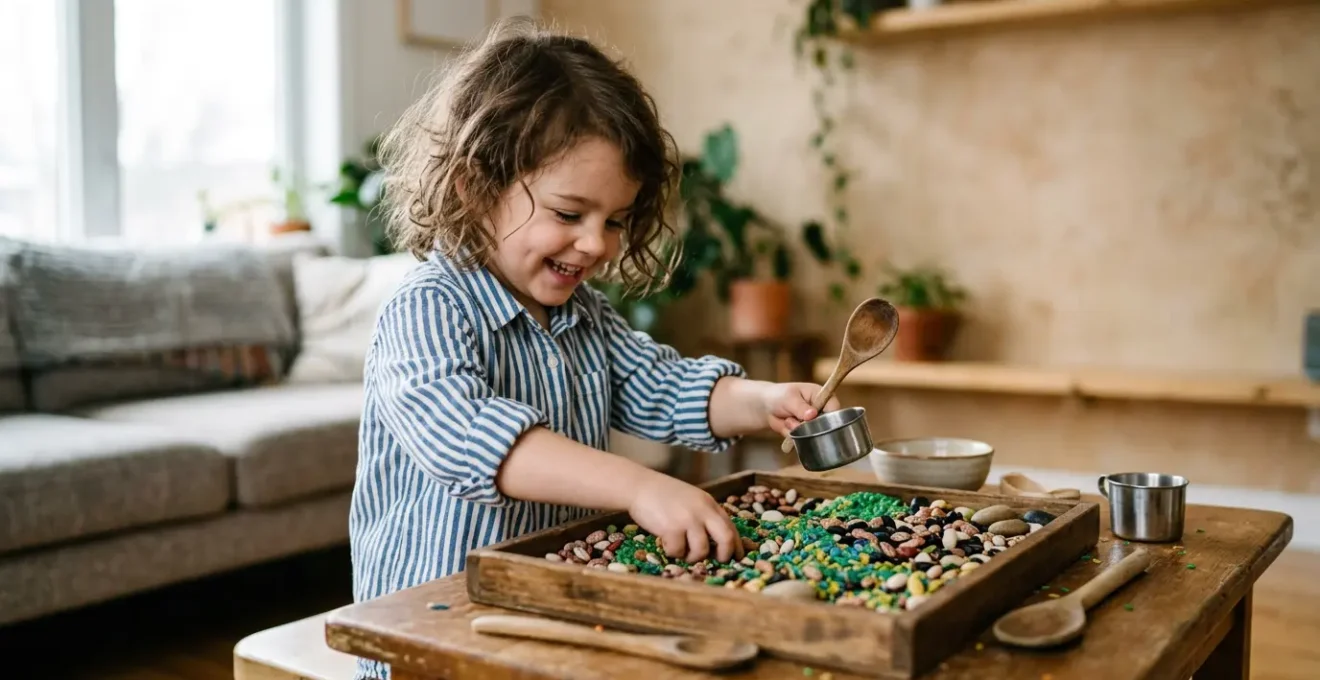
A sensory bin—a simple container filled with a tactile material like rice, sand, or water—is a universe of learning in a box. It provides a safe, contained space for children to explore, experiment, and regulate their senses. For many children, especially those with sensory processing needs, these bins can be incredibly calming. The repetitive motions of scooping, pouring, and running fingers through the materials provide a soothing and predictable sensory input, helping to organize the nervous system.
This approach has proven therapeutic value. In fact, research confirms that Ayres Sensory Integration intervention, which includes tools like sensory tables, is an effective evidence-based practice for children with autism. By providing a sensory bin, you are creating a space not just for play, but for self-regulation and focused exploration. You can theme the bins to introduce new concepts, like an “ocean bin” with blue-dyed rice and sea creatures, or a “construction site” with sand and small trucks.
However, the key to successful sensory bin play is establishing a framework of safety and clear expectations. A few ground rules ensure the experience remains positive and contained, turning what could be chaos into a structured learning opportunity. Your role is to set up a safe environment where your child is free to explore within established boundaries.
Your Safety Checklist for Sensory Bins
- Base Material Choice: Avoid small items like dry beans or small pasta for children under 3 who still mouth objects. Use larger, taste-safe materials like rolled oats or large pom-poms.
- Allergy Check: Be mindful of food allergies. Avoid wheat pasta or flour for children with gluten sensitivities; opt for rice, sand, or water as alternatives.
- The ‘It Stays in the Bin’ Rule: Before play begins, clearly establish the primary boundary: all materials must remain inside the designated container or on a mat placed underneath.
- Choking Hazard Sweep: Regularly inspect the bin’s contents and remove any small toys or objects that could break and pose a choking risk for young children.
- Plan for Cleanup: Involve the child in the cleanup process. Having a small dustpan and brush ready makes it part of the activity, teaching responsibility.
With these guidelines in place, the sensory bin becomes a powerful, versatile, and—most importantly—safe tool for independent play, learning, and emotional regulation.
Sound Lotto: Guessing Sounds to Improve Auditory Processing
In our visually-dominated world, we often forget the importance of listening. Activities like “Sound Lotto” are a vital workout for a child’s auditory processing skills—the ability to take in sound, process it, and make sense of it. This skill is a direct precursor to phonemic awareness, which is the ability to identify and manipulate individual sounds in spoken words. A child who can distinguish the jingle of keys from the crinkle of paper is building the same neural pathways needed to later distinguish “b” from “d.”
By playing sound-guessing games, you are essentially training your child’s brain for reading. It encourages active, focused listening rather than passive hearing. When a child closes their eyes and focuses solely on what they can hear, they are isolating one sense and heightening its power. This sensory-motor integration, connecting an auditory cue to a cognitive answer, is fundamental for learning.
Case Study: From Sound Discrimination to Phonemic Awareness
Sound discrimination activities help students develop phonemic awareness by teaching them to listen attentively and distinguish between different sounds. The ability to differentiate between the ‘crinkle’ of paper and the ‘rustle’ of leaves builds crucial auditory processing abilities that are precursors to phonemic awareness—the ability to distinguish between letter sounds like ‘b’ and ‘d’ in language, which is essential for reading readiness.
A simple “Household Sound Scavenger Hunt” is a perfect way to practice this skill. It requires no special equipment and turns your home into an auditory landscape waiting to be discovered.
- Step 1: Have the child close their eyes to focus solely on auditory input without visual distractions.
- Step 2: As the parent, create distinct sounds around the house (e.g., shaking keys, crinkling paper, tapping a glass, ringing a bell).
- Step 3: The child tries to guess both the object making the sound and its location in the room.
- Step 4: Encourage the child to describe the sound in a full sentence, such as, “That was the sound of keys jingling by the door.”
This purposeful play sharpens the listening skills that form the bedrock of language and literacy development, all through a simple game of hide-and-seek with sound.
The Taste Test: Using Blindfolds to Explore Flavors
Mealtime battles with a “picky eater” can be draining. The “Taste Test” game reframes the experience of trying new foods by transforming it from a high-pressure situation into a fun, low-stakes scientific exploration. By using a blindfold (or simply having the child close their eyes), you remove visual prejudice. A child who insists they “don’t like green food” might discover they love the tart crunch of a Granny Smith apple when they can’t see its color.
The goal of this activity is exploration, not consumption. You are shifting the focus from “you have to eat this” to “let’s be food scientists and describe this.” This simple change in language removes the pressure and empowers the child. You are building their emotional literacy around food, giving them a rich vocabulary to describe what they are experiencing instead of a simple “like” or “dislike.” Words like “crunchy,” “smooth,” “juicy,” “tangy,” or “earthy” create positive and neutral associations with food.
This activity encourages mindfulness, asking the child to slow down and use all their other senses—smell, touch, and hearing (the “crunch!”)—to investigate. This is a powerful strategy for building food flexibility and curiosity.
- Remove Pressure: Frame the activity as exploration. The goal is to describe the food’s properties (texture, smell, sound), not to eat it.
- Encourage Scientific Language: Ask, “Is it crunchy, smooth, juicy, or bumpy?” and “What does it smell like?” to build positive food associations.
- Expand Vocabulary: Introduce richer descriptive words like ‘zesty,’ ‘earthy,’ ‘crisp,’ and ‘creamy’ beyond just sweet or sour.
- Same But Different Test: Offer three varieties of the same food (e.g., three different kinds of apples or cheese) to demonstrate natural variety and encourage flexibility.
By turning your kitchen table into a taste laboratory, you can help dismantle food-related anxiety and cultivate a more adventurous and mindful eater.
The Pom-Pom Rescue: Using Tweezers to Save Toys from Ice
The “Pom-Pom Rescue” is a brilliantly simple activity with a significant developmental payoff. The setup is easy: freeze small toys like pom-poms or plastic figures in an ice cube tray or a block of ice. The child’s mission is to “rescue” them. This game is a fantastic tool for developing the pincer grip—the precise coordination of the thumb and index finger—which is one of the most critical fine motor skills for writing readiness.
This activity also introduces scientific concepts like melting and the properties of water in its solid and liquid states. But its primary benefit is as a fine motor boot camp. The challenge of grasping a slippery pom-pom with a tool requires immense focus and dexterity. As the facilitator, your role is to provide a progression of tools, creating a system of developmental scaffolding that meets your child where they are and gently pushes them to the next level.
Starting with their hands and progressing to more challenging tools like tweezers allows the child to build confidence while steadily refining their motor control. This isn’t just about getting the toys out; it’s about the process and the skill-building journey along the way.
- Level 1 (Easiest): Use bare hands to pick out pom-poms as the ice begins to melt.
- Level 2: Progress to large scoops or spoons for scooping out the objects.
- Level 3: Use kitchen tongs, which require moderate grip strength and coordination.
- Level 4: Advance to clothespins, which demand more precise pincer control.
- Level 5 (Most Challenging): Master small tweezers, requiring the fine pincer-grip dexterity crucial for holding a pencil correctly.
Through this engaging rescue mission, your child is not only having fun but also performing targeted exercises that pave the way for successful writing.
Music Painting: Expressing Energy Through Brushstrokes
Creativity is not just about making something pretty; it’s a way for children to express what they cannot say. Music painting is a powerful activity that connects the auditory system with the motor system, allowing a child to translate the energy of sound into physical movement and visual expression. It’s a full-body experience that fosters emotional expression, coordination, and sensory integration.
The key to this activity is contrast. By playing music with starkly different tempos and moods, you give your child a wide emotional and energetic palette to draw from. A fast, chaotic piece like “Flight of the Bumblebee” might inspire quick, jagged scribbles, while a slow, gentle piano composition could lead to long, flowing strokes. This isn’t about the final product; it’s about the process of expression. According to research, listening to music can help with vocabulary, lift mood, and build coordination in children, and this activity combines all those benefits.
Your role is to facilitate this expression, not to direct it. Use process-oriented language that focuses on their actions rather than the result. Phrases like, “I see you are using big, powerful strokes for that loud song,” validate their experience and encourage them to continue exploring the connection between sound and movement.
- Select Contrasting Music: Create a playlist that juxtaposes fast, energetic music with slow, calm pieces to inspire a dynamic range of movement.
- Encourage Whole-Body Engagement: Move beyond the tabletop. Use a large roll of paper on the floor to allow the child to make large, sweeping arm movements or even paint with their feet.
- Vary the Tools: Offer different brushes, sponges, or even just their hands to change the sensory experience of applying the paint.
- Use Process-Oriented Language: Praise the effort and describe the action. “You are moving your arm so fast with the music!” is more effective than “What a pretty picture.”
Through music painting, children learn that their feelings have a rhythm and that art can be a powerful voice for their inner world.
Key Takeaways
- Purposeful Play: Every sensory activity can be a targeted tool for developing specific cognitive, motor, or emotional skills.
- Process Over Product: The learning happens in the doing—the scooping, squeezing, and scribbling—not in the final creation.
- Developmental Scaffolding: Start with simple actions and gradually introduce more complex tools or steps to continually challenge your child.
Art Therapy at Home: Using Creativity to Process Emotions
For children, big feelings like anger, sadness, or anxiety can be overwhelming and difficult to articulate with words. Art provides a safe and essential non-verbal language for them to process these emotions. When you offer a child paper and crayons after a difficult moment, you are not just distracting them; you are giving them a tool for emotional literacy and regulation. The act of creating can externalize an internal feeling, making it feel more manageable.
As a facilitator, your role is not to be a therapist but to create a safe, non-judgmental space for expression. The most important rule is to describe, not interpret. Instead of asking, “Why did you draw such an angry monster?” you can say, “I see you used a lot of red in this drawing. Tell me about this part.” This opens the door for the child to share if they feel comfortable, without feeling pressured or judged. This philosophy is central to art therapy, as experts note.
Creativity through art provides non-verbal expression for those who may struggle with verbal communication or have not yet developed that skill.
Using concrete prompts can help a child who doesn’t know where to start. These prompts give a starting point for translating an abstract feeling into a tangible image, serving as a bridge between their inner world and the outside.
- The Feeling Monster: “Can you draw a monster that shows the big feeling you’re having right now?”
- The Worry Scribble: “Let’s scribble out that worried feeling as hard as we can. Now, can we turn the scribble into something new?”
- Draw a Weather Report of Your Heart: Use weather symbols (sun, clouds, rain, lightning) to show how you are feeling inside.
- The Safe Place Drawing: “Can you draw a place where you feel completely safe and happy?”
By embracing art as a form of communication, you provide your child with a lifelong strategy for understanding and navigating their emotional landscape.