
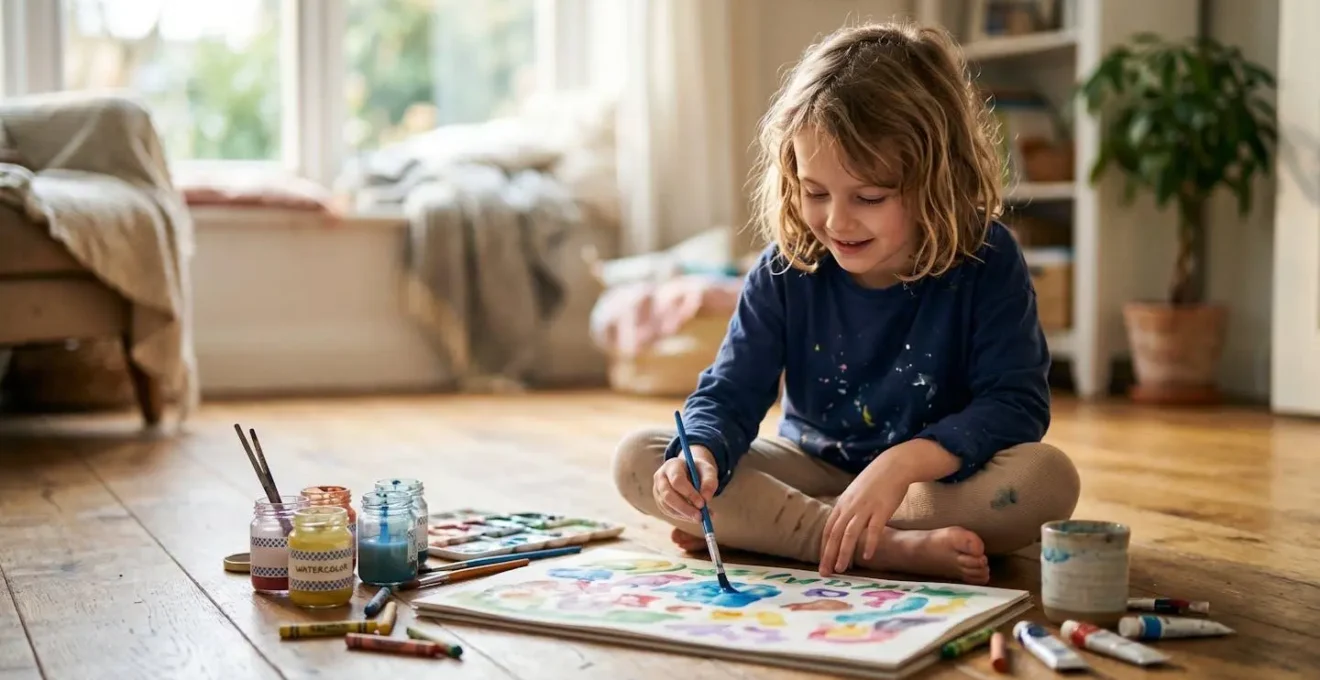
When words fail, art provides a powerful language for your child’s big emotions.
- These activities are designed to help children externalize internal struggles (like drawing a Worry Monster) and physically release pent-up tension (like smashing clay).
- The therapeutic goal is always the process of emotional expression, not creating a perfect artistic product.
Recommendation: Start with one activity that matches your child’s current energy, create alongside them to model emotional acceptance, and remember to validate the feeling before trying to fix it.
The silence can be the hardest part. You know your child is struggling with something big on the inside—you see it in their clenched fists, their withdrawn posture, or their sudden outbursts. But when you ask what’s wrong, you’re met with a shrug, an “I don’t know,” or a wall of silence. As a parent, this is a deeply frustrating and worrying place to be. You want to help, but you can’t help if you don’t know what’s happening.
Many of us default to what we know: talking. We try to coax out the feelings with questions or offer generic advice. We might even suggest, “Why don’t you draw a picture about it?” only to find the suggestion fall flat. This is because these approaches often miss a crucial point. For a child who is overwhelmed, finding the right words can be an impossible task. Their thinking brain is offline, and their feeling brain is in complete control.
The solution isn’t about forcing your child to talk; it’s about giving them a different language. As an art therapist, I’ve seen firsthand that the true power of healing through creativity lies in a structured process. It’s about using intentional, hands-on activities to help a child externalize, confront, and reframe their feelings. This isn’t about making pretty pictures; it’s about making overwhelming emotions tangible and manageable. It’s about giving form to the formless, so a child can finally interact with their feelings instead of being consumed by them.
This guide will walk you through eight specific, therapist-approved art activities you can do at home. More importantly, we will explore not just the “how-to,” but the therapeutic “why” behind each one. You will learn to facilitate a process that builds emotional intelligence, resilience, and a deeper connection with your child, empowering you to become their most effective emotion coach.
Each activity is designed to address different emotional needs, from managing anxiety to releasing anger. The following guide provides a table of contents to help you navigate these powerful tools and find the right starting point for you and your child.
Summary: Art Therapy for Unspoken Childhood Emotions
- The Worry Monster: Drawing Fear to Make It Manageable
- Music Painting: Expressing Energy Through Brushstrokes
- Safe Place Collage: Visualizing Comfort and Security
- Clay Smash: Releasing Tension Physically with Clay
- Visual Diary: Drawing the Day Instead of Writing
- The Calm Down Corner: Creating a Safe Space for Big Feelings
- Calm Down Jars: Making and Using Glitter Jars for Focus
- Emotional Regulation 101: Helping Kids Manage Big Feelings
The Worry Monster: Drawing Fear to Make It Manageable
For a child, anxiety is often a vague, looming monster with no name. They feel its effects—the tight chest, the racing thoughts—but they can’t describe it. The Worry Monster activity is a classic art therapy technique because it’s a direct exercise in externalization. By giving a form, a name, and even a personality to their anxiety, a child moves the fear from an uncontrollable internal state to a manageable external object. They are no longer the victim of the feeling; they are the creator and controller of the thing that represents it.
As the child draws, you can guide them with gentle questions. What color is the worry? Does it have sharp teeth or silly googly eyes? This process isn’t just about drawing; it’s about information gathering. Once the monster is on paper, its power is immediately diminished. You can talk *about* the monster instead of talking about the child’s abstract anxiety. This creates a safe, psychological distance. The act of redrawing it over time—making it smaller, adding a party hat, or showing it sleeping—becomes a visual record of the child’s growing mastery over their fear.
Case Study: The Power of Naming Worry
In a school counseling group focused on worry management, students created personalized worry monsters. One child named theirs “Worry Wilbert.” By externalizing the feeling into a character, the children learned to talk directly to their worries, practicing phrases like, “I don’t have to listen to you, Wilbert” or “You’re not welcome here right now.” This simple shift in perspective helped the students recognize their anxiety triggers and develop self-talk strategies, with many reporting they felt more in control of their emotions after giving their fears a face and a name.
By transforming a scary, internal feeling into a tangible, and often silly, external character, the child learns a fundamental lesson in emotional regulation: feelings are visitors, not residents, and you have the power to decide how you interact with them.
Music Painting: Expressing Energy Through Brushstrokes
Sometimes the feeling isn’t specific like worry; it’s a raw, buzzing energy. It could be frantic frustration, explosive excitement, or a heavy, draining sadness. For these non-verbal, high-energy states, Music Painting is a perfect outlet. This activity creates a direct bridge between a physical sensation in the body and a creative action on paper, a concept we call somatic-to-creative link. It bypasses the thinking brain entirely and allows for pure, unedited emotional expression. The music provides the rhythm and mood, while the colors and brushstrokes become the child’s emotional vocabulary.
The key is to use instrumental music so that lyrics don’t guide the narrative. A fast-paced drum solo can invite angry, stabbing brushstrokes of red and black. A slow, melancholic cello piece might evoke long, flowing strokes of blue and grey. Ask your child to close their eyes, listen to the music, and notice where they feel it in their body—a tapping in their feet, a tightness in their jaw, a fluttering in their stomach. Then, encourage them to let their paintbrush or crayon move from that very spot. This isn’t about painting *what the music sounds like*; it’s about painting *what the music feels like* inside their body.
This process of translating internal states into external art has proven therapeutic benefits. In fact, research demonstrates that art therapy interventions show a statistically significant reduction in emotional dysregulation and acute distress in children. By providing a safe and acceptable channel for big energies, you teach your child that all feelings have a place and can be expressed without causing harm to themselves or others. The final painting is not a picture of a thing; it is a snapshot of an emotional state, a beautiful and honest expression of a moment in time.
Ultimately, Music Painting validates the child’s inner world, no matter how chaotic it may seem, and gives them a powerful tool for transforming that chaos into something visible, understood, and released.
Safe Place Collage: Visualizing Comfort and Security
While some art therapy activities focus on expressing difficult emotions, others are about building and reinforcing positive ones. The Safe Place Collage is a powerful tool for cultivating internal resources. For a child who often feels anxious or out of control, having a mentally accessible “safe place” is an essential coping skill. This activity makes that abstract concept concrete and multi-sensory. It’s not just about thinking of a safe place; it’s about physically building a representation of it.
Gather a wide range of materials: magazine clippings of peaceful scenes (beaches, forests), soft fabrics, cotton balls for clouds, smooth stones, and even scented items like a sprig of lavender. The goal is to engage multiple senses. As they build their collage, you are helping them construct a mental sanctuary. This isn’t just a craft project; it’s an act of psychological fortification. As noted by therapy experts, this tangible creation acts as a touchstone for the mind. As the experts at Reality Pathing explain, this process is about creating a mental anchor for difficult moments.
This ‘safe place’ image can be used as a mental anchor during anxious moments.
– Reality Pathing Therapy Experts, Ideas for Using Art Therapy to Help Kids Express Their Anxiety
A crucial part of this exercise is defining what is *not* in the safe place. This introduces the concept of boundary-setting. You can ask, “Who is not allowed in your safe place?” or “What sounds will you never hear there?” This empowers the child to define safety on their own terms. They might draw a shield or a forcefield around their collage, reinforcing their sense of control. For a more immersive experience, a shoebox can be turned into a 3D diorama—a contained, protected world that belongs only to them. This act of creating and curating a space of total security is deeply regulating and affirming.
Once completed, the safe place collage or diorama can be kept in the child’s room as a physical reminder. When they feel overwhelmed, you can guide them to look at it, touch the soft materials, and mentally transport themselves back to the feeling of peace and control they felt while creating it.
Clay Smash: Releasing Tension Physically with Clay
Anger and frustration are powerful, physical emotions. They demand a physical release. Telling an angry child to “calm down” is like trying to cap a volcano with a bottle cap—it’s not only ineffective, but it can also make the pressure build. The Clay Smash activity provides a safe, contained, and incredibly satisfying channel for this intense somatic energy. Clay is the perfect medium for this; it’s tactile, responsive, and can be endlessly destroyed and rebuilt. This process validates the child’s anger while teaching them a constructive way to express it.
The process begins with “emotional transfer.” Have the child hold a ball of clay and guide them to consciously “pour” all their anger, frustration, and tension into it. They can squeeze it, poke it, and imagine the clay absorbing all the “yucky” feelings from their body. This pre-smash ritual is crucial—it turns a random act of aggression into an intentional act of somatic release. When they finally smash the clay onto a protected surface, encourage them to make a sound—a grunt, a yell, a roar. This combines the physical and vocal channels for a more complete release. As art therapy research confirms, working with clay offers powerful sensory and tactile benefits for releasing physical tension and regulating emotions.
But the most important part of this activity is what happens after the smash. This is the “Smash and Rebuild” cycle. The child now has a pile of broken pieces. The next step is to use those very pieces to build something new, something positive or strong. This is a profound, non-verbal metaphor for resilience and post-traumatic growth. It teaches a child that anger can be a transformative force. The remnants of a destructive feeling can be reshaped into something beautiful, funny, or powerful. They learn that even after a big emotional explosion, they have the power to put the pieces back together in a new and intentional way.
This cycle of destruction and creation shows a child that feelings are not permanent states, but energy that can be molded and changed. It’s a lesson in resilience they will carry with them long after the clay has been put away.
Visual Diary: Drawing the Day Instead of Writing
Journaling is a well-known tool for emotional processing, but for a child who struggles with words or finds writing a chore, it can feel like another form of pressure. A Visual Diary, or drawing journal, removes this barrier and honors the principle of process over product. The goal isn’t to write a coherent narrative or draw a masterpiece; it’s to create a low-stakes, daily ritual for checking in with one’s feelings. It’s a space where a scribble can say more than a paragraph.
To make this accessible, introduce abstract concepts. One powerful format is the “Emotional Weather Report.” Instead of drawing what happened, the child draws their “internal weather” for the day. Was it sunny with a few fluffy clouds? A dark thunderstorm? A thick, confusing fog? This uses color, shape, and line to express a feeling state, bypassing the need for representational drawing skills. Another great format is a simple three-panel comic strip: Panel 1 shows what happened (the trigger), Panel 2 shows the peak feeling (as a color or abstract shape), and Panel 3 shows the outcome or a wish for what could have happened next. This helps children begin to understand cause-and-effect in their emotional lives.
This practice can be a shared family activity, lowering the barrier to entry and normalizing the expression of all feelings. As the experts at Choosing Therapy suggest, it can be a source of connection.
Families can have fun creating a joint or individual journal using an inexpensive notebook or making a journal as an art project.
– Choosing Therapy Experts, Art Therapy for Children & Teens: How It Works, Examples, & Effectiveness
By dividing a page in two for a “Highlight and Hardship” drawing—one side for the best part of the day, one for the hardest—you validate their struggles while also gently guiding their focus toward gratitude and positive experiences. This consistent, non-judgmental practice of externalizing the day’s events builds emotional awareness and provides a rich, ongoing record of a child’s inner world, creating a unique language shared between you and them.
This visual log becomes an invaluable tool, allowing you to track patterns and open up conversations not by asking “What’s wrong?” but by observing, “I see a lot of thunderstorms in your journal this week. What does that feel like?”
The Calm Down Corner: Creating a Safe Space for Big Feelings
When a child is overwhelmed by a big feeling, their nervous system is in overdrive. At that moment, they don’t need lectures or problem-solving; they need a safe place to regulate. A Calm Down Corner is a dedicated space in your home designed for precisely this purpose. However, it’s crucial to frame it correctly. This is not a punishment or a “time-out” corner. It is a “Recharge Station,” a “Cozy Corner,” or a “Peace Place”—a sanctuary the child can go to willingly to feel safe and regain control. The importance of such tools is underscored by the fact that, according to recent data, about one in five children have a mental health challenge that can benefit from such self-regulation strategies.
The effectiveness of this space hinges on one key factor: co-creation. You must design it *with* your child, giving them agency and ownership. This turns it from a space they are *sent* to into a space they have *built*. Start by conducting a “sensory audit” with your child, asking them what feels good to their body. Do they prefer soft, fuzzy textures or smooth, cool ones? Do they like a dark, cave-like space or gentle, warm light? This act of collaboration is the first step in building the emotional scaffolding that will support them during a meltdown.
The corner should be filled with tools, not just pillows. These tools empower the child to actively participate in their own calming process. Instead of just sitting passively, they can choose an activity from a “Menu of Calm,” helping them move from a reactive state to a proactive one.
Your Action Plan: Co-Designing a ‘Recharge Station’
- Frame it as a ‘Recharge Station’, not punishment: Parents must model its use by occasionally saying, “I’m feeling overwhelmed, I’m going to the Recharge Station,” to remove any stigma.
- Conduct a ‘Sensory Audit’ with the child: Co-design the space by asking, “Do you like fuzzy or smooth things? Dark like a cave or gentle light? Want a weighted lap pad?” This gives the child agency.
- Choose a quiet, low-traffic area: Add soft cushions or a bean bag, and use soft, dim lighting, avoiding harsh overhead lights.
- Create a ‘Menu of Calm’: Make a visual list with pictures (for young kids) of activities they can do: ‘Listen to music with headphones,’ ‘Squeeze stress ball,’ ‘Look at glitter jar,’ ‘Sniff lavender sachet.’
- Empower the child to choose: The goal is for the child to actively choose a coping strategy rather than passively sitting, ensuring the space helps them build self-regulation skills.
By providing a dedicated physical space for emotional regulation, you are sending a powerful message: your big feelings are welcome here, and you have the tools and the ability to navigate them safely.
Calm Down Jars: Making and Using Glitter Jars for Focus
Within the Calm Down Corner, one of the most effective tools is a Calm Down Jar, often called a glitter jar. Its magic lies in the powerful and simple metaphor it provides for a child’s chaotic inner world. This isn’t just a pretty distraction; it’s a hands-on lesson in mindfulness. When a child is upset, their mind is like the jar just after it’s been shaken—a swirling, chaotic storm of glitter where nothing is clear. You can’t see through it, and you can’t think straight.
The key to using this tool therapeutically is to explicitly teach the “Glitter-as-Thoughts” metaphor. You can say, “Right now, your mind feels like this jar. All of your angry (or worried, or sad) thoughts are swirling around so fast. Let’s just watch them.” As the child holds the jar and watches the glitter slowly, gracefully settle to the bottom, the water clears. This provides a visual representation of what happens to our minds when we stop struggling and allow things to settle. It’s a non-verbal demonstration of the path from chaos to clarity.
To make this even more powerful, you can create a library of “Themed Emotion Jars.” An “Anger Jar” might have red and black chunky glitter that settles quickly. A “Worry Jar” could have fine, iridescent glitter that stays suspended for a long time, representing persistent thoughts. A “Sadness Jar” could be filled with different shades of blue. This allows a child to select the jar that matches their feeling, an act that helps them name and validate their own emotion. As experts from Generation Mindful note, “Calming jars that are glued shut are a great accent for visual stimuli for all ages.” They become reliable, safe tools for emotional processing.
The final step is to integrate this visual tool with a physiological regulation technique: breathing. Instruct the child: “Shake the jar as hard as you feel. Now, put one hand on your belly and let’s take slow, deep breaths together. We’ll keep breathing slowly until the very last piece of glitter has settled.” This connects the external visual anchor to an internal, body-based action, teaching the child the fundamental mind-body connection in emotional regulation.
The glitter jar becomes more than a toy; it becomes a tangible anchor that guides a child from a state of emotional storm to a place of quiet observation and calm.
Key Takeaways
- Emotional expression is not limited to words; art provides a necessary language for feelings that are too big or confusing to talk about.
- The parent’s role is not to be a therapist, but a calm ‘Emotion Coach’ who validates feelings, sets limits on behavior, and provides tools for expression.
- The therapeutic value is in the process of creating—the squeezing, the smashing, the brushing—not in the aesthetic quality of the final product.
Emotional Regulation 101: Helping Kids Manage Big Feelings
All of these activities—from drawing monsters to smashing clay—are tools. But a tool is only as effective as the person guiding its use. The final, and most important, piece of the puzzle is your role as the parent. Your goal is not to become a therapist, but to become an “Emotion Coach.” This framework shifts the focus from fixing the problem to connecting with the child during their emotional storm. As education experts from WeAreTeachers state, this process is transformative.
Art projects promote self-expression, enhance emotional well-being, and offer new ways of identifying, processing, and coping with big feelings.
– WeAreTeachers Education Experts, 24 Art Therapy Activities to Help Kids Identify and Manage Their Feelings
The core of being an Emotion Coach is simple: validate the feeling, while setting limits on the behavior. This looks like saying, “I see you are incredibly angry right now. It’s okay to feel angry, but it’s not okay to hit.” This simple statement does two crucial things: it tells the child their internal experience is real and accepted, and it maintains a necessary boundary for safety. Only after the emotional storm has passed—when the glitter has settled—can you move on to problem-solving. This approach is profoundly effective, and a systematic review and meta-analysis found that art therapy significantly reduces depressive symptoms in children by providing this very kind of structured emotional outlet.
A simple yet powerful framework you can use is: Name it, Feel it, Create it. First, help your child NAME the emotion (“It sounds like you’re feeling frustrated”). Second, validate their right to FEEL it (“It makes sense that you would feel that way”). Finally, empower them to CREATE something with that feeling using the tools in this guide (“Would you like to smash some clay or do some music painting?”). This teaches your child that feelings are like weather. You can’t stop the rain, but you can learn to grab an umbrella and put on your boots. These art activities are the umbrellas and boots. They are the practical tools that empower your child to navigate their internal weather, no matter how stormy it gets.
By consistently applying this empathetic framework, you not only help your child through a difficult moment, but you also equip them with the emotional intelligence and resilience they need for a lifetime. If you ever feel your child’s emotions are too big for you to handle alone, or if their struggles are persistently impacting their daily life, please don’t hesitate to seek support from a licensed child therapist or counselor.