

In summary:
- Shift from “I can’t” to “I can’t yet” to cultivate a growth mindset.
- Allow children to experience and navigate minor discomforts to build coping skills.
- Model resilience by verbalizing how you handle your own frustrations and setbacks.
- Assign age-appropriate chores to build a sense of competence, which fuels confidence.
- Validate all feelings as acceptable, even while setting firm boundaries on behavior.
As a parent, your deepest instinct is to protect your child from hardship. When you see them struggle with a difficult puzzle, get upset over a lost game, or feel excluded by friends, the urge to jump in and fix it is overwhelming. But a nagging question often follows: “Am I making them too soft? How will they handle the real world if I solve every problem for them?” This concern is especially potent for parents of sensitive children, where the common advice to “toughen them up” feels both counterintuitive and harsh.
The dominant cultural narrative often equates resilience with a hard, unbreakable shell. We’re told to encourage stoicism and to let children fail, but this advice often lacks a crucial roadmap. It ignores the risk of leaving a child feeling abandoned in their frustration, potentially damaging their self-worth rather than building it. This approach misses the fundamental point of what resilience truly is.
What if the key isn’t to build a fortress around your child, but to help them construct a flexible, robust internal structure? The goal isn’t to prevent them from feeling pain or disappointment, but to give them the tools to process these emotions and bounce back stronger. This is the concept of psychological scaffolding. It’s about systematically nurturing their internal world—their mindset, emotional literacy, and sense of competence—so they can face life’s ups and downs with confidence and adaptability.
This guide will walk you through eight foundational pillars for building that psychological scaffolding. Each section provides a research-backed strategy that moves beyond simplistic advice, offering you a practical and empathetic framework to nurture a truly resilient child—one who is not just tough, but also self-aware, capable, and emotionally intelligent.
To fully understand how to put these ideas into practice, this article breaks down the core components of building resilience. The following summary outlines the key areas we will explore, from shifting your child’s mindset about challenges to helping them manage the big feelings that come with them.
Summary: Building Your Child’s Psychological Scaffolding
- The “Not Yet” Concept: Adding “Yet” to “I Can’t Do It”
- Sitting with Discomfort: Why You Shouldn’t Fix Every Problem?
- Narrating Resilience: Showing How You Handle Your Own Bad Days
- Competence Leads to Confidence: Why Chores Build Self-Esteem?
- Support Systems: Why One Good Friend Is Enough?
- All Feelings Are Okay: Why You Should Validate Anger (But Not Hitting)?
- Learning Styles: Matching the Pedagogy to Your Child’s Personality
- Emotional Regulation 101: Helping Kids Manage Big Feelings
The “Not Yet” Concept: Adding “Yet” to “I Can’t Do It”
One of the most powerful and simple tools in a parent’s toolkit is a single, three-letter word: “yet.” When a child cries out, “I can’t do this puzzle!” or “I can’t ride my bike!”, their statement feels absolute and final. It reflects a “fixed mindset”—the belief that abilities are static and unchangeable. By gently reframing their declaration to “You can’t do it yet,” you fundamentally change the narrative. You transform a statement of permanent failure into a temporary state of learning. This small linguistic shift is the cornerstone of fostering a growth mindset, the belief that abilities can be developed through dedication and hard work.
Explaining this concept to a child can be simple. You can say, “Your brain is like a muscle. When you practice something hard, you’re making your brain stronger. You just haven’t practiced this enough… yet.” This approach separates their identity from the outcome. The struggle isn’t a reflection of their inadequacy; it’s a necessary part of the growth process. Reinforcing this mindset through your language has profound, long-term effects. In fact, research shows that children whose parents used more process praise (e.g., “You worked so hard on that!”) at ages 1-3 were more likely to have a growth mindset five years later. Praising the effort, the strategy, and the persistence—rather than just the talent or the result—is how you build the first, most critical piece of psychological scaffolding.
The “not yet” principle empowers children to view challenges not as threats, but as opportunities. It gives them permission to be imperfect and teaches them that learning is a journey, not a destination. By embedding this concept into your daily interactions, you equip them with an optimistic and resilient perspective that will serve them long after they’ve mastered that puzzle or bike ride.
Sitting with Discomfort: Why You Shouldn’t Fix Every Problem?
Your child is struggling to build a Lego tower that keeps falling. Your first instinct is to rush over, identify the flawed base, and fix it for them. While well-intentioned, this “rescue” sends an unintentional message: “You are not capable of handling this frustration, so I must do it for you.” Constantly shielding children from minor struggles robs them of the chance to develop discomfort tolerance and problem-solving skills. Learning to sit with the frustration of a wobbly tower is a low-stakes training ground for handling bigger, more complex life challenges later on.
This doesn’t mean you should stand by idly while your child is in genuine distress or danger. The key is to differentiate between productive struggle and overwhelming distress. Your role is to become a supportive observer, not an immediate solver. By standing back, you create a space for them to experiment, fail, and try a different approach. This act of observing without intervening demonstrates your confidence in their ability to eventually figure it out. This is particularly critical because parental anxiety can be contagious; kids whose parents struggle with anxiety are 2 to 7 times more likely to develop an anxiety disorder themselves. Managing your own urge to fix is a gift to their long-term mental health.
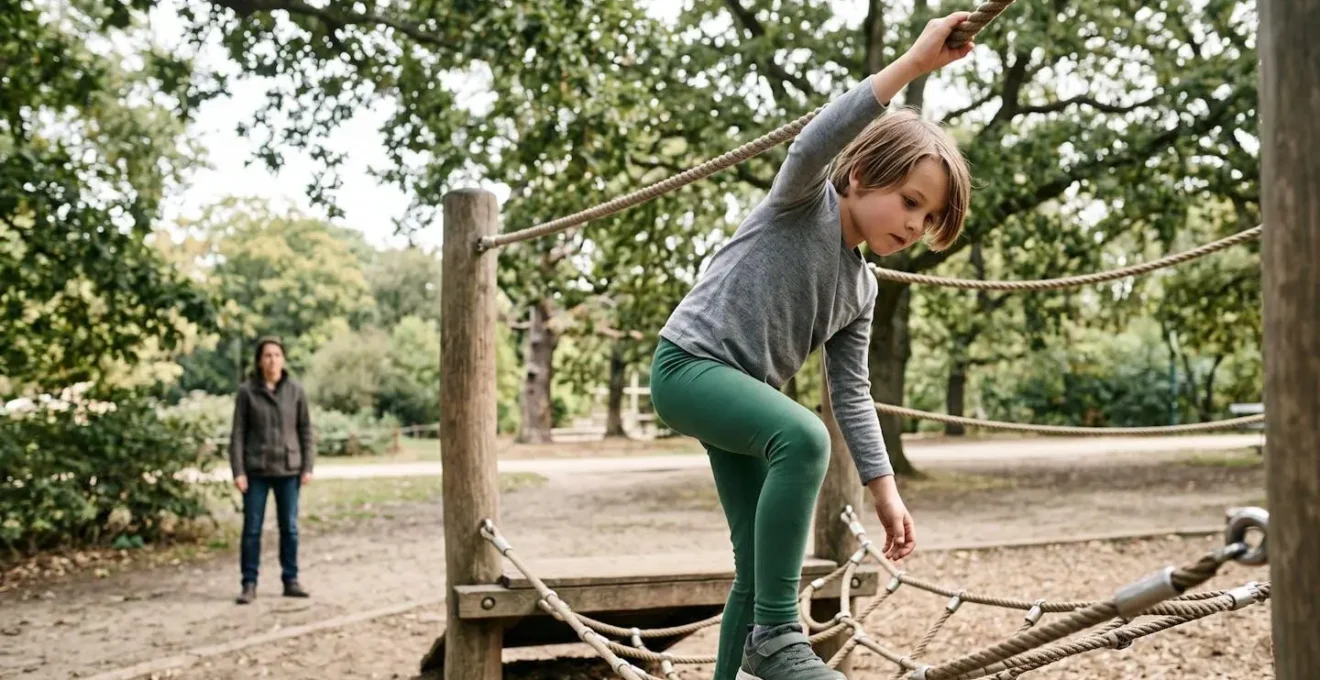
As shown in the image, allowing a child space to navigate a challenge on their own terms builds incredible internal resources. You can offer emotional support (“I see that’s really frustrating”) without providing the solution. This process of emotional co-regulation, where you help them manage the feeling without removing the problem, is far more valuable than co-solving. It teaches them that they can survive negative emotions and that they possess the inner strength to overcome obstacles independently.
Narrating Resilience: Showing How You Handle Your Own Bad Days
Children are master observers. They learn more from what you do than from what you say. The advice to “be a good role model” is common, but true modeling goes beyond simply staying calm. It involves actively and intentionally narrating your own process of resilience. When you have a bad day, miss a deadline, or get frustrated with traffic, you have a prime opportunity to teach. Instead of hiding your frustration or pretending everything is fine, you can use it as a live demonstration of healthy coping.
This means verbalizing your internal experience in an age-appropriate way. You might say, “I’m feeling really frustrated right now because my computer just crashed and I lost my work. I’m going to take five deep breaths to help my body calm down before I try to fix it.” In this one statement, you’ve modeled several critical skills: you’ve named your emotion, identified its cause, and announced a constructive coping strategy. You’ve made the invisible process of emotional regulation visible and understandable.
This “Resilience Narrative” shows your child that negative feelings are a normal part of life and that there are concrete steps one can take to manage them. It demystifies the process of bouncing back. They see that resilience isn’t a magical trait you’re born with; it’s a set of skills you can practice. By making your coping mechanisms transparent, you are giving your child a repeatable script they can adapt for their own challenges. You are, in effect, teaching what you preach in real-time.
Action Plan: Modeling Your Own Resilience
- Acknowledge the negative thoughts: Say out loud, “I’m feeling really frustrated right now because the plan changed unexpectedly.” This normalizes difficult emotions.
- Name your coping strategy: Verbalize your next step, such as, “I’m going to take a short walk to clear my head and think about a new plan.”
- Model the process, not just the outcome: Let your child see the “messy middle.” Show them the steps you take to regulate your emotions, not just the final calm state.
- Use skills you want them to learn: Practice the same deep breathing, problem-solving, or positive reframing techniques you hope your children will one day use.
- Make problem-solving visible: Talk through your thought process for finding a solution. “Okay, Plan A didn’t work. What are my options for Plan B? I could try…”
Competence Leads to Confidence: Why Chores Build Self-Esteem?
Many parents view chores as a transactional way to teach responsibility or earn an allowance. However, their deepest psychological benefit is often overlooked: chores are a primary engine for building competence, and competence is the most authentic source of confidence. When a child successfully masters a real-world task—whether it’s setting the table, watering the plants, or folding their own laundry—they receive tangible proof of their capability. This isn’t empty praise; it’s earned self-esteem.
This creates a powerful positive feedback loop, what can be called a “competence loop.” A child contributes to the family unit, feels capable, and their sense of self-worth grows. This newfound confidence then makes them more willing to tackle the next, slightly harder task. This process is about contribution, not just obedience. When you frame chores as “how we all help our family run smoothly,” they become an act of belonging and significance. The child learns that their actions matter and have a positive impact on others, which is a profound source of self-worth.
The long-term impact of this early-life competence-building is staggering. A famous longitudinal study from the University of Minnesota determined that the best predictor of young adults’ success was that they participated in household tasks when they were three or four years old. These individuals were more likely to have better relationships, achieve their academic goals, and be more self-sufficient. By assigning age-appropriate chores, you aren’t just getting help around the house; you are laying the foundation for a capable, confident, and resilient adult.
Support Systems: Why One Good Friend Is Enough?
In a world of social media and schoolyard politics, it’s easy for parents and children to become fixated on popularity. We count party invitations and worry about the size of a friend group, equating quantity with social success. However, decades of developmental research tell a different story: for building resilience, the quality of friendships matters far more than the quantity. Having just one or two close, trusted friends provides a powerful buffer against stress, loneliness, and bullying.
This single, stable relationship provides what psychologists call “relational security.” It’s a secure base from which a child can explore the world, knowing they have a safe person to return to who accepts them for who they are. This one friend becomes a confidant for sharing worries, a partner for navigating social complexities, and a mirror reflecting their worth. Longitudinal research reveals that only friendship quality (not quantity) predicted future levels of social withdrawal in adolescents. A child with one good friend is better equipped to handle social adversity than a popular child with many superficial connections.
As experts in the field have noted, the role of friendship goes deeper than just avoiding negative feelings. It’s about building a core sense of belonging that popularity can’t provide. Douglas W. Nangle and his colleagues explain this dynamic clearly:
Although popularity exerted no direct impact on adjustment indexes, it strongly influenced friendship, which in turn affected depression through its strong association with loneliness. It appears that popularity is important for setting the stage for relationship development, but that it is dyadic friendship experiences that most directly influence feelings of loneliness and depression.
– Douglas W. Nangle, Cynthia A. Erdley, et al., Journal of Clinical Child & Adolescent Psychology study on friendship quality and mental health
Your role as a parent is to shift the focus from popularity to connection. Encourage activities that foster deep, one-on-one interactions. Help your child identify the qualities of a good friend—kindness, trustworthiness, shared interests—and celebrate the strength of that single, powerful bond.
All Feelings Are Okay: Why You Should Validate Anger (But Not Hitting)?
When a child has a meltdown, throwing a toy in anger or bursting into tears over a perceived injustice, a parent’s immediate goal is often to stop the emotion. We say “Don’t be sad,” “Calm down,” or “There’s no reason to be angry.” In doing so, we unintentionally invalidate their internal experience, sending the message that certain feelings are “bad” or unacceptable. A core principle of emotional resilience is this: all feelings are okay; not all behaviors are okay.
Validation is the act of acknowledging and accepting your child’s emotional state without judgment. It sounds like, “I can see you’re feeling very angry right now,” or “It’s so disappointing when the game doesn’t go your way.” This simple act of naming and accepting the feeling does not mean you are condoning a negative behavior. It is the critical first step in emotional co-regulation. Only after a child feels seen and understood can they begin to process the emotion and become receptive to guidance. You can hold two truths at once: “It’s okay to feel furious, but it’s not okay to hit your brother.”

Getting down on their level, making eye contact, and offering a calm presence creates a connection that de-escalates the situation. This approach builds emotional intelligence by helping children develop a vocabulary for their feelings. As the Communication Clubhouse Psychology Team advises, this is a direct path to building resilience:
Building resilience in children can occur by listening and validating their feelings without trying to minimize or problem-solve. Invite your child to decide how they want to move forward, perhaps offering to brainstorm some ways to manage the negative feelings and then work through the situation together.
– Communication Clubhouse Psychology Team, Modeling Resilience and Growth Mindset for Your Child
By separating the feeling from the action, you teach your child that their internal world is safe and valid, while still holding firm, loving boundaries on how they express it. This builds a foundation of trust and emotional safety, making them more likely to come to you with their big feelings in the future.
Learning Styles: Matching the Pedagogy to Your Child’s Personality
There is no one-size-fits-all formula for building resilience. A strategy that works wonders for an outgoing, boisterous child might overwhelm one who is more introverted and sensitive. Effective parenting involves becoming a keen observer of your child’s unique temperament and adapting your approach accordingly. Is your child a kinesthetic learner who needs to move their body to process emotions? Or are they more verbal, needing to talk things through? Matching your “pedagogy” (your method of teaching) to their personality is a sign of respect for their individuality and dramatically increases the chances of success.
For a child with high energy, teaching emotional regulation might involve “stomping out the mad” in the backyard. For a quieter child, it might mean creating a “calm-down corner” with soft pillows and books. For a creative child, it could involve drawing their feelings. This tailoring shows you see and understand them on a deep level. It also applies to how you introduce challenges. For a cautious child, you might use graded exposure, breaking down a new experience (like attending a party) into tiny, manageable steps, celebrating each one along the way. For a more daring child, you might allow for more independent, trial-and-error learning.
This tailored approach is the basis for many successful, evidence-based therapeutic programs designed to help children and families manage anxiety and build coping skills. They don’t offer a single script; they provide a framework that parents can adapt.
Case Study: Adapting Interventions to a Child’s Neurotype
Parent-only treatment programs like ‘Timid to Tiger’ and ‘SPACE’ are excellent examples of this principle in action. As described in a recent analysis, these programs are designed to help parents manage a child’s anxiety by adapting strategies to their specific temperament and needs. The ‘Timid to Tiger’ protocol, for instance, is a 10-session parent-led treatment that teaches cognitive-behavioral skills like graded exposure and problem-solving. Crucially, the program’s goals include helping parents apply these skills in a way that is matched to the child’s developmental level and personality, fostering a home environment that is warm, predictable, and responsive to the individual child.
By becoming a student of your child, you can move from applying generic advice to implementing a personalized resilience-building plan that truly fits.
Key takeaways
- Resilience is not about being “tough” but about having the internal skills to bounce back from adversity.
- Parents play a crucial role in modeling and narrating their own coping strategies for handling stress and frustration.
- Authentic confidence stems from earned competence, making age-appropriate chores a powerful tool for self-esteem.
Emotional Regulation 101: Helping Kids Manage Big Feelings
When a child is in the grip of a big feeling—overwhelming anger, paralyzing fear, or deep sadness—their prefrontal cortex, the “thinking” part of the brain, effectively goes offline. In that moment, you cannot reason with them or lecture them. The first and most important step is to help them regulate their nervous system and return to a state of calm. Teaching children concrete, body-based techniques for self-soothing is a foundational life skill. It’s the practical “how-to” of managing emotions.
These are not complex psychological exercises. They are simple, physiological tools that directly interact with the body’s stress response. You can practice them with your child when they are calm, creating a “menu” of coping skills they can choose from when they feel overwhelmed. These science-backed techniques provide a tangible way for a child to feel a sense of control over their own body and emotions.
Some of the most effective physiological regulation techniques include:
- The Physiological Sigh: Teach your child to take two quick inhales through the nose followed by a long, slow exhale through the mouth. This is the fastest known way to voluntarily calm the nervous system.
- Proprioceptive Input: The sensation of deep pressure is naturally regulating. Offering a tight hug (with permission), wrapping them snugly in a weighted blanket, or even just having them push against a wall can provide this calming input.
- The Mammalian Dive Reflex: Briefly splashing cold water on the face or holding a cold pack to the cheeks can trigger a natural reflex that slows the heart rate and calms the body.
- Mindful Breathing: Simply guiding them to place a hand on their belly and feel it rise and fall with each breath can anchor them in the present moment and away from the overwhelming emotion.
By equipping your child with these tools, you are giving them an internal “first-aid kit” for their emotional life. They learn that while they can’t always control what happens to them, they can learn to control their body’s reaction. This sense of agency is the very essence of resilience.
Building your child’s psychological scaffolding is a marathon, not a sprint. Start today by choosing just one of these strategies to focus on. Whether it’s introducing the word “yet,” narrating your own frustration, or practicing a physiological sigh together, each small step is an investment in their lifelong well-being and mental strength.