
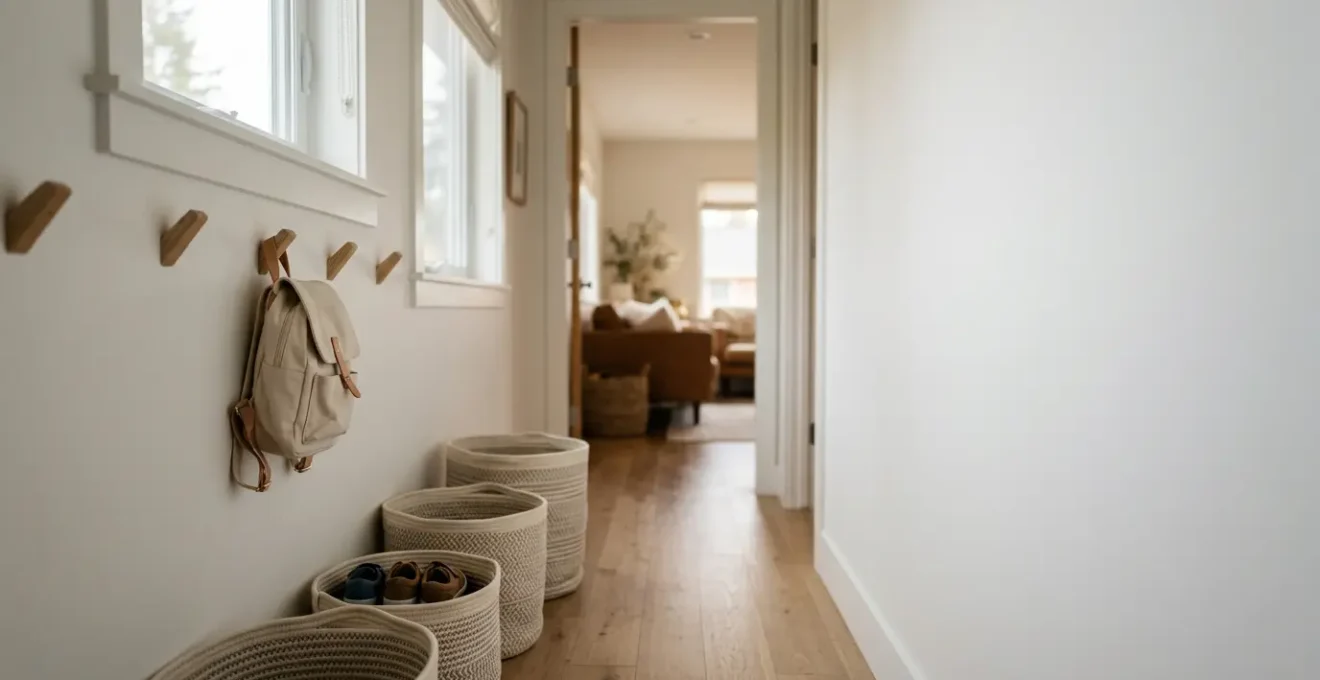
The secret to a sustainably organized home with kids isn’t more bins or better labels; it’s engineering systems around the physical and cognitive reality of a child.
- Effective systems reduce friction by making the desired action the easiest possible option for a small body.
- Empowering kids with age-appropriate autonomy within a parent-designed structure builds competence and reduces conflict.
Recommendation: Stop acting as the family janitor and start thinking like a systems engineer. Identify one major friction point in your home (like coats on the floor) and redesign the process for your child, not for yourself.
You’ve just spent an hour resetting the playroom. Every toy is in its designated, beautifully-labeled bin. The books are perfectly aligned on the shelf. You take a deep breath, savoring the momentary calm. Twenty minutes later, it looks like a miniature hurricane passed through. This cycle of chaos, cleanup, and collapse is the frustrating reality for many parents. We’re told the solution is to declutter more, buy more storage, and create elaborate labeling systems. We try to teach our kids to be tidy, to put things back where they belong, but the mess always seems to win.
But what if the problem isn’t the child’s willingness or the number of bins you own? What if the systems themselves are flawed? The common approach to kid’s organization is designed by adults, for adults, with adult-sized bodies and fully developed brains. We expect a three-year-old to have the fine motor skills, spatial reasoning, and executive function to operate systems that even some adults struggle with. This approach is doomed from the start because it ignores the fundamental user: the child.
This guide proposes a radical shift in mindset. Instead of being a manager who enforces rules, you will become a systems engineer who designs for your end-user. We will move beyond the aesthetic of organization and dive into the mechanics of it, exploring the ergonomics of a child, the cognitive load of a task, and the power of designing for the path of least resistance. It’s about creating systems so intuitive and frictionless that using them correctly is easier than not.
We’ll deconstruct the most common household battlegrounds—from hallways piled with coats to chaotic playrooms—and rebuild them with principles of developmental psychology and systems thinking. Prepare to stop organizing *for* your kids and start engineering systems *with* and *because of* them, creating a home that is not just tidier, but also fosters genuine independence and competence.
Table of Contents : Systems That Kids Can Actually Maintain
- Low Hooks: Why Coat Hangers Are Too Hard for Toddlers?
- Shoe Baskets: The “Dump and Go” Solution for Hallways
- Hamper Height: Making Laundry Accessible for Short Arms
- The Self-Serve Snack Drawer: fostering Independence (and Sleep-Ins)
- The Launch Pad: A Spot for Everything Leaving the House
- The Command Center: Setting Up a Hallway Hub for Keys, Mail, and Dates
- Coat and Shoes: Why Putting on Their Own Shoes Is Key for School?
- Playroom Design and Storage Solutions: Creating Order from Chaos
Low Hooks: Why Coat Hangers Are Too Hard for Toddlers?
The coat lying on the floor next to a closet full of empty hangers is a universal symbol of parental frustration. We see it as defiance or laziness, but from a systems engineering perspective, it’s a predictable system failure. The culprit is not the child; it’s the hanger. A coat hanger is a deceptively complex tool that demands a level of dexterity most young children simply do not possess. Putting a coat on a hanger isn’t one action; it’s a multi-step sequence requiring advanced skills.
As occupational therapists point out, the task requires bilateral coordination (using both hands together for different tasks), a strong pincer grasp, and the ability to visually guide the hanger through a small opening while supporting the weight of the jacket. For a toddler, this is the equivalent of a difficult brain teaser. According to research on occupational therapy for dressing skills, these are skills that develop progressively through the preschool years. Expecting a toddler to master this sequence under the pressure of leaving the house is designing a friction point into your daily routine.
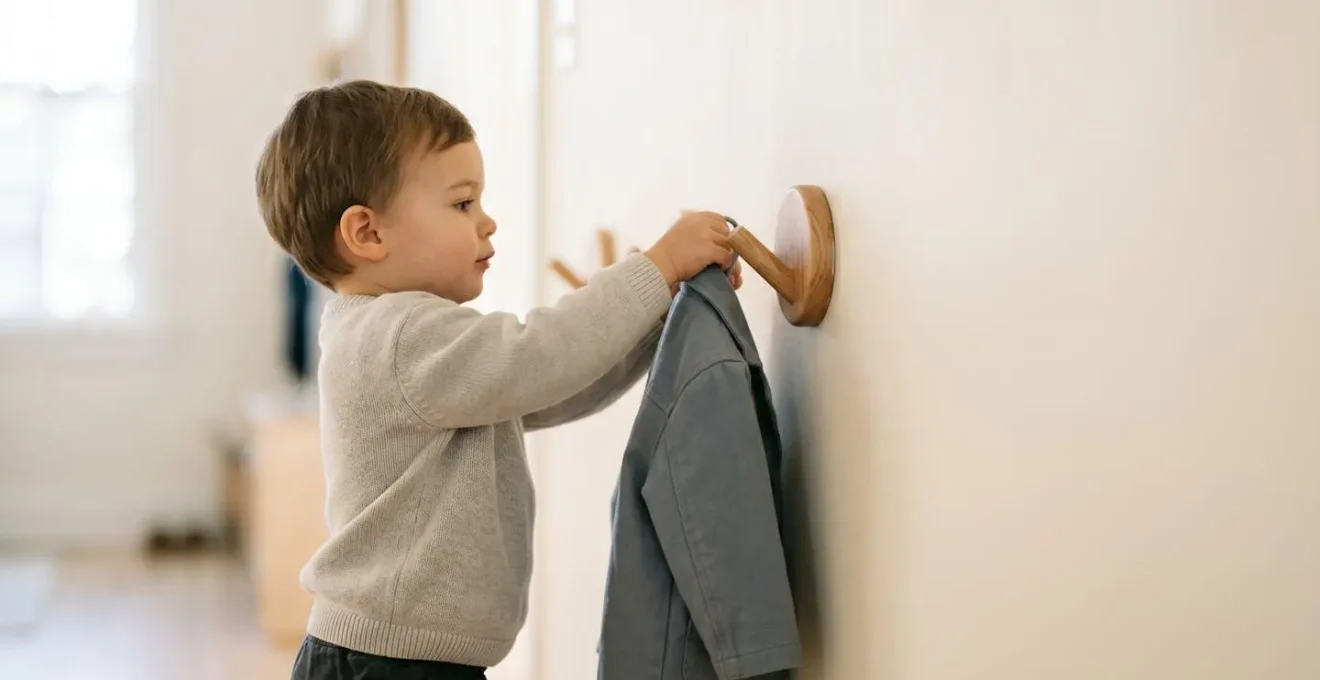
The solution is to eliminate the friction. A low, open hook mounted at the child’s eye level is the answer. It transforms a complex, multi-step process into a single, satisfying one. The child can see the target and perform the action of hanging their coat in one fluid motion. This isn’t “dumbing it down”; it’s smart design. It aligns the task with the user’s current capabilities, turning a potential point of conflict into a moment of success and independence. The hook becomes the path of least resistance, making the desired action—hanging up the coat—the easiest possible outcome.
Shoe Baskets: The “Dump and Go” Solution for Hallways
The entryway is the first and last line of defense in home organization. If this system fails, chaos quickly spills into the rest of the house. The most common failure point? Shoes. Shoe racks, with their neat rows and designated slots, are an adult’s ideal. For a child, they present a series of unnecessary challenges: finding the right spot, aligning both shoes perfectly, and fitting them into a constrained space. It’s a system with too many rules and too much required precision.
Enter the “Dump and Go” basket. A simple, large, open basket by the door is the epitome of a low-friction system. It requires one action: drop. There is no lining up, no pairing, no wrong way to do it. It perfectly leverages a child’s natural inclination to drop things the moment they cross the threshold. By placing a basket exactly in that drop zone, you make the correct action the most convenient one. This isn’t a compromise on order; it’s a strategic harnessing of natural behavior.
As a child’s cognitive and organizational skills develop, this system can evolve. You can progress from a single family “dump basket” to individual baskets for each person (using a picture for a label), and eventually, to an assigned spot on a rack. This tiered approach respects the child’s developmental stage, gradually increasing the cognitive load as they become more capable. However, it’s important to recognize that for some children, the visual chaos of a jumbled basket can be overwhelming. As one piece of research notes, “For some children (especially neurodivergent children), the jumble can be visually chaotic.” In these cases, individual bins or a rack with wider, more forgiving cubbies might be a better Level 1 solution, demonstrating that the best system is always the one tailored to the specific user.
Hamper Height: Making Laundry Accessible for Short Arms
The trail of discarded clothes leading from the bedroom to the bathroom is another common symptom of a broken system. Often, the laundry hamper is the problem. A typical hamper is tall, may have a lid, and is often tucked away in a closet. For a child, this presents a series of physical and logistical hurdles. It’s too high to see into, the lid is an extra step (a friction point), and its location is inconvenient. The floor, by comparison, is always accessible and requires zero effort.
The solution lies in applying child-centric ergonomics. A successful laundry system for a child begins with a hamper that is short, wide, and has an open top. It should be placed in plain sight in the room where they undress. This design turns the act of putting clothes away into an easy, satisfying game of “basketball.” The child can see the target, easily reach it, and score a “basket” with their dirty socks. This immediate success builds a positive feedback loop and a consistent habit.
As the child grows, this system can be upgraded to teach more complex skills like sorting. You can move from a single hamper to a two-bin system labeled with simple, visual cues (e.g., a sun for whites, a dark cloud for colors). This should be introduced when the child is developmentally ready. According to developmental research on executive function, the working memory required for such categorization tasks becomes more robust around the ages of 4 to 6. Introducing a complex sorting system to a two-year-old is setting them up for failure; waiting until they are ready is setting them up for success.
Action Plan: Auditing Your Child-Centric Systems
- Identify Point of Contact: Where does the task begin for the child? List all the physical and mental touchpoints of the process (e.g., for laundry: undressing, carrying clothes, finding the hamper).
- Collect Existing Elements: Inventory the current tools. What is the hamper’s height, location, and design? Note every element that could add or reduce friction.
- Check for Coherence: Does the tool match the user’s abilities? Confront the design with the child’s physical (height, strength) and cognitive (multi-step tasks) reality. Identify the primary friction point.
- Assess Memorability & Emotion: Is the task a frustrating chore or a moment of mastery? Observe the child’s reaction. A system that creates dread is a failing system.
- Create an Integration Plan: What is the simplest, Level 1 fix? Prioritize replacing or modifying the greatest friction point to create an immediate win (e.g., swap the tall, lidded hamper for a short, open basket).
The Self-Serve Snack Drawer: fostering Independence (and Sleep-Ins)
The constant refrain of “I’m hungry!” is a major drain on a parent’s time and energy. A self-serve snack station is more than just an organizational hack; it’s a powerful system for fostering independence, teaching self-regulation, and potentially buying you a few extra minutes of sleep on a Saturday morning. However, its success hinges entirely on its design.
An effective snack station is not a free-for-all. It is a carefully curated environment. The parent acts as the system architect, using a principle called “covert control.” You control the *what* and the *when* by stocking a designated low drawer or cabinet with a limited number of healthy, parent-approved options. The child then has complete autonomy to control the *whether* and *how much* they eat from those options. This brilliant division of responsibility, a concept championed by dietitian Ellyn Satter, removes the food battles from the equation.
The parent’s job is to curate the choices available, and the child’s job is to choose from those options.
– Ellyn Satter, Registered Dietitian, Division of Responsibility feeding method
By placing pre-portioned, easy-to-open snacks within their physical reach, you remove the friction of having to ask for help. This empowers them and builds their confidence. They learn to listen to their body’s hunger cues and make choices within a safe and healthy framework. The system is designed for success because every available option is a “good” option. This is a profound shift from a restrictive mindset (“You can’t have that”) to an empowering one (“Which of these would you like?”).
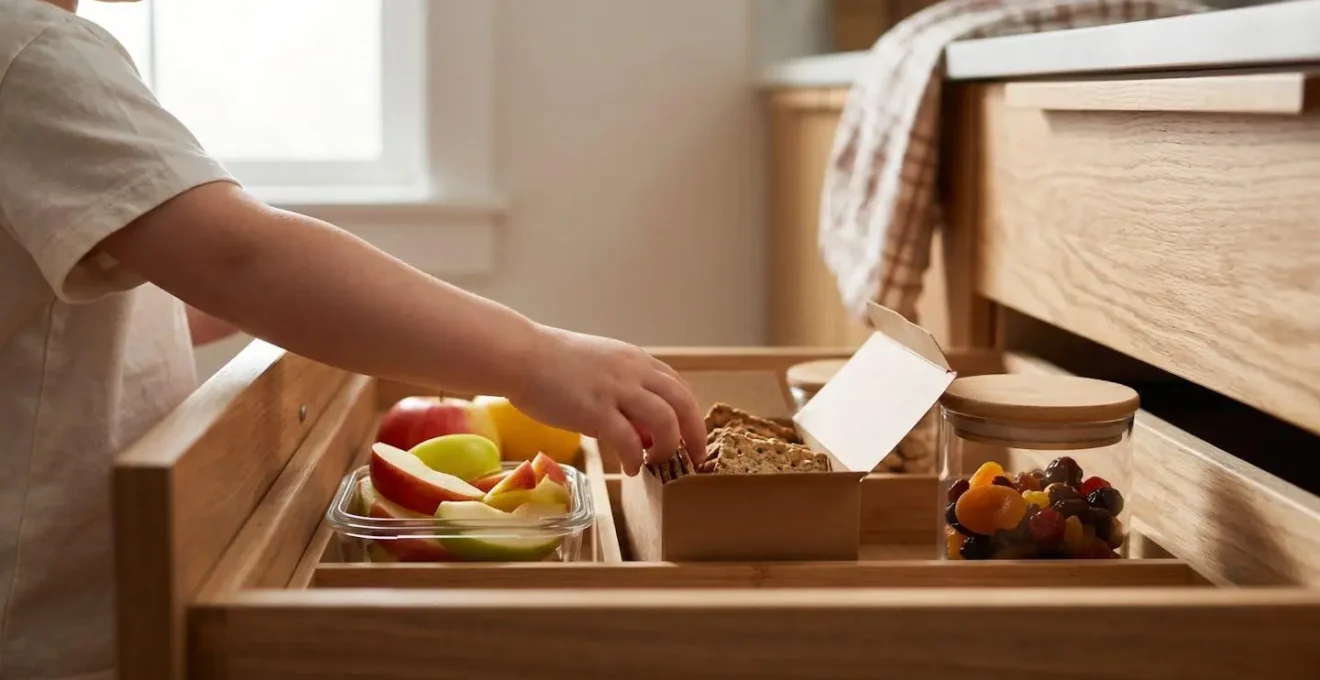
The physical design is crucial. Use clear containers so they can see their choices. Choose items their small hands can manage independently. The goal is to create a seamless, frustration-free experience that makes them feel capable and trusted.
The Launch Pad: A Spot for Everything Leaving the House
The frantic 10-minute search for a missing backpack, library book, or permission slip is a classic morning friction point. This chaos stems from a lack of a cohesive “off-boarding” system. A “Launch Pad” is a designated spot near the exit where everything needed for the next day is gathered the night before. It’s a simple concept, but its power lies in turning it into a complete, closed-loop system.
A truly effective Launch Pad system has three components. First is the Landing Zone: the moment a child comes home, the backpack is emptied in a designated spot. Papers are sorted, the lunchbox is dealt with. Second is the Reset Station: this is the process, done at a consistent time (like after dinner), where you prepare for the next day. The new lunch is packed, homework is signed and put back in the backpack. Third is the Launch Pad itself: the final staging area. The fully packed backpack, shoes, coat, and any other items are placed here, ready for a grab-and-go departure.
To handle the inevitable non-routine items—a permission slip, a birthday party invitation, a book for show-and-tell—add a “Floating Item Tray.” This is a brightly colored, designated tray where these special items live. Its distinct color makes it visually unmissable during the morning rush. This system works because it externalizes memory. It removes the mental load from both parent and child of having to remember everything. The system remembers for you.
This may seem like a simple routine, but it’s a powerful training ground for executive function—the set of mental skills that include working memory, flexible thinking, and self-control. By practicing this daily loop, children learn planning, sequencing, and organization in a tangible way. And this has profound long-term benefits; research on executive function in education shows that these early skills are significant predictors of later academic and social competence.
The Command Center: Setting Up a Hallway Hub for Keys, Mail, and Dates
If individual systems like the Launch Pad are the “apps,” the Command Center is the family’s “operating system.” It’s a centralized, physical hub that makes the invisible logistics of family life visible and accessible to everyone. In a world of digital calendars and apps, a physical command center is a superior tool for young families because it provides ambient awareness. It’s always on, always visible, and requires no login or special device. It makes the abstract concept of time tangible for children.
A good Command Center is more than just a calendar on the wall. It’s an interactive dashboard for family life. The core component is a large calendar, but it should also include a space for mail, a key hook, and a whiteboard for messages. To make it truly child-centric, assign each family member a different color marker. This allows even pre-readers to track their activities (“My green line means I have swimming today”). Giving a child their own small section of the board to manage fosters a sense of ownership and teaches calendar literacy through daily, passive exposure.
The Command Center can also be transformed from a purely logistical tool into a cultural one. Add a “Weekly Wins” board where anyone can write down an accomplishment—from acing a test to finally learning to tie their shoes. Display a visual representation of a shared family goal, like a drawing of a mountain with a path colored in for every dollar saved for a special trip. This transforms the Command Center from a list of obligations into a celebration of family identity and progress.
The location is key. It should be in a high-traffic area, like the kitchen or main hallway, at a height where both adults and children can see and interact with it. It becomes the background radiation of your family’s schedule, absorbed passively by everyone, reducing the need for constant verbal reminders.
Coat and Shoes: Why Putting on Their Own Shoes Is Key for School?
The ability for a child to put on their own coat and shoes is not just a matter of convenience for a busy parent; it’s a critical developmental milestone that is a key indicator of school readiness. The struggle to get out the door often obscures the incredible complexity of these tasks. An occupational therapy study describes it perfectly: “Donning and doffing a coat requires bilateral coordination, crossing midline, extrinsic and intrinsic muscle strength of the hands, and forearm supination and pronation.” It’s a full-body workout that builds crucial neural pathways.
These are not just “life skills”; they are foundational “academic skills” in disguise. The fine motor strength and coordination required to work a zipper or tie a shoelace are the very same skills needed to hold a pencil, use scissors, and control a computer mouse. It is no surprise that research on fine motor development shows that there is a strong link between these physical skills and a child’s development in language and literacy. When we rush and do it for them, we are robbing them of a vital learning opportunity.
The key is to separate the practice from the performance. The morning rush, with its time pressure and stress, is the worst possible time to learn a new skill. The system for success here is the Off-Peak Practice Strategy. Set aside low-stress time on a weekend to focus solely on these skills. Turn it into a game. Use adaptive tools like zipper pulls or elastic laces to provide an initial scaffold. Employ clever hacks like the sticker-cut-in-half trick (placing one half in each shoe to show which is left and which is right) to provide clear visual cues.
By creating a dedicated, low-pressure system for skill acquisition, you remove the friction from the high-pressure morning routine. The child builds muscle memory and confidence, allowing them to eventually perform the task independently when it really counts.
Key Takeaways
- Engineer, Don’t Decorate: Shift your mindset from creating a “pretty” space to engineering a “functional” system based on your child’s actual physical and cognitive abilities.
- Friction is the Enemy: Identify and eliminate every unnecessary step, lid, or precision requirement. The right action should always be the easiest action.
- Build Evolving Systems: Start with the simplest possible version of a system (a dump basket) and add complexity (sorting, designated spots) only as your child’s developmental capacity grows.
Playroom Design and Storage Solutions: Creating Order from Chaos
The playroom is the final boss of home organization. It’s a dynamic, high-volume environment that can descend into chaos in minutes. Applying the same systems thinking, however, can create a space that is not only easy for a child to use but also easy for them to help reset. The goal is not a showroom that is never played in, but a functional workshop for play.
Effective playroom design follows a few key principles. First, less is more. Too many toys on display create visual overstimulation and decision fatigue. Implement a toy rotation system, keeping a portion of toys stored away. This not only reduces clutter but also renews a child’s interest in their toys when they are reintroduced. Second, use low, open shelving instead of deep toy chests. A toy chest with a lid is a classic high-friction system; toys on the bottom are lost forever, and cleanup means dumping everything in, creating a jumble. Open shelves allow children to see all their options and retrieve and replace items with ease.
For smaller items, use clear or photo-labeled bins. For pre-readers, a photo of the contents is far more effective than a written word. This empowers them to find what they’re looking for and, crucially, to put it back in the right place without needing to ask for help. This is not just about tidiness; it’s about giving them ownership and control over their environment.
Finally, no system is self-sustaining without maintenance protocols. The most important system in the playroom is the System Reset Ritual. This is not a marathon cleaning session but a small, consistent daily habit. The “10-Minute Tidy” with a timer at the end of the day is a perfect example. It’s a predictable routine that makes cleanup a manageable, non-negotiable part of play. Involving the whole family in a slightly more comprehensive “Sunday Sort-Out” helps maintain the system and provides a weekly opportunity to audit what’s working and what isn’t.
By shifting your perspective from enforcer to engineer, you can move beyond the endless cycle of mess and frustration. The goal is not a pristine, un-lived-in home. The goal is to build a resilient framework that supports your child’s development, fosters their independence, and gives you back your time and sanity. Start small. Pick one friction point this week and redesign the system. You are not just building a tidier home; you are building more capable and confident human beings.