
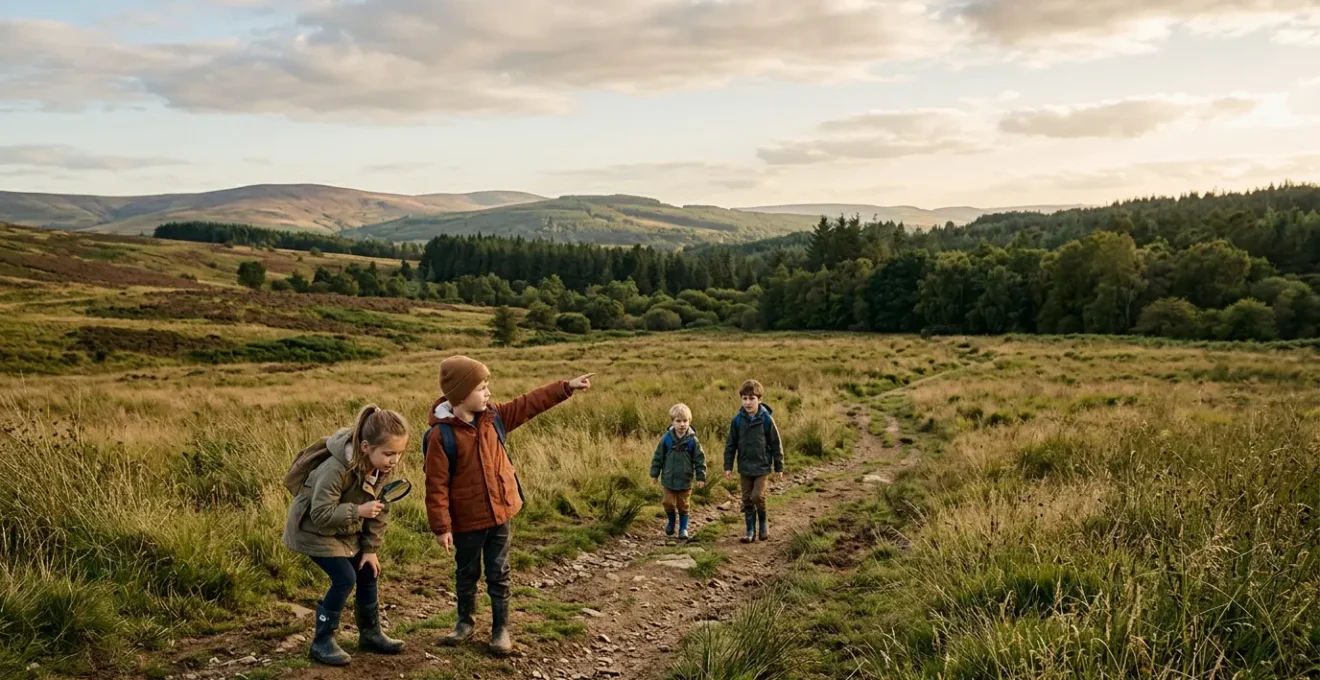
Feeling like you’re losing the battle against screens? The solution isn’t about planning epic, exhausting adventures. It’s about shifting your mindset. This guide reveals how to weave small, consistent, and ownable “micro-adventures” into your family’s daily life, making nature connection an easy, irresistible alternative to the digital world. You’ll learn to transform your garden, window, and even a rainy day into a playground for the imagination.
As a parent, you’ve likely seen the statistics and felt the quiet pang of guilt. Some recent studies reveal that children spend over 7 hours daily on screen time but only 4 to 7 minutes outdoors. You’re not alone in feeling that the iPad’s glow is a constant, formidable competitor to the sun’s. The common advice—”just limit screens” or “go on a hike”—often feels simplistic or adds another item to an already overflowing mental load. We’re told to make it fun, to lead by example, but the logistics can feel overwhelming.
What if the antidote to the digital deluge isn’t a grand escape to a national park? What if the secret lies not in adding more to your plate, but in reframing what you already have? The key to raising a “wild kid” isn’t about becoming a wilderness survival expert overnight. It’s about becoming a guide to the wonders hidden in plain sight—in a square meter of soil, on a window ledge, or during a walk to the corner park. It’s about fostering a deep, personal connection through small, consistent rituals that give your child a sense of ownership and discovery.
This article isn’t another list of 101 activities to feel guilty about not doing. Instead, it’s a practical guide to building a foundation of nature connection, one tiny, powerful step at a time. We’ll explore how to equip for any weather, create personal nature museums, and turn a simple park visit into a heroic quest, proving that the biggest adventures often start in the smallest of spaces.
This guide offers eight simple, yet profound, shifts in perspective that can help you cultivate a love for the outdoors in your children. Each section provides a practical starting point to make nature the easy, compelling choice.
Summary: Raising Wild Kids in a Digital World
- There’s No Bad Weather: The Right Gear for UK Rain
- Kids’ Patches: Giving Ownership of a Square Meter of Soil
- Bird Feeders: Bringing Wildlife to the Window
- The Nature Table: Displaying Rocks, Sticks, and Feathers
- Garden Camping: Testing the Waters Before the Real Thing
- Bug Hunt: Sorting Insects by Number of Legs
- Museum Bingo: Turning a Gallery Visit into a Treasure Hunt
- Park Excursions: Turning a Trip to the Swings into an Adventure
There’s No Bad Weather: The Right Gear for UK Rain
One of the biggest mental barriers to outdoor play is the weather. We wait for the perfect sunny day, but in many places, that means missing countless opportunities for adventure. The Nordic philosophy of friluftsliv (open-air life) offers a powerful mindset shift, perfectly encapsulated by a famous cultural saying.
There is no bad weather, only bad clothing.
– Norwegian cultural saying, Norwegian friluftsliv philosophy
Embracing this idea means rain is no longer a stop sign; it’s simply a different set of conditions. Puddles become lakes for leaf-boats, the smell of wet earth fills the air, and worms come out to say hello. The key is removing the discomfort. When a child is warm and dry, rain becomes an asset, not a liability. Equipping them properly isn’t about buying expensive gear; it’s an investment in year-round freedom and resilience. A good set of waterproofs transforms the outdoors from a “sometimes” place into an “anytime” place.
The right clothing functions as a system of layers, allowing you to adapt to changing conditions and activity levels. This three-layer approach is the cornerstone of comfortable outdoor play, ensuring warmth without overheating and dryness without clamminess.
- Layer 1 (Base): Thermal or merino wool layers that wick moisture away from skin and maintain warmth even when damp.
- Layer 2 (Insulation): Fleece or wool mid-layer for warmth regulation without bulk, allowing freedom of movement.
- Layer 3 (Waterproof Shell): High-quality waterproof jacket and trousers with sealed seams and adjustable cuffs to keep rain completely out.
- Footwear: Insulated, waterproof boots with good grip for muddy terrain; wool or synthetic socks that stay warm when wet.
- Accessories: Waterproof gloves or mittens, and a hood or waterproof hat to protect head and neck from rain and wind.
This preparation teaches a valuable life lesson: with the right tools and mindset, you don’t have to wait for the world to be perfect to go out and live in it.
Kids’ Patches: Giving Ownership of a Square Meter of Soil
In a world where children have little control, giving them true ownership over a small piece of it can be a revolutionary act. A “kid’s patch”—whether a square meter in the garden, a single large pot on the balcony, or a window box—is more than just a place to grow things. It’s a personal laboratory, a sanctuary, and a classroom. This isn’t your garden that they “help” with; it’s their land. They choose what to plant (even if it’s “just” dandelions), they decide when to water, and they are the primary observer of its life cycle.
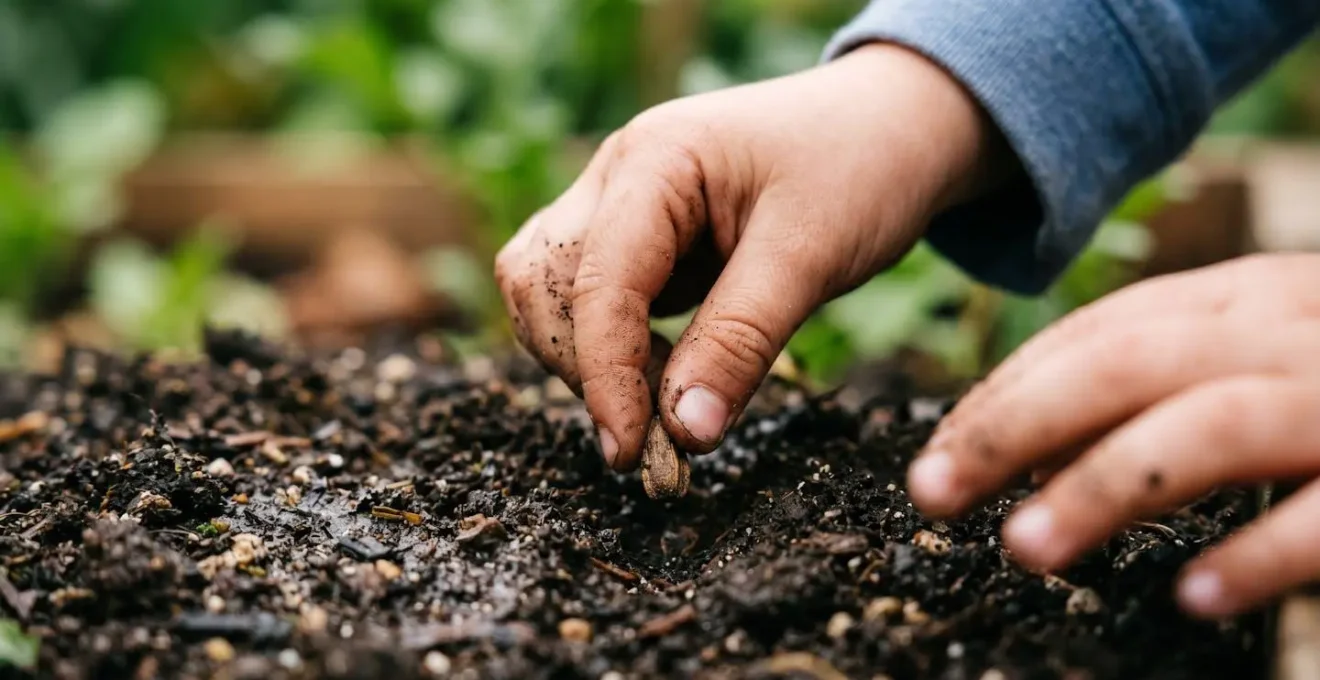
This simple act of ceding control fosters a profound sense of responsibility and connection. The child isn’t just a visitor in nature; they are a custodian. They witness the magic of a seed sprouting, the drama of a ladybug hunting aphids, and the quiet tragedy of a plant that wasn’t watered. These are not lessons taught from a book; they are truths learned through dirt-stained fingers. This hands-on engagement has tangible benefits beyond the garden, as research consistently shows that in all 12 quantitative studies reviewed, students engaged in gardening scored higher on science achievement tests.
To start, simply define the space and declare it theirs. Provide a few simple tools—a trowel, a small watering can—and a packet of easy-to-grow seeds like radishes, sunflowers, or beans. Then, the hardest part for any parent: step back. Let them make mistakes. Let them discover. Their patch, their rules, their discoveries.
Through this small plot of land, a child learns the fundamental rhythms of life, death, and renewal, and their relationship with the natural world shifts from passive observer to active participant.
Bird Feeders: Bringing Wildlife to the Window
You don’t need to travel to a nature reserve to see wildlife. One of the most effective ways to foster a connection with the animal kingdom is to invite it right to your window. A simple bird feeder acts as a bridge, transforming your home into a live-action nature documentary. For a child accustomed to fast-paced digital entertainment, the subtle drama of the bird world—the territorial squabbles of sparrows, the acrobatic feats of a nuthatch, the flash of a cardinal’s crimson—offers a different, more patient kind of engagement.
The key is to elevate this from a passive activity into an interactive one. By creating a dedicated “Bird-Watching Station,” you provide the tools and structure for your child to become a junior ornithologist. This process turns casual observation into a scientific ritual, teaching skills of data collection, pattern recognition, and technological literacy in service of nature. It’s a perfect, low-effort way to build a daily or weekly habit of nature connection, regardless of the weather or your schedule.
Your Action Plan: Creating a Bird-Watching Station
- Feeder Setup: Install a simple bird feeder visible from a child-height window; use multiple seed types (sunflower, nyjer, suet) to attract diverse species.
- Observation Tools: Provide child-friendly binoculars (lightweight, 6x magnification) and a field guide or printable bird identification chart.
- Recording System: Create a “Bird-Dex” journal where children can check off sightings, sketch birds, and note feeding preferences (which seeds attract which birds).
- Tech Integration: Download the Merlin Bird ID app (Cornell Lab) to identify birds from photos or sounds, transforming smartphones into scientific tools.
- Pattern Analysis: Weekly, review the journal together to identify patterns—most common visitors, favorite foods, time-of-day activity—teaching the scientific method through observation.
Suddenly, the window is no longer just a barrier to the outside world; it’s a screen showing the most interesting, unscripted reality show in town.
The Nature Table: Displaying Rocks, Sticks, and Feathers
A walk in the park or woods often results in pockets full of treasures: a smooth grey stone, a curiously twisted stick, a vibrant autumn leaf, a pigeon feather. To a child, these are not random debris; they are artifacts from an adventure. Too often, these treasures end up in the washing machine or are quietly discarded. A “Nature Table” offers a powerful alternative: a dedicated space to honor and display these finds.
This designated shelf or low table becomes the child’s personal Museum of Natural History. It validates their discoveries and communicates that the things they find in nature are valuable and worthy of attention. It’s a physical manifestation of their outdoor experiences, a tangible story of their adventures. This act of curating their collection transforms them from a mere collector into a storyteller and a scientist, fostering skills of categorization, observation, and inquiry. An empty space on the table becomes an invitation for the next adventure.
Setting up an interactive museum is simple and can be adapted to any home, large or small. The goal is to create a dynamic, engaging space that evolves with the seasons and your child’s interests.
- Step 1 (Dedicated Space): Designate a low table or shelf accessible to children as their personal ‘Natural History Museum’ with clear boundaries for their collection.
- Step 2 (Labeling System): Create simple labels for each item featuring the object’s name and an open-ended question (e.g., ‘Pine Cone—How many seeds does it hold?’ or ‘Smooth Stone—Where did this come from?’).
- Step 3 (Curator’s Rotation): Establish a monthly rotation schedule where the child selects new items to display and archives older ones in a ‘Collection Box,’ preventing clutter while maintaining continuity.
- Step 4 (Thematic Exhibits): Encourage themed collections that change seasonally or by concept (‘Fall Colors,’ ‘Things Found After Rain,’ ‘Feathers from Different Birds’), fostering categorization skills.
- Step 5 (Story Integration): Pair each display with a ‘Field Journal’ where children draw or write the adventure story of finding each item, creating narrative connections to outdoor exploration.
The Nature Table becomes a living scrapbook of outdoor memories, sparking conversations and inspiring the question that fuels all exploration: “I wonder what we’ll find next?”
Garden Camping: Testing the Waters Before the Real Thing
The idea of “real” camping can be intimidating for both parents and kids. There’s the packing, the long drive, the fear of the unknown, and the pressure for it to be a perfect experience. This is a significant barrier, especially when according to a 2024 national survey, 37% of preschool-aged children play outdoors for ≤1 hour on weekdays. The solution is to lower the stakes dramatically. Garden camping is the perfect stepping stone—all the thrill of sleeping outdoors with none of the logistical nightmares. The house, with its familiar bathroom and snack-filled kitchen, is just a few feet away.
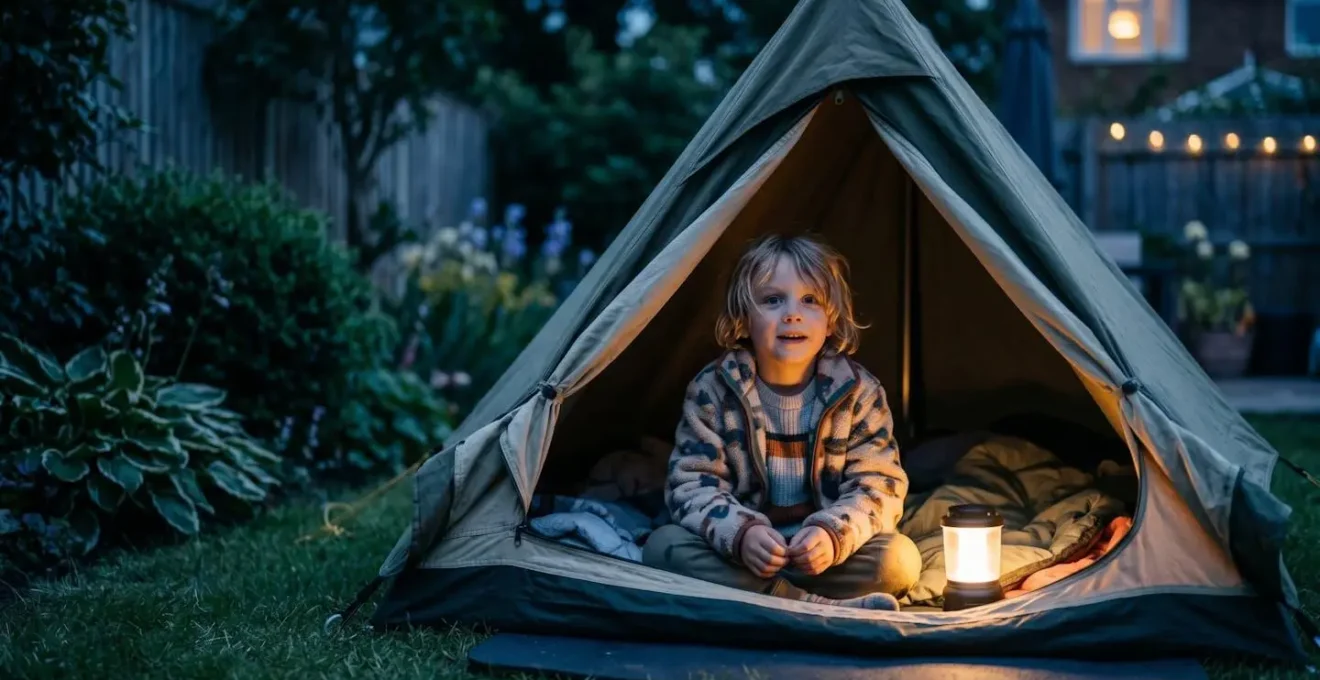
This experience is a safe, controlled way to cross the threshold of adventure. For a child, the backyard transforms into a wild, new landscape after dark. Familiar shapes become mysterious silhouettes, and the chorus of nighttime sounds—the chirp of crickets, a distant siren, the rustle of a nocturnal animal—is both thrilling and a little scary. It’s a low-risk environment to build high-value skills: resilience, comfort with the dark, and self-reliance.
Instead of just pitching a tent, frame the garden overnight as a “Camping Skills Workshop.” This gives the experience purpose and turns potential anxieties into learning opportunities. Each small success builds confidence for bigger adventures down the road.
- Skill 1 (Shelter Building): Have children help pitch the tent during daylight, learning pole assembly, stake placement, and guy-line tensioning.
- Skill 2 (Navigation & Mapping): Together, draw a simple map of the ‘campsite’ (garden) marking the tent, house, and points of interest.
- Skill 3 (Nighttime Comfort): Practice using headlamps for tasks and conduct a ‘sound identification’ activity to demystify nocturnal noises.
- Skill 4 (Mission Planning): Assign the night a purpose—’observe the stars,’ ‘listen for owl calls’—giving the experience structure.
- Skill 5 (Fear Management): Use the controlled environment to address specific anxieties, like fear of the dark or strange sounds, by investigating them together.
This single night in the garden can do more to build a child’s confidence and sense of adventure than a dozen perfectly planned, high-stress wilderness trips.
Bug Hunt: Sorting Insects by Number of Legs
For many, the world of “bugs” can be intimidating or even repulsive. But for a child, it’s a hidden kingdom of tiny, fascinating creatures. A bug hunt is a classic outdoor activity, but we can elevate it from simple collection to a genuine scientific inquiry. The goal isn’t just to find critters, but to observe, classify, and respect them. By focusing on a simple, observable trait—the number of legs—we introduce a fundamental concept of biology in a hands-on, memorable way.
Is it an insect with six legs? An arachnid with eight? Or a myriapod with many? Suddenly, a simple pill bug or garden spider is no longer just a “bug,” but a specimen with a place in a larger system. This simple act of sorting builds critical thinking skills and replaces fear with curiosity. The key is to equip your young explorer with the tools and a protocol that prioritizes the well-being of the creatures they are studying. This teaches a profound lesson in empathy and ecological responsibility.
Assembling a simple “Entomologist Field Kit” turns a casual hunt into an official expedition, making the child feel like a real scientist on a mission.
- Tool 1 (Observation Chamber): A clear container with a magnifying lid serves as a ‘portable lab’ for safe, close-up observation without harm.
- Tool 2 (Gentle Capture): A soft paintbrush or a ‘pooter’ (mouth-operated aspirator) for transferring delicate insects into the chamber without touching them.
- Tool 3 (Classification Guide): A simple chart showing groups like insects (6 legs) and arachnids (8 legs) with visual examples.
- Tool 4 (Field Journal): A notebook for sketching discoveries and tallying finds by leg count.
- Tool 5 (Release Protocol): After a few minutes of observation, always return creatures to exactly where they were found, teaching respect for ecosystems.
This gentle, scientific approach has lasting impacts. In fact, Cornell University research found that individuals who participated in outdoor activities like playing in nature before age 11 were more likely to demonstrate pro-environment attitudes and behaviors as adults. This small act of counting legs is a seed for future environmental stewardship.
By shifting the focus from “catching” to “understanding,” you empower your child to see the immense and intricate world that exists right under their feet.
Museum Bingo: Turning a Gallery Visit into a Treasure Hunt
Nature connection isn’t just about forests and fields. The “muscles” of observation, curiosity, and personal connection that we build outdoors can be exercised anywhere—even inside a museum or art gallery. For many children, these institutions can feel stuffy and boring. “Museum Bingo” transforms a passive walk-through into an active, engaging treasure hunt. The goal shifts from “seeing everything” to “finding specific things,” a much more manageable and fun task for a young mind.
But we can push this concept even further. Instead of just searching for objects (‘find a painting of a boat’), we can prompt them to search for feelings, senses, and stories. This enhanced version of bingo encourages a deeper, more personal level of engagement with the art and artifacts. It teaches children that their emotional response to a piece is just as valid as knowing the artist’s name or the historical date. It’s a powerful way to build visual literacy and emotional intelligence simultaneously.
The bingo card becomes a set of prompts for a different kind of seeing. It invites the child to connect what’s on the wall with what’s inside their own heart and mind.
- Prompt Type 1 (Emotional Connection): Include squares like ‘Find a painting that makes you feel happy,’ ‘Find a sculpture that makes you curious,’ or ‘Find colors that feel calm.’
- Prompt Type 2 (Sensory Engagement): Add ‘Find a sculpture that looks cold to touch,’ ‘Find the brightest color in this room,’ or ‘Find a texture you want to feel’ (without touching).
- Prompt Type 3 (Detective Missions): Create narrative challenges: ‘The artist hid a dog in three paintings. Find all three and decide if it’s the same dog.’
- Prompt Type 4 (Pattern Recognition): Include ‘Find three artworks with triangles’ or ‘Find paintings with more blue than red,’ introducing visual analysis.
- Prompt Type 5 (Post-Visit Creativity): After the museum, challenge them to ‘Draw that portrait but give them a superhero cape,’ extending engagement beyond the visit.
By playing this game, children learn a vital skill: how to find personal meaning and create their own stories in any environment, whether it’s made of canvas and marble or bark and stone.
Key Takeaways
- The most effective way to compete with screens is to lower the barrier to outdoor fun, making it the easier, more interesting choice.
- Granting children true ownership of small natural spaces (a garden patch, a nature table) fosters profound responsibility and connection.
- Reframing mundane outings as “micro-adventures” or “missions” transforms routine into a story, building resilience and curiosity.
Park Excursions: Turning a Trip to the Swings into an Adventure
The local park. It’s the go-to destination for countless families, a place often reduced to a single purpose: hitting the swings or the slide. But what if we saw the entire park as a canvas for adventure? The final and perhaps most important mindset shift is learning to see the extraordinary in the ordinary. A routine trip to the park can be transformed into an epic quest, not by changing the location, but by changing the narrative.
This is where the concept of the “Hero’s Journey” comes into play. This classic storytelling structure—a hero receives a call to adventure, faces challenges, and returns with a treasure—is a powerful framework for a child’s mind. By overlaying this narrative onto a park visit, you give it purpose, drama, and a satisfying conclusion. The child is no longer just “going to the park”; they are the hero on a mission.
This approach requires nothing more than a little imagination and a willingness to play along. It leverages the park’s existing landscape—the grassy hills, the cluster of trees, the winding paths—and re-imagines them as elements in a grand story.
- Stage 1 (Quest Definition): Before leaving, establish a mission: ‘Today we seek the oldest tree,’ or ‘We’re searching for five different leaf shapes,’ giving the trip narrative purpose.
- Stage 2 (Journey Preparation): Pack a simple ‘adventure kit’—a small backpack with water, a snack, and a collection bag—making departure feel intentional.
- Stage 3 (Creative Movement): Reframe the park landscape as a dynamic playground: balance on low walls, roll down grassy hills, navigate between trees, encouraging physical risk-taking.
- Stage 4 (Sensory Mapping): Create a ‘Sensory Park Map’ together: identify the ‘Loud Zone’ (swings), ‘Soft Zone’ (grass), and ‘Smelly Zone’ (flowers), deepening environmental awareness.
- Stage 5 (Returning with Treasure): Find a small ‘elixir’ to bring home—an interesting stick, a pretty stone—concluding the Hero’s Journey and creating a tangible memory anchor.
By becoming the storyteller, you empower your child to see the magic and potential for adventure that exists everywhere, proving that you don’t need to go far to have a journey that changes you.