
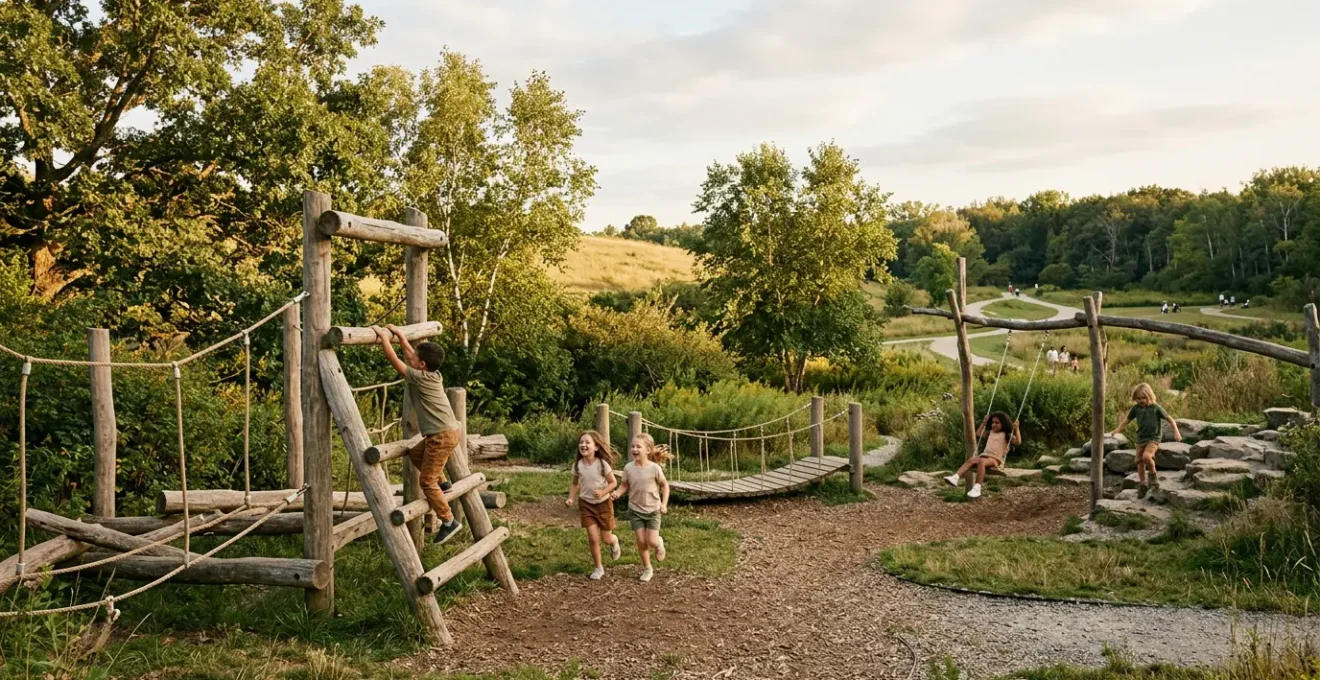
The secret to a great park trip isn’t packing more toys; it’s changing your role from ‘entertainer’ to ‘play facilitator’.
- See the park not as a playground, but as a dynamic ‘playscape’ full of potential for discovery.
- Embrace manageable risk and child-led exploration to build resilience and confidence.
Recommendation: On your next visit, try this one shift: instead of suggesting an activity, simply narrate what you see your child doing. This small change is the first step toward co-creating an adventure.
There’s a universal image of modern parenthood: standing by a slide, phone in hand, while your child repeats the same two activities for forty-five minutes before inevitably declaring, “I’m bored.” The default response is often to pack more for the next trip—more balls, more bubbles, more snacks—turning a simple outing into a logistical operation. We try to direct the fun, suggesting games and refereeing disputes, effectively becoming the on-site entertainment director.
But what if the solution wasn’t to add more, but to see more? What if the key to unlocking a real adventure was to shift our own perspective? This isn’t about ignoring your child; it’s about engaging differently. It’s about stepping back from the role of entertainer and embracing the mindset of a playworker: a facilitator who understands the deep, developmental power of play. It means seeing the park not as a fixed set of equipment, but as a living, breathing ‘playscape’ filled with opportunities for creativity, social learning, and, yes, even a little bit of healthy risk.
This guide will walk you through this transformative mindset. We will explore how to turn simple observations into a game, understand the crucial difference between a hazard and a risk, and learn the language that turns sharing squabbles into social skill-building. By the end, you’ll have the tools to help your child find the adventure that’s already there, hidden just off the beaten path.
To help you navigate these concepts, this article is structured to build your skills as a play facilitator, from observing the environment to planning bigger adventures. Here is a summary of what we will cover.
Summary: A Playworker’s Secrets to Adventurous Park Trips
- Park Bingo: Spotting Dogs, Squirrels, and Benches
- Risky Play: When to Step Back and Let Them Climb?
- Playground Socializing: Navigating Sharing and Turn-Taking
- Off the Path: Finding the “Wild” Bits of the Park
- Park Snacks: Fueling Play Without Plastic Waste
- Car Games: Screen-Free Ways to Survive “Are We There Yet?”
- Dressing Up: Why Pretend Play Is Crucial for Social Skills?
- Weekend Getaways: Planning Stress-Free Family Trips in the UK
Park Bingo: Spotting Dogs, Squirrels, and Benches
The classic game of “I Spy” or a park bingo is often a parent’s first tool against boredom, but it can quickly become a repetitive checklist. The playworker approach transforms this from a simple spotting game into a powerful tool for sharpening observation and fostering mindfulness. Instead of just finding a squirrel, the goal is to notice *how* the squirrel moves, what it’s doing, and what story that might tell. Is it a spy on a mission? A treasure hunter burying its loot?
This isn’t about creating more work for the parent; it’s about giving the child a new lens through which to see their environment. By shifting the focus from objects to sensory experiences and emotional cues, a simple bingo card becomes a prompt for deeper engagement. You’re not just looking for a bench; you’re looking for “something that feels smooth” or “a sound that makes you feel happy.”
This practice of “noticing” is the foundation of imaginative play. It teaches children to find the extraordinary in the ordinary, turning a mundane patch of grass into a stage for drama and discovery. By co-creating these small narratives—”That dog is the queen’s royal guard!”—you move from directing play to facilitating a shared world, a much more rewarding role for both of you.
Risky Play: When to Step Back and Let Them Climb?
One of the most challenging instincts for any parent to manage is the urge to shout “Be careful!” the moment a child climbs higher than usual. Our brains are wired to see danger, but from a playwork perspective, it’s vital to distinguish between a true hazard and a manageable risk. A hazard is something a child cannot see and has no control over (like a broken piece of equipment). A risk is a challenge that a child can see, assess, and choose to take on, like climbing a tree or balancing on a log.
This “risky play” is not about recklessness; it’s one of the most important ways children learn. It’s how they develop physical coordination, problem-solving skills, and emotional resilience. When a child navigates a tricky climb, they are conducting a complex risk-benefit assessment in real-time. They are learning their own limits, building self-confidence, and experiencing the thrill of accomplishment. Our role as facilitators is not to eliminate all risk, but to create a reasonably safe environment where they can test their abilities.
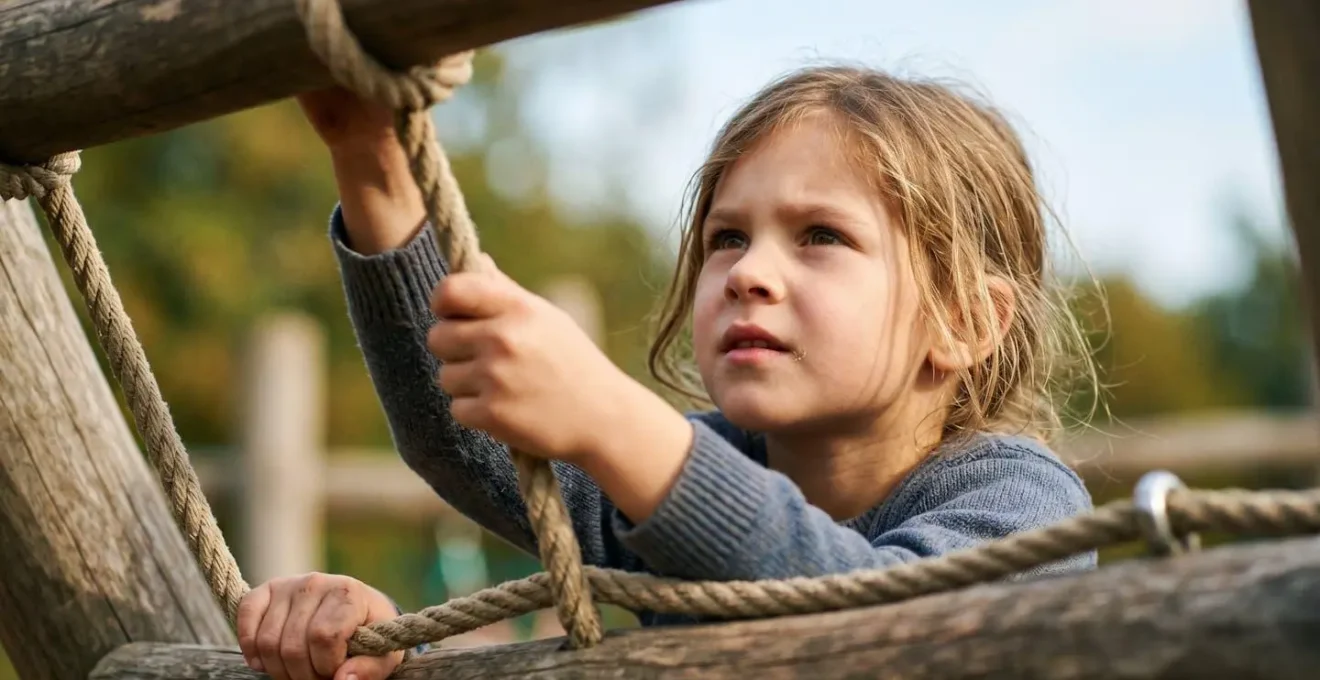
As the image above shows, the look of a child engaged in risky play is one of intense focus, not fear. They are present, calculating, and learning. Of course, supervision is key, but “spotting” from nearby is often more helpful than intervening. It’s also reassuring to know that the perception of danger is often greater than the reality. In fact, research shows children would need to spend about 3 hours per day for 10 years in risky play before they would be likely to experience one injury requiring medical treatment.
Playground Socializing: Navigating Sharing and Turn-Taking
The playground is often a child’s first major foray into complex social negotiation. Conflicts over swings, shovels, and territory are not just problems to be solved; they are rich learning opportunities. The standard parental script—”You need to share!”—is often ineffective because it’s an abstract command. A playworker’s approach is to provide children with more specific tools and language to navigate these situations themselves.
Instead of refereeing, try being a “sports announcer.” Simply narrate the facts without judgment: “I see that you are using the red bucket. I see that Liam is waiting and watching you.” This technique, known as objective observation, helps children become aware of the social dynamics at play without feeling accused. It gives them the space to come up with their own solution.
You can also introduce more nuanced vocabulary. “Sharing” can mean many things, so offer specific scripts for different scenarios: turn-taking (“When you’re finished, she can have a turn”), trading (“Would you like to trade your blue spade for her yellow one?”), or collaborating (“Could you both use the bucket to build a giant castle together?”). This equips children with a toolkit for negotiation that extends far beyond the sandbox, fostering empathy and problem-solving skills.
Case Study: Structured Turn-Taking
A study highlighted on Paths of Learning found that when preschools implemented a structured system for popular equipment, conflicts dropped dramatically. By using a simple 5-minute sand timer for the swings and appointing a child as the “rotation captain” to announce the switch, turn-taking became a predictable and even celebrated part of the playground culture. This demonstrates that clear, simple structures can empower children to manage sharing independently, turning a point of conflict into a cooperative game.
Off the Path: Finding the “Wild” Bits of the Park
Playgrounds are wonderful, but they offer a manufactured, predictable experience. The real magic of a park often lies in its “wild” corners—the patch of overgrown woods, the muddy creek bed, or the cluster of fallen logs. These unstructured environments are what play experts call “playscapes” rich with “loose parts.” Unlike a slide, which has one function, loose parts like sticks, stones, leaves, and pinecones can become anything a child imagines: a wizard’s wand, ingredients for a magic potion, or bricks for a fairy house.
Encouraging exploration off the manicured path does more than just spark creativity. It’s physically beneficial. According to UNICEF, children who spent at least two hours a day outside had 27% more moderate-to-vigorous physical activity. Navigating uneven ground, climbing over logs, and balancing on rocks engages a much wider range of muscle groups and develops proprioception—the body’s awareness of itself in space.
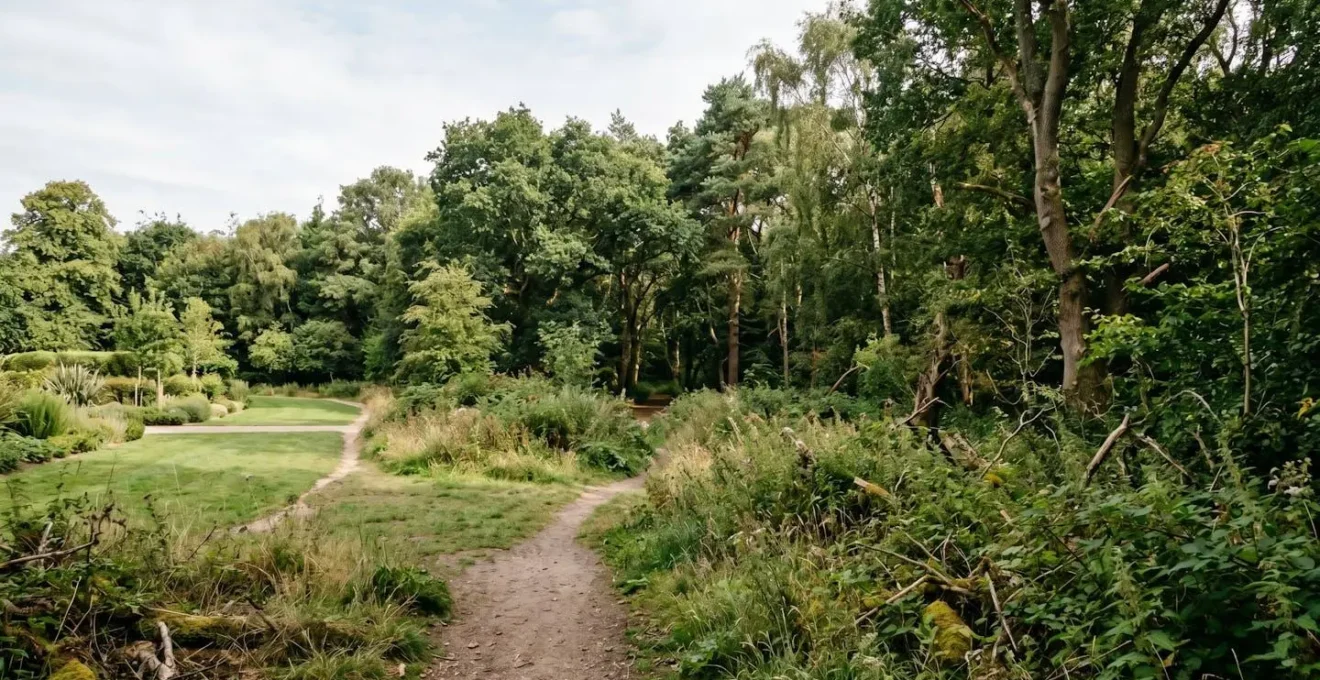
As a facilitator, your role is simply to give permission. Instead of steering them back to the pavement, say, “I wonder what’s behind those trees?” or “Look at all these interesting stones.” You are not leading an expedition but sanctioning their natural curiosity. By showing that you value these wild spaces, you teach them that adventure and learning aren’t confined to designated play areas.
Park Snacks: Fueling Play Without Plastic Waste
Even the most mundane part of a park trip—the snack break—can be woven into the fabric of adventurous play while also teaching important values. The tide of single-use plastic wrappers that accompanies most family outings presents a perfect opportunity to gamify sustainability. The goal isn’t just to refuel, but to do so in a way that respects the playscape you’re enjoying.
This starts with preparation at home. Involving children in packing their own snacks in reusable containers gives them a sense of ownership and responsibility. But the real magic happens at the park, where you can connect the food to the imaginative world you’re co-creating. If you’re pirates, apple slices become “maps to treasure” and handfuls of nuts are “gold nuggets.” This simple act of narrative framing turns a functional break into an extension of the game.
By making sustainability a core part of the adventure, you’re doing more than just reducing waste. You are teaching your child to be a steward of their environment. They learn that their actions have an impact and that being a responsible explorer is just as important as the exploring itself. This integrates a life lesson seamlessly into a moment of fun.
Action Plan: The Zero-Waste Park Snack Mission
- Equip Your Agents: Before the mission (the park trip), pack all fuel (snacks) in reusable gear like metal bento boxes, silicone bags, or fabric wraps to eliminate single-use packaging.
- Use Codenames: Integrate snacks into the play theme. If playing spies, call carrot sticks ‘laser pointers’ and berries ‘secret messages’.
- Set the Objective: Launch the ‘Leave No Trace Agent Mission’. The primary objective is to return to base (home) with zero disposable waste. Success is a clean playscape.
- Practice ‘Intel Gathering’: Play a game of ‘Pretend Foraging’ by creating a fantasy menu from found natural items (without eating them): ‘Mud Pie with a Garnish of Clover’.
- Debrief the Agent: Involve your child in the pre-mission prep, letting them choose and pack their own waste-free snacks to build ownership of sustainable habits.
Car Games: Screen-Free Ways to Survive “Are We There Yet?”
The adventure doesn’t have to begin when you arrive at the park gates. The journey itself, whether it’s a five-minute drive or a thirty-minute trek, is a golden opportunity to prime the imagination and build anticipation. Instead of using screens to pacify, you can use this captive time to begin the process of co-creating the day’s narrative. This transforms the dreaded “Are we there yet?” into an integral part of the experience.
Frame the journey as the start of a mission. You are not just ‘driving to the park’; you are ‘agents en route to Sector P’. This simple shift in language invites the child into a story. From there, you can build layers of lore together. What is the secret history of this park? Are the tall trees ancient guardians? Is the slide a portal to another dimension? There are no wrong answers, and the act of creating the story together is the whole point.
This approach also helps children with transitions, which can often be a point of friction. By building anticipation, they arrive at the park already immersed in a world of play, ready to explore. Here are a few screen-free ways to make the journey part of the adventure:
- Adventure Briefing: Formally announce the mission. “Agents, our objective is to make contact with the squirrel informants and map the uncharted territory beyond the swings.”
- Destination I-Spy: Instead of colors, spy things related to the park. “I spy with my little eye, something you can climb on.”
- Sound Scavenger Hunt: Prime their observation skills by listening for specific sounds on the way—a bird, a siren, a lorry.
- Map Tracking: For longer journeys, a simple hand-drawn map with landmarks to check off gives a visual sense of progress and builds excitement.
Dressing Up: Why Pretend Play Is Crucial for Social Skills?
Pretend play is the engine of social and emotional development. When a child takes on a role—a doctor, a knight, a talking animal—they are practicing empathy, negotiation, and perspective-taking. They have to imagine what it’s like to be someone else, communicate their character’s intentions, and collaborate with others to maintain the shared story. This is a highly sophisticated cognitive and social workout.
While a box of costumes at home is great, you can elevate this in the park by encouraging what some researchers call “Environmental Costume Design.” This is where the playscape itself becomes the costume department. A simple cape or hat brought from home can be the starting point, but the rest of the character’s attire must be assembled from ‘loose parts’ found in the park. A crown of leaves, a belt of ivy (non-poisonous, of course), a ‘shield’ made of bark—these items connect the imaginative play directly to the natural environment.

This approach deepens the play in two ways. First, it requires more creativity and problem-solving than simply pulling a pre-made costume out of a bag. Second, it teaches children to see the park as a collaborative partner in their play, not just a backdrop. The environment provides the materials and inspiration, fostering a deeper connection to nature.
Case Study: Quality of Pretend Play
Research on social pretend play shows that the greatest benefits come from high-quality interactions involving role-taking and symbolic transformation. A study in the *Educational Psychology Review* found that when children engaged in “Environmental Costume Design”—using found natural items to create their outfits—their play was more complex. They spent more time planning their roles and negotiating how natural objects could symbolically represent costume pieces, thereby integrating environmental interaction directly into their social development.
Key Takeaways
- Your role is a facilitator, not an entertainer; the goal is to empower child-led play.
- View the park as a ‘playscape’ rich with ‘loose parts’ and opportunities beyond the equipment.
- Manageable risk is essential for building resilience, confidence, and physical literacy.
Weekend Getaways: Planning Stress-Free Family Trips in the UK
The playworker mindset isn’t just for a quick trip to the local swings; it can transform how you approach a whole day out or even a weekend getaway. You don’t need to travel far or spend a fortune to create a memorable family adventure. By treating your local area with the curiosity of a tourist, you can turn a collection of nearby parks and green spaces into a “mini-vacation.” This is especially easy in the UK, with its dense network of public footpaths, local nature reserves, and historic gardens.
Instead of one destination, plan a “Park-Hopping Tour.” Start the morning at a local woods managed by the Forestry Commission for a nature walk, move to a town park with a great playground for a midday picnic and play, and end the day at a scenic spot with a view for a “sunset debriefing.” Each location has a different purpose, creating a sense of a journey and varied experience. You can even research the history of a National Trust garden or a local park beforehand, turning the visit into a treasure hunt for historical markers or unique botanical specimens.
The key is to establish rituals that elevate these days from routine outings to special events. This could be a specific ‘adventure breakfast,’ a dedicated packing routine for your ‘expedition gear,’ or an end-of-day ritual where everyone shares their ‘best discovery.’ By framing these local trips as getaways, you build a family culture of exploration and make memories, proving that adventure is a state of mind, not a destination. Ultimately, as multiple studies agree that kids who play outside are smarter, happier, more attentive, and less anxious, making these small trips a priority is one of the best investments in family well-being.
Now that you have this new toolkit, the next step is to put it into practice. Start small. On your very next park visit, commit to trying just one of these techniques and observe the difference it makes.