
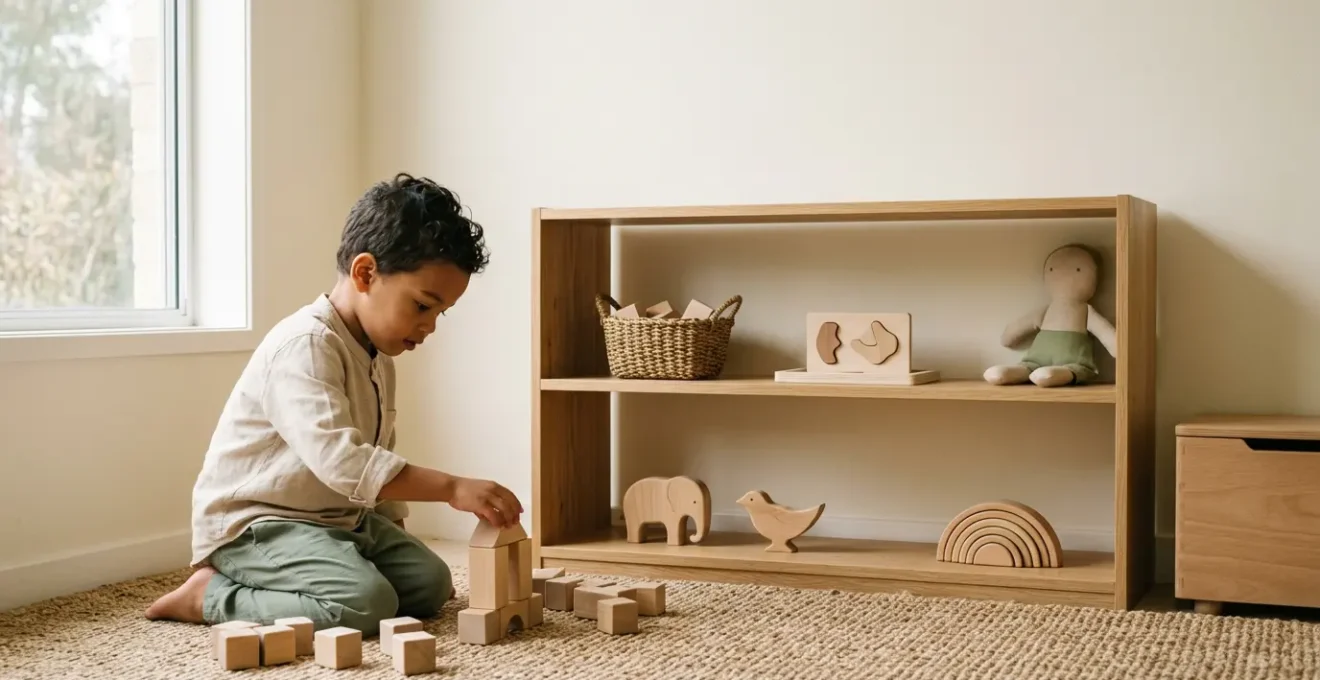
Contrary to popular belief, a room full of toys doesn’t create more play; it creates more overwhelm, and the traditional toy chest is the primary culprit.
- A cluttered play environment dramatically increases a child’s cognitive load, making it nearly impossible for them to focus and engage in deep, meaningful play.
- Strategic organization—using visible, accessible, and limited choices—is not about tidiness for adults but is a crucial tool for fostering a child’s independence, creativity, and executive function skills.
Recommendation: Ditch the “dump and dig” method of the toy chest in favor of open shelving and curated, visible containers to transform your child’s play environment from one of chaos to one of calm, focused discovery.
It’s a scene familiar to almost every parent: you navigate a landscape of scattered toys, only to hear your child declare, “I’m bored, I have nothing to play with!” This paradox of a room full of toys yet an under-stimulated child is baffling. The common response is to buy more organizers or embark on a massive decluttering spree. But as a play researcher, I can tell you the problem often isn’t the number of toys, but their accessibility and presentation. The villain in this story is often the very symbol of childhood storage: the toy chest.
The “dump and hide” method of a deep toy box creates a black hole for play. It overwhelms a child’s developing brain with a chaotic jumble of stimuli, burying creative potential under a pile of plastic. The truth is, effective toy organization is a powerful cognitive tool. It’s not about achieving a perfectly tidy room for the parent’s peace of mind; it’s about designing an environment that reduces a child’s cognitive load, promotes deep play, and systematically builds their sense of independence and order.
This guide moves beyond simple tidying tips. We will explore the developmental science behind a well-organized playroom. By understanding *why* certain methods work, you can transform your child’s space from a source of stress into a landscape of focused, imaginative engagement. We’ll dismantle the logic of the toy chest piece by piece and build a new framework for storage that truly serves your child’s play.
Summary: The Death of the Toy Chest: Why Dumping Toys is a Bad Idea
- Micro-Sorting: Why Lego Needs Its Own Bin?
- Clear Bins vs Baskets: The Visibility Factor
- Deep Box Danger: Why Shallow Trays Are Better for Play
- Wall Storage: Getting Toys Off the Floor
- Picture Labels: Essential for Pre-Readers to Tidy Up
- Open Shelving vs Toy Chests: Why Dumping Toys Hides Them from Play?
- Toy Rotation: How Fewer Toys Lead to Deeper Play?
- Playroom Design and Storage Solutions: Creating Order from Chaos
Micro-Sorting: Why Lego Needs Its Own Bin?
Have you ever tried to find a specific spice in a drawer where every jar is jumbled together? It’s frustrating and time-consuming. For a young child, a bin filled with LEGOs, dolls, puzzle pieces, and toy cars is that chaotic spice drawer, magnified. Micro-sorting—the practice of giving each category of toy its own dedicated home—is not about obsessive neatness. It’s a fundamental strategy for reducing a child’s cognitive load and enabling focused play.
When a child decides they want to build a tower, they have a clear goal. If the blocks are mixed with other items, they must first engage in a complex sorting task, sifting through irrelevant objects. This “work before the work” can exhaust their limited attention span before the creative play even begins. This is especially true for younger children. Research indicates that children under age 3 lack fully developed impulse control, making them easily distracted by the visual noise of a mixed-up bin. A shiny toy car can derail the entire block-building project.
By giving LEGOs their own bin, dolls their own basket, and art supplies their own tray, you create an environment of purpose. The child can easily retrieve the tools they need for the play schema they wish to explore. This simple act of separation removes a significant barrier to entry, making it more likely that they will initiate play independently and, more importantly, sustain that play for longer periods. Sorting isn’t just for cleanup; it’s the setup for success.
Clear Bins vs Baskets: The Visibility Factor
When it comes to toy storage, what is aesthetically pleasing to an adult is not always what is functional for a child. Beautiful woven or canvas baskets can perfectly match a room’s decor, but they often function just like a miniature toy chest: once a toy is inside, it visually ceases to exist. For children, especially toddlers and preschoolers, the principle of “out of sight, out of mind” is a powerful reality. If they can’t see a toy, they are far less likely to choose to play with it.
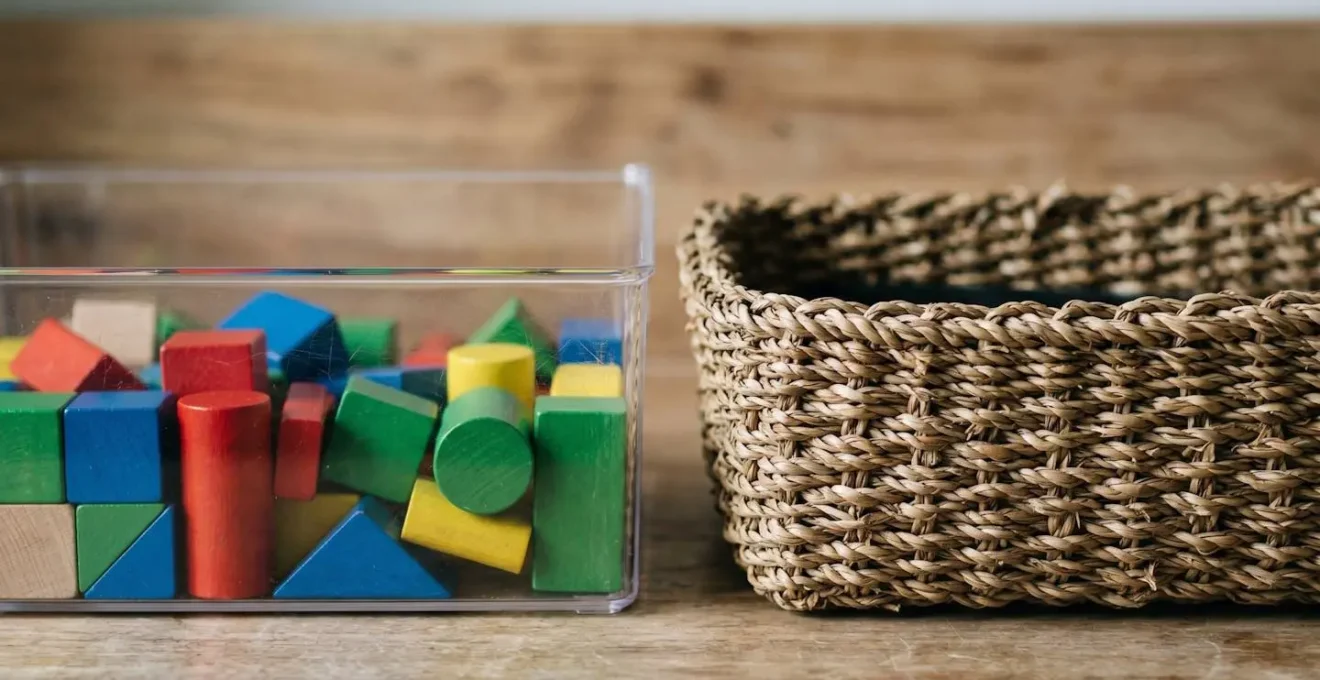
This is where the humble clear bin proves its superiority. As this image illustrates, the contrast is stark. A transparent container acts as a constant, gentle invitation to play. The child can scan their options at a glance, and the colors and shapes of the toys inside can spark an idea for an activity without them having to dump the contents. This visual accessibility empowers the child to make a conscious choice, fostering independence and reducing the familiar “I don’t know what to play with” complaint.
Think of it as a well-organized pantry versus a pile of unmarked grocery bags. In the pantry, you can see you have pasta and decide to make spaghetti. With the bags, you have to rummage through each one just to know what your options are. The clear bin is the organized pantry of the playroom. It turns the environment into a “prepared” one that respects the child’s developmental need to see their choices clearly, making the act of selecting a toy effortless and intentional.
Deep Box Danger: Why Shallow Trays Are Better for Play
The traditional toy chest is the ultimate “deep box.” It encourages the layering of toys, creating a vertical abyss where items at the bottom are lost and forgotten. A child’s play is dominated by the top 10% of toys, while the rest are effectively in deep storage. This leads to a frustrating cycle of “toy excavation,” where everything is dumped onto the floor just to find one specific item. This is not play; it’s a chaotic and often overwhelming search that discourages focused engagement.
Shallow trays, low-profile bins, or open-front containers are the antidote to this deep box danger. By presenting toys in a single, visible layer, you eliminate the need to dig. Every item is accessible. This simple change has a profound impact on the quality of play. It allows a child to see their full, albeit limited, range of options and make a deliberate choice. This concept is backed by significant research.
Case Study: The University of Toledo’s “Fewer Toys” Experiment
In a landmark study, researchers at the University of Toledo observed toddlers in two different environments: one with 16 toys and one with only 4. The results were telling. In the 4-toy environment, children engaged with each item for significantly longer periods. Their play was more sophisticated and imaginative; they explored the toys in more diverse ways and developed more complex play scenarios. A key finding published in the journal Infant Behavior and Development found that children played twice as long with each toy in the less cluttered environment. The children with 16 toys were more distracted, flitting from one item to the next in a pattern of superficial engagement.
This study perfectly illustrates why shallow, curated presentation is superior. A shallow tray naturally limits the number of items on display, preventing the sensory overload that leads to toy-hopping. It encourages a child to go deeper with a single toy, fostering the concentration and creativity that are the hallmarks of deep play.
Wall Storage: Getting Toys Off the Floor
A floor covered in toys is a floor that cannot be used for play. It becomes a minefield to navigate rather than an open canvas for building, creating, and moving. The solution is to think vertically. Using low, open wall shelving is one of the most transformative changes you can make to a playroom. It reclaims the floor as usable play space and elevates toys from clutter to carefully presented “work” for the child.
This approach is a cornerstone of the Montessori philosophy, which emphasizes creating a “prepared environment” that is orderly, accessible, and beautiful. The goal of wall storage is not just to store things, but to display them in a way that is respectful and enticing. A low, open shelf puts toys at the child’s eye level, communicating that these items are for them, that they are valued, and that they are free to choose them independently. This simple act of raising toys off the floor fosters a sense of ownership and competence in a child.
Setting up such a system doesn’t have to be complicated or expensive. The key is accessibility and order. By following a few simple guidelines, you can create a shelf that invites engagement rather than chaos. The focus should be on creating a calm, uncluttered display where each toy has its own defined space.
Action Plan: Setting Up a Montessori-Style Shelf
- Set the Right Height: Position shelves at a height of one to two feet, ensuring the child can independently see and reach every single item without needing to climb or ask for help.
- Limit the Options: Display only 6-8 toys or activities at a time. This curated selection prevents the cognitive overload that leads to indecision and superficial play.
- Contain Each Activity: Use trays or small, open baskets to group all the pieces of a single activity together. This teaches the child that the puzzle and its pieces are one unit.
- Invite Engagement: Leave items slightly “undone” to visually call out for interaction—a puzzle with one piece out, a ring stacker with the rings beside it.
- Prioritize Safety: Anchor all shelving units securely to the wall to eliminate any risk of tipping as the child interacts with them.
- Create Visual Space: Avoid crowding. Leave intentional empty space between each tray or toy. This visual separation helps the child’s brain process their choices more easily.
Picture Labels: Essential for Pre-Readers to Tidy Up
The request “clean up your toys” can be overwhelming for a young child who can’t yet read. To them, a pile of toys is just a pile, and a row of identical bins offers no clue as to what belongs where. This is where picture labels become a revolutionary tool. By pairing a simple, clear image of the toy with its designated bin or shelf space, you transform tidying from a frustrating chore into a simple and empowering matching game.
This visual system is about much more than organization; it’s a powerful way to build a child’s executive function skills. When a child picks up a toy car, finds the bin with the car picture, and places it inside, they are practicing categorization, task initiation, and follow-through. They are learning to create order in their environment, a skill that builds confidence and a sense of competence. Picture labels provide the scaffolding they need to succeed at this task independently.
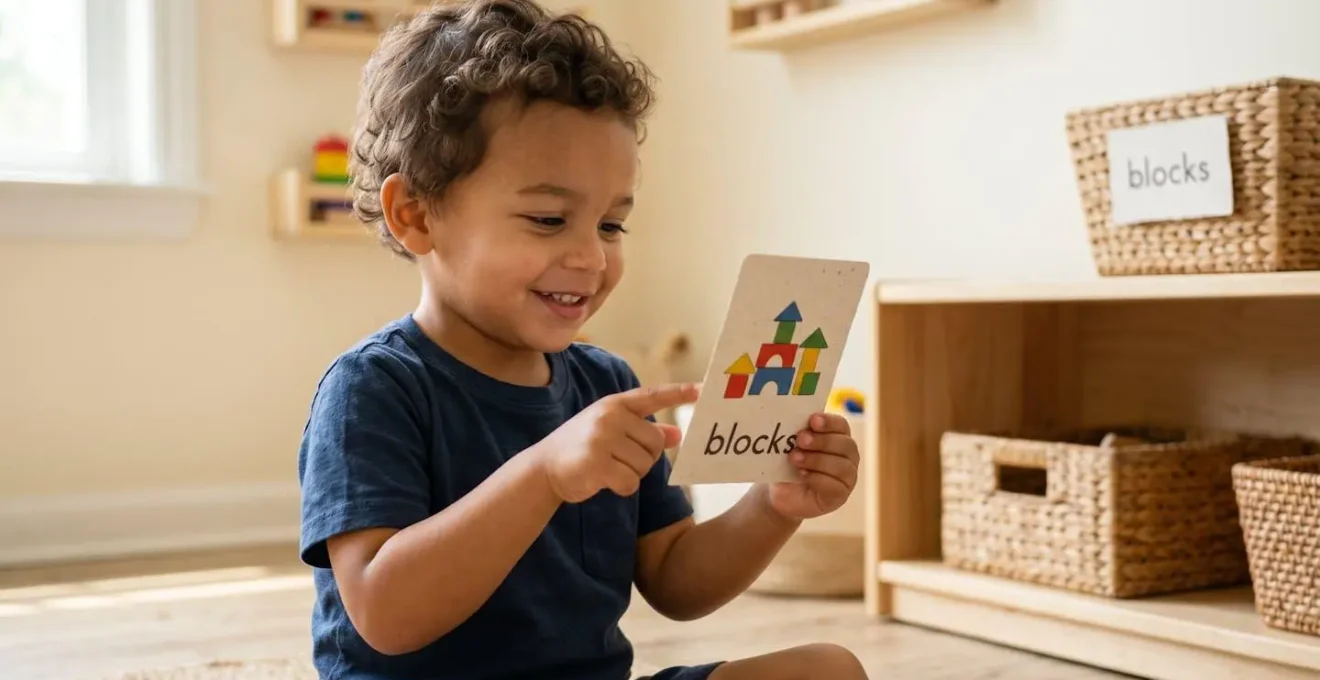
As a play researcher, I see this as a critical step in a child’s development. It provides predictability and structure, which helps children feel secure. As experts in early childhood education point out, this sense of order is fundamental to learning. In a guide for educators, Environments, Inc. notes the developmental benefits:
Classroom labeling can also encourage the development of responsibility and independence. These visual ‘clues’ help children become more secure as they make choices and learn to manage their classroom world.
– Environments, Inc. Early Childhood Education, Classroom Labeling Staff Training Guide
For pre-readers, a picture is the most effective “clue.” You can even add the written word below the picture to create a print-rich environment that gently introduces word-object association, laying the groundwork for literacy.
Open Shelving vs Toy Chests: Why Dumping Toys Hides Them from Play?
The contrast between a toy chest and a set of open shelves gets to the very heart of two opposing philosophies of play. The toy chest operates on a “dump and hide” model. Its primary function is to quickly get clutter out of the adult’s sight. The message it sends to a child, however, is that toys are a jumble of disposable items to be shoved away without care. It actively hides play potential under layers of chaos.
This problem is magnified in societies with high consumption. Consider that while having just 3.1% of the world’s children, the US purchases 40% of the world’s toys. This sheer volume makes the toy chest model a recipe for overwhelming clutter and disengagement. Parents often express this frustration perfectly:
Parents report tidying the same pile every night, yet kids insist they have ‘nothing to do.’ Children hop from toy to toy in minutes, rarely finishing tasks. This disconnect signals sensory overload rather than insufficient toys.
– Parent Testimony
Open shelving, on the other hand, operates on a “select and respect” model. By displaying a limited number of toys in an orderly fashion, it communicates that each item is a valuable tool for learning and discovery. It respects the toy, and more importantly, it respects the child’s ability to make an independent and thoughtful choice. Every toy is visible, accessible, and has a designated place, which provides the environmental stability children need to thrive. The choice is clear, the cognitive load is low, and the invitation to deep play is always open.
Toy Rotation: How Fewer Toys Lead to Deeper Play?
The concept of toy rotation directly addresses the question, “How many toys should a child have available?” The answer is, “Fewer than you think.” Toy rotation is the practice of having only a small, curated selection of toys available at any one time, while the rest are stored away out of sight. Every week or two, some toys are swapped out, making old toys feel new again and keeping the play environment fresh and engaging.
This strategy works because it dramatically reduces sensory overload. When a child is faced with dozens of options, they often can’t decide where to begin. This leads to flitting between toys, touching one for a moment before being distracted by another, without ever settling into the focused, imaginative state of deep play. By limiting the choices, you give your child’s brain the space it needs to fully engage with the materials at hand. They are encouraged to explore a single toy’s full potential—turning blocks into a castle, then a car, then a telephone—rather than just superficially touching it and moving on.
Case Study: A Montessori Classroom in Practice
An educator in a Montessori toddler environment implemented a strict weekly toy rotation to combat distraction and foster concentration. Unused toys were stored out of sight in simple boxes and crates. Each Monday, a few “new” items from storage would replace some of the items on the open shelves. The result was a dramatic improvement in the children’s ability to focus. They became more deeply engaged with the materials, their play was more creative, and the classroom felt calmer and more purposeful. For the adult, the system simplified organization, creating “a place for everything and everything in its place” and reducing the daily cleanup burden.
Toy rotation isn’t about depriving a child; it’s about providing focus. It honors a toy by giving it a chance to be fully seen and explored. It respects the child by providing a calm, manageable environment where they can truly master the tools of their “work,” which is play.
Key Takeaways
- Visibility is king: If a child can’t see a toy, they won’t play with it. Clear bins and open shelves are cognitively superior to opaque baskets and deep chests.
- Fewer choices lead to deeper play: Limiting the number of available toys reduces cognitive load and encourages a child to explore items with more creativity and focus.
- Organization is a skill, not a chore: Using systems like picture labels and accessible shelves empowers children to tidy up independently, building crucial executive function skills.
Playroom Design and Storage Solutions: Creating Order from Chaos
Rethinking toy storage is not about finding the perfect bin or label maker. It’s about a fundamental shift in perspective: designing a playroom as a learning landscape rather than a warehouse for clutter. The ultimate goal is to create an environment that supports your child’s development by being calm, orderly, and empowering. The principles we’ve discussed—micro-sorting, visibility, shallow storage, and rotation—all work together to achieve this.
The core conflict lies between the adult desire for quick tidiness (the toy chest) and the child’s need for accessible order (Montessori shelving). While one seems faster in the short term, the other builds long-term skills and fosters higher-quality play. Understanding the developmental impact of each method makes the choice clear.
This table summarizes the profound differences in the message each storage system sends to a child.
| Feature | Traditional Toy Chest | Montessori Open Shelving |
|---|---|---|
| Visibility | Toys hidden at bottom; top items dominate | All toys visible and accessible at eye level |
| Child Independence | Requires adult help to find items | Child can independently select and return toys |
| Organization Impact | Jumbled together; difficult to find specific items | Each toy has designated space with visual separation |
| Cognitive Load | High; dozens of stimuli processed at once | Low; limited choices (6-8 items) prevent overwhelm |
| Play Quality | Superficial; constant toy-hopping | Deep, focused engagement with each item |
| Cleanup Process | Fast dump; no skill development | Intentional placement; builds orderliness and responsibility |
| Developmental Message | Toys are disposable clutter | Toys are valued tools for learning |
As this analysis of Montessori principles shows, creating this environment is an ongoing process that adapts as your child grows. A toddler’s setup with large, simple categories will evolve into a preschooler’s space with picture-word labels, and later into an elementary student’s system with hobby zones and written labels. The key is to involve the child in the process, giving them ownership over their space and the tools to maintain it. By killing the toy chest, you are not just cleaning a room; you are cultivating an environment where focus, creativity, and independence can flourish.
Begin today by observing your child’s play and applying one of these principles. Swap one basket for a clear bin, set up one low shelf, or create three simple picture labels. Start small, and watch as you transform your play space from one of chaos to one that truly invites focus and creativity.