
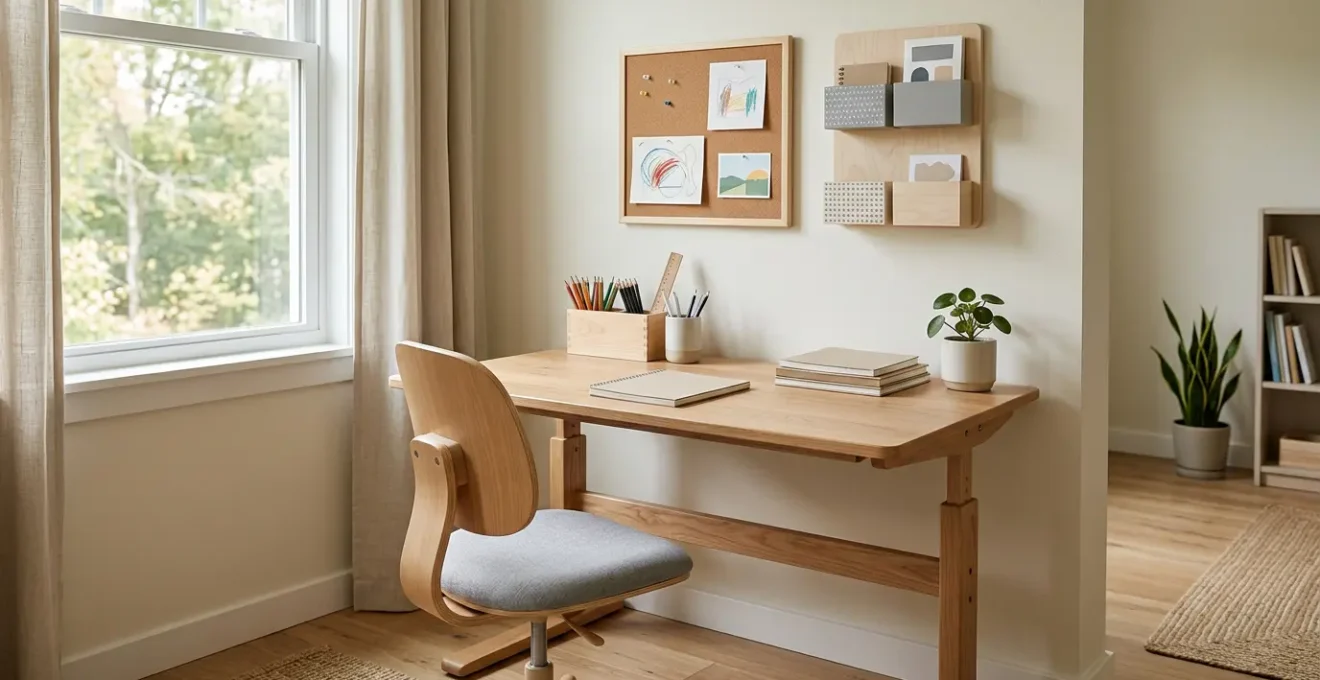
Contrary to popular belief, a ‘fun’ and colorful study corner might be doing more harm than good for your child’s focus.
- True concentration comes from reducing ‘visual noise’ and cognitive load, not from adding more stimulation.
- Proper ergonomics and lighting are not minor details; they are foundational for preventing the physical and mental fatigue that leads to distraction.
Recommendation: Focus on creating a calm, supportive, and child-owned space to unlock your child’s natural ability to concentrate.
The scene is all too familiar: the history textbook is open on the table, but your child’s eyes are glued to the television in the living room. You’ve tried everything—reminders, scheduled homework time, even rewards—but the battle for their attention feels like a losing one. In an attempt to solve this, many parents create a dedicated ‘homework spot’, often decorating it with bright colors and fun posters, believing this will make learning more appealing. We are told to keep it organized and make it an inviting space.
But what if the very elements we think are helpful are actually part of the problem? The secret to a successful study corner isn’t about decoration; it’s about brain science. It’s about systematically removing the invisible friction that drains a child’s limited supply of focus. The constant visual stimulation of a cluttered or overly decorated space creates what neuroscientists call visual noise, forcing a child’s brain to work overtime just to filter out distractions before they’ve even started on their first math problem. This creates a high cognitive load, leaving little mental energy for actual learning.
This guide moves beyond generic advice to explore the evidence-based principles of creating a cognitively supportive environment. We will deconstruct the essential components of a high-focus study area, from the science of lighting and ergonomics to the psychology of ownership and organization. By understanding and implementing these strategies, you can build a space that doesn’t just contain your child’s homework, but actively helps them think, learn, and succeed.
Summary: A Blueprint for a High-Focus Study Nook
- Task Lighting: Why Good Light Reduces Eye Strain and Fatigue?
- Ergonomic Chairs for Kids: Protecting Posture While They Learn
- The Clean Desk: Reducing Visual Noise for Better Concentration
- The Homework Caddy: Keeping Pencils and Rulers Within Reach
- Ownership: Why Letting Them Choose the Decor Boosts Motivation?
- Online Tutoring: Is Zoom Effective for Primary School Kids?
- Grow-with-Me Desks: Are They Worth the Investment?
- Child Safety and Ergonomic Furniture: Investing in Health and Peace of Mind
Task Lighting: Why Good Light Reduces Eye Strain and Fatigue?
Before a child even feels distracted, their body may already be fighting a silent battle against fatigue. One of the biggest culprits is poor lighting. When the eyes have to strain to read text or see the board, the brain expends precious energy compensating. This leads to headaches, fatigue, and a diminished ability to concentrate. In the age of screens, this issue is more critical than ever, with research showing that 50-60% of children experience digital eye strain during online learning.
The solution is not just a brighter room, but the right kind of light in the right place, known as task lighting. This is a focused beam of light directed onto the work area—the textbook, the notebook, or the keyboard. It provides a high-contrast environment that makes reading effortless, reducing the subconscious effort the brain makes to decipher words. While ambient room light is important, a dedicated, adjustable desk lamp is non-negotiable for protecting your child’s vision and preserving their mental energy for learning.
To maximize the benefits, position the desk parallel to windows to avoid glare on screens or shadows on paper. This simple change leverages natural light without causing new problems. Furthermore, encourage your child to follow the 20-20-20 rule: every 20 minutes, they should look at something 20 feet away for 20 seconds. This simple habit, combined with proper task lighting, acts as a reset button for their eyes, preventing the buildup of fatigue that so often masquerades as a lack of focus.
By managing light, you’re not just illuminating a desk; you’re conserving your child’s most valuable resource: their ability to pay attention.
Ergonomic Chairs for Kids: Protecting Posture While They Learn
A child wiggling in their chair, slumping over the desk, or constantly shifting position isn’t always a sign of boredom. Often, it’s their body’s cry for help against discomfort. Using adult-sized furniture or a chair that’s simply “good enough” forces a child’s body into unnatural positions, causing muscle strain and poor circulation. This physical stress is a powerful internal distraction. In fact, studies show that over 83% of school children sit in improperly fitted furniture, creating long-term risks for musculoskeletal issues.
Investing in an ergonomic chair designed for a child’s body is a direct investment in their ability to focus. The goal is to create a setup that follows the “90-90-90 rule” of posture: their feet are flat on the floor (or a footrest) with their knees bent at a 90-degree angle, their hips are at a 90-degree angle, and their elbows rest comfortably on the desk at a 90-degree angle. This alignment minimizes physical strain and promotes healthy blood flow, allowing the brain to dedicate its resources to learning rather than managing bodily discomfort.
This illustration demonstrates the ideal seating posture, where the body’s joints are aligned to reduce stress and allow for longer periods of comfortable focus.

As you can see, an adjustable chair is key. It allows you to fine-tune the height so your child’s feet can be properly supported and their arms can rest at the correct level relative to the desk. This isn’t a luxury; it’s an essential guardrail that protects their developing body and removes a significant, often invisible, barrier to concentration. The wiggling stops when the body is properly supported.
Ultimately, a supportive chair creates a stable and comfortable base, freeing up your child’s mind to engage fully with their work.
The Clean Desk: Reducing Visual Noise for Better Concentration
Imagine trying to have a quiet conversation in the middle of a loud concert. That’s what a cluttered desk does to your child’s brain. Every object in their field of vision—stray toys, old drawings, stacks of paper, a dozen colored pens—is a piece of information competing for mental resources. This “visual noise” overloads the brain’s processing capacity, a phenomenon explained by neuroscience. As researchers from the Princeton University Neuroscience Institute found, visual clutter competes for neural representation in our visual cortex, severely limiting our ability to process information effectively.
This directly impacts what is known as cognitive load—the amount of mental effort held in our working memory. A child’s working memory is limited. When it’s filled with processing the visual clutter of a messy desk, there’s very little space left for understanding a history chapter or solving a math equation. Research on learning environments has shown this effect in stark terms: a child in a cluttered space might only manage 20-30 minutes of real focus, whereas the same child in a clean, organized environment can often sustain concentration for 45-60 minutes. Their brainpower isn’t being “leaked” just to manage their surroundings.
The principle of a clean desk is not about sterile minimalism or enforcing rigid tidiness. It is a strategic act of clearing the runway for your child’s thoughts. The rule is simple: the only things on the desk should be the materials required for the immediate task. A history book and a notebook for history homework. A calculator and graph paper for math. Everything else should have a designated home, out of sight and out of mind.
By curating the visual environment, you are actively managing your child’s cognitive load, freeing up their mind to do what it’s meant to do: think, learn, and create.
The Homework Caddy: Keeping Pencils and Rulers Within Reach
A clean desk is essential, but it can’t function without a robust organization system supporting it. The number one enemy of focus is friction. A 10-minute hunt for a protractor or a frantic search for a sharpened pencil is enough to completely derail a study session. The solution is to create a “command center” for all necessary supplies—a dedicated, portable homework caddy or a well-organized set of drawers.
The goal is to ensure that every tool your child might need is instantly accessible but not visually distracting. This isn’t just about tidiness; it’s about task-based organization. By grouping items by function (e.g., a “writing kit” with pens and pencils, a “math kit” with a calculator and compass), you reduce the mental effort needed to find things. This system empowers your child to be self-sufficient and keeps them in the “flow” of their work, rather than having their concentration broken by a logistical search.
Establishing this system is a powerful way to teach organizational skills while simultaneously boosting focus. It transforms the act of “cleaning up” into a proactive “setting up for success.”
Your Action Plan: The Task-Based Supply System
- Categorize and Conquer: Organize books, workbooks, flashcards, and tools by subject or category to make them easily accessible.
- Contain and Label: Use magazine holders for workbooks, wall organizers for papers, or clearly labeled bins for different supply types (e.g., “Art Supplies,” “Math Tools”).
- Create Task Kits: Assemble task-specific kits in small pouches or boxes: a writing kit, a math kit with a protractor and calculator, and a creative kit with colored pencils. Only the relevant kit comes out on the desk.
- Rotate and Refresh: To prevent visual overload, rotate materials every week or two. Store less frequently used items away, keeping the immediate workspace fresh and uncluttered.
- Implement a Restock Ritual: Establish a quick Sunday night habit where your child checks their inventory (pencils, paper, staples) and reports what’s needed for the week ahead, preventing mid-week emergencies.
By making supplies easy to find and easy to put away, you remove one of the most common and disruptive sources of homework-time friction.
Ownership: Why Letting Them Choose the Decor Boosts Motivation?
What if the most powerful tool for boosting motivation in the study corner isn’t something you can buy? What if it’s the simple act of letting go of control? As a parent, it’s tempting to design the “perfect” space based on your own aesthetic. However, when a child has a say in their environment—choosing the color of their pencil holder, picking a motivational poster, or selecting a desk lamp—a profound psychological shift occurs. The space transforms from a place they are *sent* to work into *their* personal headquarters.
This principle is known in psychology as autonomy support, and it is a cornerstone of intrinsic motivation. It’s the idea that feeling a sense of control and competence in one’s environment fosters a desire to engage. The science backs this up unequivocally. A landmark meta-analysis of 144 studies covering over 79,000 students demonstrated large positive effects of autonomy support on student motivation. When children are given meaningful, self-relevant choices, they feel more competent and connected to the task at hand.
This doesn’t mean letting your child paint the walls black or fill the desk with action figures. It’s about offering guided choices. “Would you prefer this blue bin or this green one for your papers?” “Let’s pick out one poster for the wall together. Which of these three do you find most inspiring?” By providing a curated set of options, you maintain the functional integrity of the space while still giving them a powerful sense of ownership. This buy-in is invaluable; a child is far more likely to respect and maintain a space they feel they helped create.
By empowering them with choice, you’re not just decorating a corner; you’re building their confidence and cultivating the internal drive needed to tackle challenges.
Online Tutoring: Is Zoom Effective for Primary School Kids?
The principles of a high-focus study corner are even more critical when the classroom is a computer screen. Online tutoring sessions on platforms like Zoom can be incredibly effective, but only if the digital and physical environment is set up to support concentration. All the previous rules about cognitive load and visual noise apply, but now with an added layer of digital complexity. A sense of control and ownership, so crucial for motivation, is just as important in the digital realm.
For a primary school child, the line between the computer as an entertainment device and a learning tool can be blurry. The key is to create clear boundaries and a dedicated setup for “learning mode.” This means ensuring the physical space around the computer is optimized. A front-facing light source (like a window or lamp placed behind the screen) is essential to keep their face well-lit and prevent them from appearing as a silhouette, which helps the tutor connect with them. A neutral, uncluttered background is equally important to minimize distractions for both your child and everyone else on the call.
Technically, the setup should be frictionless. Ensure the camera is at eye level to promote good posture and create a more natural sense of conversation. Before a session begins, make it a ritual to close all other browser tabs and turn off notifications. For some children, using browser extensions that temporarily block distracting websites during tutoring time can be a lifesaver. By minimizing both physical and digital distractions, you allow the Zoom session to be a clear, direct channel for learning, not a frustrating battle against technology.
These small adjustments can make the difference between a session that feels like a video game and one that provides a powerful, focused educational experience.
Grow-with-Me Desks: Are They Worth the Investment?
When setting up a study corner, parents often face a financial crossroads: do you buy a small, inexpensive desk that fits your child now, or invest in a more expensive “grow-with-me” adjustable model? It’s a classic case of short-term cost versus long-term value. While the initial price tag of an adjustable desk can be daunting, a closer look at the ergonomics and economics often reveals it to be the smarter investment.
A fixed-height desk is a snapshot in time. A child’s body is in a constant state of growth. A desk that is the perfect height for a 7-year-old will be far too low for a 10-year-old, forcing them to slump and compromising the 90-90-90 ergonomic rule we discussed earlier. This means that over the course of a child’s primary and secondary education, you will likely need to purchase two, or even three, different desks to maintain proper ergonomic support. The cumulative cost, not to mention the waste, can easily exceed the price of a single, high-quality adjustable desk.
The following table breaks down the long-term cost and benefit analysis of choosing an adjustable desk versus multiple fixed-height desks.
| Option | Initial Cost Range | Longevity | Key Features | Long-term Value |
|---|---|---|---|---|
| Single Adjustable Desk | Higher upfront investment | Ages 4-18 (14+ years) | Height adjustable, sometimes tilting surface, grows with child | One-time purchase, better resale value, sustainable choice |
| Multiple Fixed Desks | Lower individual cost | 2-3 replacements needed | Fixed height, requires replacement as child grows | Cumulative cost often exceeds adjustable option, disposal required |
| DIY Alternative | Moderate cost | Varies by quality | Standard sturdy desk + highly adjustable chair + footrest | Good compromise if budget-constrained, less optimal ergonomics |
Ultimately, a grow-with-me desk isn’t just a piece of furniture; it’s a piece of infrastructure for your child’s entire academic career, ensuring they are always supported, comfortable, and positioned for focus.
Key Takeaways
- Focus is a finite resource. The primary goal of a study corner is to reduce cognitive load by eliminating visual noise and physical discomfort.
- Ergonomics and lighting are not luxuries; they are fundamental health investments that directly impact a child’s ability to concentrate without fatigue.
- A sense of ownership is a powerful motivator. Involving your child in guided choices about their space fosters responsibility and intrinsic desire to learn.
Child Safety and Ergonomic Furniture: Investing in Health and Peace of Mind
Creating the perfect study corner goes beyond focus and motivation; it culminates in creating a space that is fundamentally safe. As a parent, your peace of mind is paramount, and ensuring the study environment poses no hidden hazards is the final, crucial layer of a well-designed space. An environment where a child feels secure, and where you don’t have to worry, is one that’s truly conducive to relaxed, deep learning. This involves thinking about everything from air quality to electrical and tipping hazards.
Many modern furniture and paint products can release volatile organic compounds (VOCs), which can impact indoor air quality and, in some cases, lead to health issues. Looking for low-VOC or VOC-free labels is a simple but important step. Furthermore, the stability of the furniture itself is a non-negotiable safety check. A child leaning on or climbing a wobbly desk or bookshelf is a recipe for disaster. Taller furniture should always be anchored to the wall to prevent tipping accidents.
Finally, even small details matter. Loose cords from lamps or chargers create trip hazards and should be secured and managed. Chair casters should ideally have pressure-sensitive brakes that lock when no one is sitting in them, preventing the chair from rolling away when a child tries to sit down. By methodically addressing these safety points, you are building the ultimate foundation for the study corner: a haven of security that allows learning to flourish without risk.
- Ensure electrical outlets are nearby and keep all cords (lamp, charger, power strips) secured and managed to prevent trip hazards.
- Look for low-VOC or VOC-free labels on furniture, paints, and finishes to ensure better indoor air quality.
- Test the stability of desks and shelving units to ensure they won’t tip over if a child leans or climbs on them.
- Anchor all furniture items taller than your child to the wall to prevent catastrophic tipping accidents.
- Check that chair casters have safety brakes that lock under pressure to prevent unwanted movement.
- Inspect for and remove or pad any sharp corners on furniture to prevent injuries.
Now that you have the complete blueprint for a study corner built on science, safety, and psychology, the next step is to begin the conversation with your child and start implementing these changes together.