
Effective routines aren’t about control; they’re about understanding your child’s brain to reduce their cognitive load and provide emotional security.
- Visual aids and preparation externalize the daily plan, freeing up a child’s precious working memory and fostering independence.
- Connection before correction and consistent biological rhythms build a foundation of safety that preempts power struggles and meltdowns.
Recommendation: Shift your mindset from being a task-master to a routine architect—someone who designs systems that work with your child’s nature, not against it.
The alarm blares, and the daily relay race begins. You’re a coach, a negotiator, and a timekeeper, all before your first cup of coffee. Mornings are a frantic search for a single shoe, and bedtimes are a drawn-out battle of wills. If this sounds familiar, you’re not alone. You’ve likely heard the standard advice: be consistent, use a chart, start earlier. While well-intentioned, these tips often miss the fundamental point.
The chaos you’re experiencing isn’t a failure of discipline; it’s a breakdown in system design. The key to transforming these stressful transitions isn’t about imposing more rules, but about understanding the cognitive and emotional needs of your child. It’s about reducing their mental workload, providing emotional anchors, and using predictable signals to guide them through the day. The true secret lies in shifting your role from a manager of tasks to an architect of routines.
But what if the true key wasn’t about enforcing a rigid schedule, but about decoding the psychological ‘why’ behind each practical ‘how’? By understanding the mechanisms at play—from cognitive load to circadian rhythms—you can design routines that feel intuitive to your child, rather than imposed upon them. This guide will walk you through eight core strategies, not as a simple checklist, but as a blueprint for becoming your family’s dedicated routine architect.
In the following sections, we will explore practical, science-backed strategies that serve as the building blocks for a more peaceful and connected home. You will learn how to leverage visual cues, the power of preparation, the importance of connection, and the biological realities of your child’s sleep cycles to create bookends for your day that are built on cooperation, not conflict.
In this guide: A Blueprint for Peaceful Family Routines
- Routine Cards: Visual Guides for Kids Who Forget to Brush Teeth
- The Night Before Rule: Laying Out Uniforms to Save Morning Panic
- Connection Before Correction: Starting the Day with a Cuddle, Not a Command
- Playlist Power: Using Songs to Signal Transitions (Clean Up, Bath Time)
- Weekend consistency: Why Keeping Routines (Mostly) Helps on Saturdays?
- The 45-Minute Window: Why Missing the Sleep Window Causes Meltdowns?
- Kids’ Visual Charts: Helping Non-Readers Know What’s Happening Today
- Sleep Hygiene for Kids: Creating a Bedtime Routine That Works
Routine Cards: Visual Guides for Kids Who Forget to Brush Teeth
The morning command center is buzzing: “Did you brush your teeth? Get your shoes on! Don’t forget your lunchbox!” For a child, this verbal onslaught is overwhelming. Their developing brains struggle to process, sequence, and retain multiple instructions. This isn’t defiance; it’s a matter of cognitive load. Every verbal reminder you give is another item they have to juggle in their working memory. Visual routine cards act as an external hard drive, offloading that mental burden.
By presenting the morning sequence as a series of simple images—a toothbrush, a shirt, a bowl of cereal—you are externalizing the plan. The child no longer needs to remember what comes next; they simply look at the card. This simple shift is transformative, especially for children who struggle with executive function. As the Daily Bloom Research Team notes, “Children with ADHD often struggle with executive function, time management, and following multi-step directions. A visual schedule externalizes the plan so they don’t have to hold every step in working memory.”
This isn’t just about getting tasks done. It’s about building autonomy and confidence. Every time a child completes a step on their own by referencing the card, they get a small hit of self-efficacy. This practice is so effective because visual supports reduce anxiety, decrease challenging behaviors, and build independence. You’re not just solving the problem of unbrushed teeth; you’re teaching a fundamental skill of self-management.
Ultimately, routine cards transform you from a nag into a facilitator. The chart becomes the boss, and you are freed up to provide encouragement and connection instead of constant directives.
The Night Before Rule: Laying Out Uniforms to Save Morning Panic
The “Night Before Rule” is a classic piece of advice, often framed as a simple time-saving hack. But its true power lies not in the minutes saved, but in the anxiety prevented. For a child, the predictability of waking up to a pre-prepared environment is a profound psychological comfort. A laid-out uniform, a packed backpack, and a ready-to-go lunchbox are not just objects; they are tangible promises that tomorrow is under control.
This act of preparation serves as a gift from “last night’s you” to “tomorrow morning’s you” and, most importantly, to your child. It eliminates a dozen potential points of friction. There’s no frantic search for matching socks, no last-minute debate over what to wear, and no panic realizing a permission slip is still on the counter. You are proactively removing decision fatigue and potential conflict from the most vulnerable part of the day.
This principle is about creating an emotional anchor of predictability. It communicates to a child, on a non-verbal level, that they are cared for and that their world is safe and orderly. An excellent example of this approach in practice comes from a PBS Kids initiative. In their resources, they reframe this preparation as a key part of the routine itself. As one case study highlights, their structured approach emphasizes preparation the night before as a way to reduce morning anxiety and resistance. They successfully transformed what many see as a chore into a tool for building psychological comfort.
Case Study: The PBS Kids Predictability Principle
PBS Kids developed simple morning and bedtime routines designed to help children navigate daily transitions. A core component of their model was structuring the night before as an integral part of the morning’s success. By framing tasks like laying out clothes not as a time-saver for the parent but as a predictability tool for the child, they helped shift the focus from efficiency to emotional well-being, effectively reducing morning anxiety and resistance.
By front-loading these small efforts, you are making a significant deposit into the bank of morning peace. The five minutes it takes to pack a bag the night before buys you twenty minutes of calm connection the next day.
Connection Before Correction: Starting the Day with a Cuddle, Not a Command
The first interaction of the day sets the tone for everything that follows. When a child’s first experience upon waking is a list of commands—”Get up! Get dressed! We’re running late!”—their nervous system immediately shifts into a state of defense and resistance. You are inadvertently starting a power struggle from the moment their eyes open. The principle of “Connection Before Correction” offers a powerful alternative: start the day by filling their emotional tank first.
This might look like a two-minute cuddle in bed, a quiet moment reading a story, or simply asking, “Did you have any interesting dreams?” before mentioning the day’s schedule. This small investment of time acts as a crucial emotional anchor. It communicates to your child that their relationship with you is more important than any task. It tells them, “You are seen, you are loved, and we are on the same team.” When a child feels this sense of safety and connection, their capacity for cooperation increases dramatically.
This isn’t about being permissive or ignoring the morning rush. It’s a strategic shift in priorities. By addressing the relational need first, you preemptively reduce the behavioral issues that arise from a feeling of disconnection. A child who feels connected is a child who is more willing to collaborate. The commands will still need to be given, but they will land on much more receptive ears.

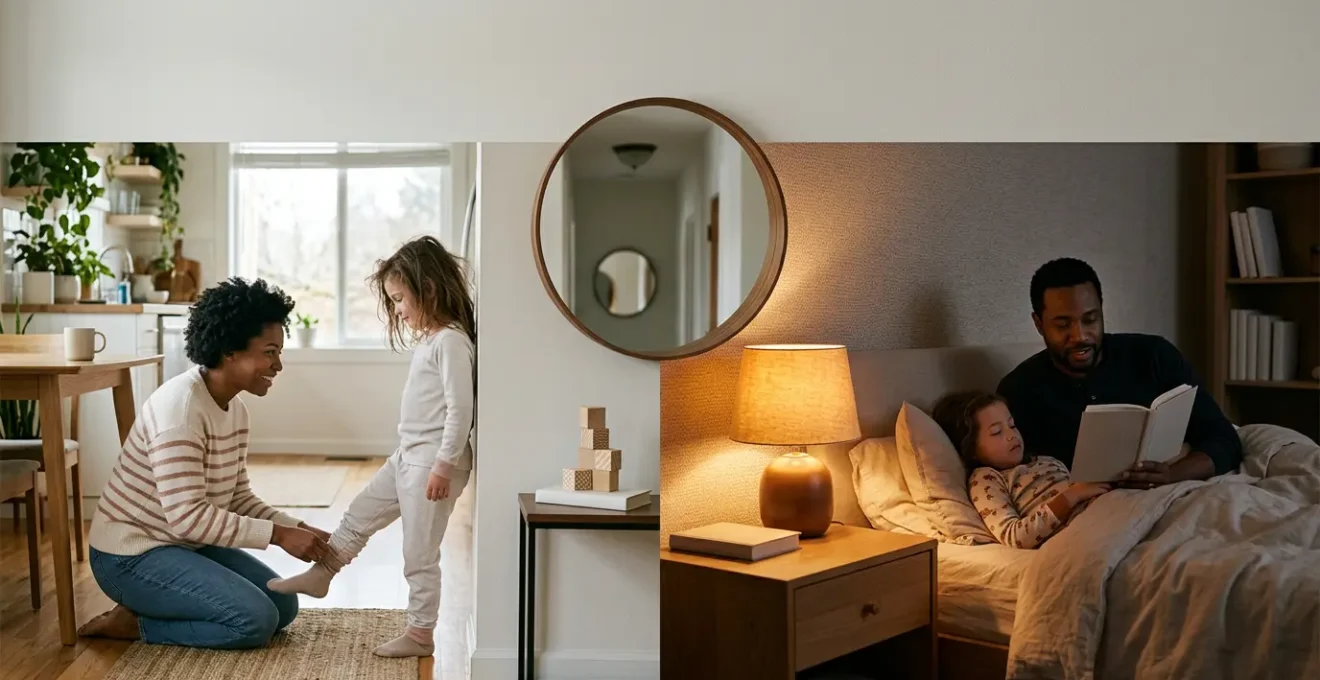
As the image beautifully illustrates, this connection is often non-verbal. It’s about presence, warmth, and gentle attention. By creating this small pocket of peace, you build a buffer against the inevitable stress of the morning schedule. It’s a proactive strategy that nurtures your relationship while simultaneously making the practical aspects of the morning run more smoothly.
Think of it as relational fuel. You wouldn’t expect a car to run on an empty tank, and you can’t expect a child to run on an empty emotional tank. A cuddle is the highest-octane fuel there is.
Playlist Power: Using Songs to Signal Transitions (Clean Up, Bath Time)
“It’s time to clean up!” How often is that phrase met with groans, negotiations, or outright refusal? The problem isn’t the task itself; it’s the transition. For a child deeply engrossed in play, your verbal command is an unwelcome interruption. Using music as a transition signal is a brilliant neurological hack that bypasses this conflict entirely.
A specific “clean-up song” or “bath time song” acts as a non-confrontational, external cue. It’s not you, the parent, demanding a change; it’s the song. This depersonalizes the request and dramatically reduces the potential for a power struggle. The song becomes part of the routine, a predictable signal that one activity is ending and another is beginning. This works because it gives the child a clear, defined timeframe to mentally and physically switch gears.
The effectiveness of this method is backed by significant research. Instead of a sudden stop, a three-minute song provides a gentle runway for landing their current activity. In classroom settings, where managing group transitions is paramount, this strategy is a cornerstone of effective management. In fact, studies demonstrate that music and movement interventions can reduce transition times by up to 75%. This isn’t just about making things more fun; it’s about making them more efficient and far less stressful.
You can create different playlists for different routines. A high-energy playlist for getting dressed in the morning, a calming instrumental playlist for the bedtime routine, and a specific, single song for acute transitions like tidying up toys. The key is consistency. The song must reliably predict the activity that follows. Over time, the mere opening notes of the “clean-up song” will trigger the desired behavior, often without a single word from you.
By becoming a family DJ, you are replacing nagging with rhythm and commands with auditory cues, creating a home environment that is more harmonious in every sense of the word.
Weekend consistency: Why Keeping Routines (Mostly) Helps on Saturdays?
The weekend arrives, and with it, the temptation to abandon all schedules. Late nights and lazy mornings feel like a well-deserved reward for a busy week. However, for a child’s developing body and brain, this dramatic shift can be deeply unsettling. While flexibility is important, maintaining a “mostly consistent” routine over the weekend is crucial for preserving the hard-won peace of your weekdays.
The reason lies in our internal body clock, or circadian rhythm. This internal master clock regulates sleep-wake cycles, hormone release, and even mood. It thrives on predictability. When a child goes to bed and wakes up at vastly different times on Saturday and Sunday, it’s the equivalent of giving them a small dose of jet lag. Come Monday morning, their internal clock is completely out of sync, making the return to the weekday schedule feel abrupt and difficult.
This doesn’t mean your weekends have to be as rigid as your weekdays. The goal is “mostly consistent.” This could mean allowing a wake-up time that is no more than an hour later than on school days, and a bedtime that is similarly adjusted. The core elements of the routine—the sequence of bath, book, bed—should remain the same. This provides a familiar and reassuring structure, even on a more relaxed day. The vast majority of parents intuitively understand this; according to CDC data, about 86% of U.S. children had a regular bedtime most days or every day in 2022, highlighting a widespread recognition of its importance.
The link between consistent sleep patterns and a child’s disposition is profound. As Adwoa Dadzie, a researcher at Penn State, found:
Children who had consistent bedtimes were generally able to regulate their behavior and emotions. On the other hand, children whose bedtimes and sleep times were all over the place showed more impulsivity and less control.
– Adwoa Dadzie, doctoral student in biobehavioral health, Penn State University
By anchoring the weekends with familiar rhythms, you prevent the “Sunday night dread” and the “Monday morning meltdown,” ensuring a smoother transition back into the weekly flow for the entire family.
The 45-Minute Window: Why Missing the Sleep Window Causes Meltdowns?
Every parent has experienced it: the moment a child goes from pleasantly tired to an overtired, inconsolable mess. This sudden shift often happens because a critical, yet fleeting, biological gate has been missed—the sleep window. This is a period, often lasting only 30-45 minutes, when a child’s body is perfectly primed for sleep. Their levels of the sleep-inducing hormone melatonin are high, while levels of the stress hormone cortisol are low.
As a routine architect, your job is to become an expert spotter of your child’s earliest sleep cues. These are the subtle signals they send before the window opens. It’s not the dramatic, overtired yawn; it’s the glassy-eyed stare, the sudden quietness, the little finger that finds its way to their mouth, or a gentle ear tug. These are the whispers that sleep is approaching. When you see these cues, the countdown begins. Your goal is to get your child into their bed before that window closes.
What happens if you miss it? The child’s body, sensing it has to stay awake longer, gets a “second wind.” The brain releases stimulating hormones like cortisol and adrenaline to fight off the fatigue. The child is now “wired but tired.” They are biologically incapable of easily settling down, even though they are exhausted. This is the recipe for a bedtime meltdown—the crying, the fighting, the “I’m not tired!” declarations that are a direct contradiction to their droopy eyes.

Missing this window consistently can create a cycle of sleep debt and behavioral challenges. The overtired child fights sleep, gets less restorative rest, and wakes up less refreshed, making them more prone to emotional dysregulation the following day. Learning to identify and honor the 45-minute window is one of the most powerful skills in a parent’s sleep toolkit.
It transforms bedtime from a battle of wills into a collaborative effort with your child’s natural physiology. You’re no longer fighting them to sleep; you’re helping them catch the perfect wave of tiredness.
Kids’ Visual Charts: Helping Non-Readers Know What’s Happening Today
While routine cards are excellent for specific sequences like getting dressed, a weekly visual chart addresses a different, broader need: understanding the shape of the day and the week. For a young child, time is an abstract concept. “We’re going to Grandma’s on Saturday” means very little to a three-year-old on a Tuesday. A visual chart with pictures or icons for each day’s main event—a schoolhouse for school days, a soccer ball for practice, a picture of Grandma for the weekend—makes time tangible.
This kind of chart acts as a “springboard” for their developing brain. It provides a scaffold for crucial executive functioning skills. As the team behind the Charmspring weekly chart explains, “Springboards help with planning, prioritizing, focusing, and following multi-step directions—all of which serve as the building blocks of Executive Functioning skills.” By seeing the week laid out visually, a child begins to grasp concepts of sequence, duration, and planning.
The primary function of these charts is to answer the constant, underlying question in a child’s mind: “What’s happening next?” This knowledge is a powerful antidote to anxiety. An unexpected event, even a fun one, can be dysregulating for a child who thrives on predictability. The visual chart removes the element of surprise. The child knows that today is a “park day” because they saw the picture of the slide that morning. This gives them a sense of control and security in their world.
Moreover, these tools are incredibly empowering. For a non-reader, being able to “read” the day’s plan from a chart is a profound experience. It allows them to participate in family planning and gives them a voice. They can point to the swimming pool icon and express their excitement. This simple act of referencing a chart builds confidence and reduces the need for constant questioning, freeing up both your and your child’s mental energy.
It’s a communication tool that bridges the gap between their concrete world and the abstract concept of a schedule, creating a shared understanding of the family’s rhythm.
Key takeaways
- Effective routines are designed around a child’s cognitive and emotional needs, not just a parent’s schedule.
- Your primary role is to be a “routine architect,” reducing your child’s cognitive load and providing emotional anchors.
- Consistency in key rhythms, even on weekends, is crucial for regulating a child’s internal body clock and mood.
Sleep Hygiene for Kids: Creating a Bedtime Routine That Works
You’ve navigated the day, honored the sleep window, and now you’re at the final, crucial stage: the bedtime routine. This isn’t just a series of tasks to be completed; it’s a carefully orchestrated descent into sleep. Good “sleep hygiene” is about creating a sensory environment and a predictable sequence of events that signal to every part of your child’s body and mind that sleep is coming. This is where your role as a routine architect culminates in the creation of a “sensory cocoon.”
The routine itself should be calming, consistent, and relatively short—typically around 30 minutes. It should flow logically from more active to more passive activities. A common, effective sequence is: bath, pajamas, brushing teeth, and then a quiet activity in the bedroom like reading a book. The key is that the sequence is the same every night. This predictability is incredibly powerful. As a landmark study of mothers and infants found, a consistent bedtime routine led to significant improvements in how quickly children fell asleep and reduced the number of times they woke up during the night.

The environment itself is a critical part of sleep hygiene. An hour before bedtime, begin to dim the lights to encourage natural melatonin production. Turn off all screens, as the blue light they emit actively suppresses melatonin. The bedroom should be cool, dark, and quiet. Consider blackout curtains and a white noise machine to create a consistent sensory space, free from disruptive light or sound. This is about crafting a calm, sensory-friendly haven that feels safe and is conducive to rest.
By deliberately designing both the sequence of events and the physical environment, you are creating a powerful, multi-layered signal for sleep. It’s a holistic approach that respects your child’s physiology and provides deep emotional reassurance. The routine becomes a cherished ritual of connection that bookends the day, leaving the child feeling safe, loved, and ready for restorative sleep.
Your Action Plan: Designing a Sensory-Friendly Bedtime
- Keep it short and sweet: Aim for a routine that lasts around 30 minutes. Any longer and it can become another battle; any shorter and it may not be calming enough.
- Do it every day: Consistency is the most critical element. Follow the exact same steps in the same order every night to build powerful, predictable sleep cues.
- Make it calming: The routine should be a wind-down. Include relaxing activities like reading a book together, listening to soothing music, or gentle rocking. Avoid stimulating activities.
- Create predictability: The routine’s purpose is to give your child a sense of security and teach them how to transition to sleep on their own. The known sequence is what provides comfort.
- Involve all caregivers: When possible, ensure both parents or other caregivers are familiar with and participate in the routine to maintain consistency and share the bonding experience.
Start tonight by implementing just one of these strategies—not as a new rule to enforce, but as an experiment in becoming your family’s thoughtful and effective routine architect.