
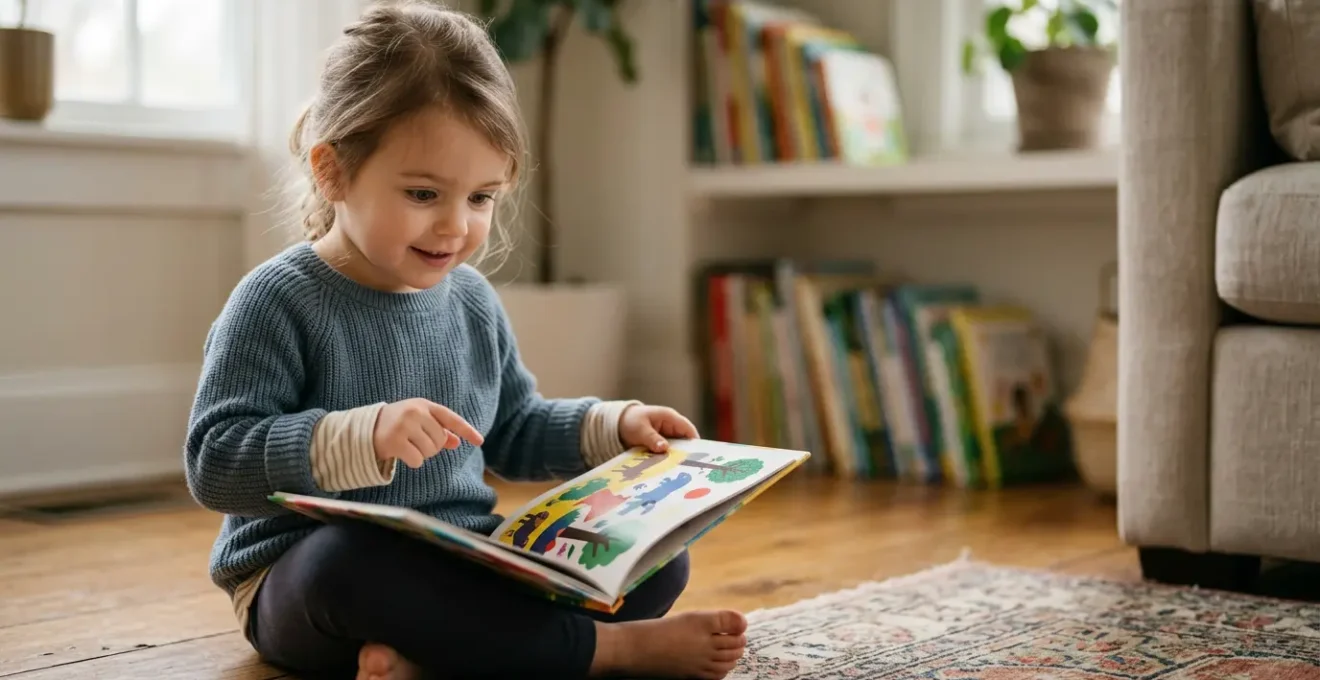
To prepare a child for reading, forget flashcards and rote memorisation; the real work lies in building the brain’s foundational wiring for language through play, rhythm, and conversation.
- The UK’s focus on phonics works because it teaches children to decode sounds, a skill built long before they see letters.
- Activities like singing rhymes and making scribbles aren’t just play; they are critical developmental stages for phonological awareness and writing.
Recommendation: Shift your focus from teaching letters to creating a rich, interactive language environment where your child can discover words and stories naturally.
As a reading recovery teacher, I see the anxiety in parents’ eyes. They come to me asking, “Should I be using flashcards? My friend’s child already knows the alphabet. Are we falling behind?” There’s a pervasive pressure to ‘teach’ reading, often leading to a focus on drills and memorisation. We buy alphabet puzzles, download educational apps, and turn storytime into a test. While well-intentioned, this approach often misses the point.
The common advice to “make reading fun” or “just read to your child” is a start, but it lacks the ‘how’ and, more importantly, the ‘why’. The truth is, preparing a child to read isn’t about pushing them to perform or memorise isolated letters. It’s about something much deeper and more intuitive. What if the real key wasn’t in the letters themselves, but in the sounds, the rhythms, and the conversations that happen long before a book is even opened?
This guide will walk you through the real building blocks of literacy. We’ll move beyond the platitudes to explore the developmental journey from sound to symbol. We’ll uncover how to intentionally build the neurological pathways for reading and writing, transforming your role from a teacher into a knowledgeable, supportive guide on your child’s journey to becoming a lifelong reader.
To help you navigate this journey, this article breaks down the essential, science-backed strategies into clear, manageable steps. Below is a summary of the key areas we will explore to build a strong foundation for your child’s literacy.
Summary: A Guide to Early Literacy Foundations
- Phonics vs Whole Word: How Do Children Actually Learn to Read in the UK?
- Nursery Rhymes: Why Rhyming Is the First Step to Reading?
- Mark Making: From Scribbles to Letters
- Labels and Lists: Creating a Print-Rich Environment at Home
- Library Visits: Making Books Exciting and Accessible
- Dialogic Reading: Turning Storytime into a Conversation
- Front-Facing Shelves: Why Seeing Covers Increases Reading?
- Designing the Ultimate Reading Nook: Inspiring a Love of Books
Phonics vs Whole Word: How Do Children Actually Learn to Read in the UK?
The debate between “phonics” (sounding out letters) and “whole word” (memorising entire words) can seem confusing for parents. However, in the UK, the evidence and curriculum have decisively landed on one side. The approach is known as systematic synthetic phonics, and it’s about teaching children the relationship between letters (graphemes) and sounds (phonemes) in a structured way. This isn’t about memorising words; it’s about giving children a code to unlock any word they encounter.
Why this method? Because it works. It teaches children the crucial skill of decoding—the ability to see a word, break it into its component sounds, and blend those sounds back together to read the word. This is the mechanical foundation upon which all reading comprehension is built. The success of this approach is measured annually, with UK government statistics showing that around 80% of pupils met the expected standard in the phonics screening check in Year 1. This isn’t just a test score; it’s a validation that teaching the code is the most effective route to reading independence.
As a reading specialist, I see the results firsthand. Children who grasp phonics are not limited to the words they have been explicitly taught. They have a powerful, transferable tool. They can tackle new and unfamiliar words with confidence. The whole-word approach, by contrast, relies on a visual memory that quickly becomes overwhelmed as vocabulary grows. Phonics empowers children to be readers, not just memorisers.
This evidence underscores the importance of phonics instruction in developing decoding skills, which are crucial for effective reading comprehension.
– Systematic Review Research Team, Oxford University
So, as a parent, your role isn’t to drill phonics rules. Instead, it’s to play with sounds. When you emphasise the ‘s’ in ‘snake’ or the ‘b’ in ‘ball’, you’re laying the groundwork for the phonics instruction your child will receive in school. You are tuning their ears to the very sounds that form the basis of our written language.
Nursery Rhymes: Why Rhyming Is the First Step to Reading?
Long before a child can recognise a letter, they can hear the music of language. Nursery rhymes are not just charming traditions or a way to pass the time; they are one of the most powerful tools we have for developing phonological awareness. This is the ability to hear, identify, and manipulate the sounds in spoken words—the ‘c-a-t’ sounds that make up ‘cat’. This skill is the single biggest predictor of later reading success, more important than knowledge of the alphabet.
Rhyming is the entry point into phonological awareness. When a child hears “Twinkle, twinkle, little star / How I wonder what you are,” their brain is subconsciously learning to identify words that have the same ending sound. This playful exposure to rhyme, rhythm, and alliteration (like in “Baa, Baa, Black Sheep”) trains the ear to dissect spoken language into smaller parts. It’s a workout for the auditory processing centres of the brain, building the neural pathways essential for linking sounds to letters later on.
This isn’t just theory. A landmark longitudinal study that tracked children from age 3 to 6 found a direct and strong correlation between early knowledge of nursery rhymes and future success in reading and spelling. The children who knew more rhymes became better readers, even after accounting for factors like IQ and social background. The study concluded that rhymes enhance phonological sensitivity, which in turn helps children learn to read.

When you see a child clapping along to a rhyme, as in the image above, you are witnessing embodied learning. They are not just hearing the rhythm; they are feeling it, internalising the beat and cadence of language. So sing, chant, and be silly. Every “Humpty Dumpty” and “Hickory Dickory Dock” is a sophisticated literacy lesson disguised as fun.
Mark Making: From Scribbles to Letters
When a toddler grabs a crayon and makes a wild, uncontrolled scribble across a page, it’s easy to dismiss it as just that—a scribble. But from a literacy perspective, this is a monumental moment. This is mark making, the very first step on the physical journey to writing. These early marks are the child’s first exploration of cause and effect: “I move my arm, and a line appears.” It’s the precursor to understanding that their actions can create symbols that hold meaning.
The journey from a random scribble to a recognisable letter is a predictable developmental path. Research shows that children progress through stages, from uncontrolled marks to more controlled lines and circles, and eventually to creating rudimentary representations of people and objects. By age three, many children can create these symbolic representations. That stick figure with a giant head and two legs? That’s not a poor drawing; it’s a graphic symbol representing “person.” This is the same cognitive leap required to understand that the symbol ‘A’ represents a specific sound.
Our job as adults is to honour this process. Instead of rushing to teach them how to write their name, we should provide a rich variety of materials and opportunities for mark making. Think thick chalk on the pavement, fingers in sand or a tray of flour, paint on a large sheet of paper, or a stick in the mud. The goal is not a perfect product but the physical experience of making a mark. It builds fine motor skills, hand-eye coordination, and the crucial understanding that these marks are a form of communication.
For young children, drawing and making marks is their first step in their journey to becoming writers. Taking a more playful approach will allow children the opportunity to find meaning from their early marks and drawings.
– Research by Ring (2003, 2006) as cited in Play of the Wild
When your child shows you a page full of scribbles and says, “This is a doggy,” don’t correct them. Ask them about it. “Tell me about your doggy.” You are validating their intent to communicate, reinforcing the idea that the marks they make can carry a story. You are telling them, without saying a word, that they are already a writer.
Labels and Lists: Creating a Print-Rich Environment at Home
Children learn what is valued in their environment. If print is visible, functional, and part of everyday life, they learn that print has a purpose. Creating a “print-rich environment” is not about plastering your walls with educational posters. It’s about integrating words and letters into daily routines in a meaningful way. This casual, constant exposure helps children understand that print carries information and is a tool for navigating the world.
The impact of such an environment is significant. A 2025 study in the journal *Reading Psychology* found that learning spaces providing opportunities to interact with different forms of print led to significantly better performance in early reading skills. Your home is your child’s first and most important classroom. Simple additions can transform it. Labelling the ‘toy box’ with the word and a picture helps a child make a direct connection between the written symbol and the object. Writing a shopping list together, even if their contribution is a scribble representing ‘bananas’, teaches them that we write things down to remember them.
The key is function. The print should *do* something. A label on a drawer helps find the socks. A chart with pictures and words shows the steps for getting ready in the morning. A name on a piece of art declares ownership. This makes print powerful, not just decorative. It also gives you natural opportunities to talk about letters and words. “Your name starts with a ‘B’, just like the ‘B’ on the ‘book’ basket.” These are low-pressure, high-impact learning moments.
This approach moves literacy from a specific “learning time” to a constant, ambient part of life. It builds a child’s confidence in navigating a world of text and shows them, from the very beginning, that reading and writing are useful, everyday tools for living.
Action plan: Auditing your home’s print environment
- Identify points of contact: Walk through your home and list all the places your child interacts with objects. Where do they get dressed, find toys, eat snacks? These are your starting points.
- Collect existing print: Gather all the “print” your child currently sees. Are book spines the only text? Or are there labels, charts, or lists they can interact with at their eye level?
- Check for coherence: Does the print you have serve a real purpose? A generic alphabet poster is less effective than a label on the ‘Lego’ bin that your child actually uses during tidy-up time.
- Assess for engagement: Look at your labels and signs. Are they just words, or do they include a picture to help your pre-reading child decode the meaning? Involve your child in making new ones.
- Create an integration plan: Start with two or three high-impact areas. Create functional labels for toy storage or a simple picture-based morning routine chart together. This is your first step.
Library Visits: Making Books Exciting and Accessible
For a child to fall in love with reading, they need access to books—a wide, ever-changing, and exciting variety of them. For many families, the public library is the single most important resource for achieving this. It transforms books from a commodity that must be purchased into a freely available public treasure. This shift in perspective is crucial, especially when we consider the stark realities of book ownership.
The link between owning books and reading skill is undeniable. As the National Literacy Trust states, “Book ownership is one of the top three predictors of reading performance.” But an alarming analysis of England’s literacy challenges reveals a difficult truth: in 2024, 1 in 10 children aged 5-8 did not own a single book. This makes the role of the library not just helpful, but absolutely essential. The library levels the playing field, ensuring every child can have the experience of being surrounded by stories, regardless of their family’s income.
However, the value of the library goes beyond just free access. It’s about creating a culture of excitement around books. A library visit can be a thrilling adventure. The act of getting their own library card is a rite of passage, a declaration that they are now a member of the reading community. Letting a child choose their own books gives them a sense of agency and ownership over their reading journey. They might choose a book based on a sparkly cover, a silly-looking dinosaur, or a topic you would never have thought to pick—and that’s wonderful. This freedom of choice is a powerful motivator.
Make library visits a regular, celebrated ritual. Talk to the children’s librarians; they are experts who can recommend hidden gems. Attend a storytime session to see books brought to life. By treating the library as a destination for fun and discovery, you are teaching your child that books are a source of joy and wonder, a gateway to a thousand different worlds, all available for the price of a free library card.
Dialogic Reading: Turning Storytime into a Conversation
Many of us think of storytime as a one-way street: the adult reads, and the child listens. But what if we transformed this monologue into a dialogue? This is the core idea behind Dialogic Reading, a research-backed method that turns reading *to* a child into reading *with* a child. It’s a simple shift in approach that has profound effects on language development, comprehension, and a child’s engagement with stories.
Instead of just reading the text, you become a conversation partner. You pause, ask questions, and encourage the child to become the storyteller. This active participation does wonders for building vocabulary and comprehension skills. The goal is to get them talking, thinking, and connecting the story to their own world. This approach also strengthens the emotional bond of storytime. As the National Literacy Trust reports, the benefits are more than academic; children who enjoy reading are three times more likely to have good mental wellbeing.
To make this happen, reading specialists use a simple set of prompts, often remembered by the acronym CROWD:
- Completion: You leave a blank at the end of a sentence for the child to fill in. “Brown Bear, Brown Bear, what do you…?” This works best with familiar, repetitive books.
- Recall: You ask questions about what has already happened in the story. “Can you remember what the caterpillar ate on Monday?”
- Open-ended: You ask questions that require more than a “yes” or “no” answer. “What do you think is happening on this page?”
- Wh- questions: You prompt the child to use new vocabulary. Pointing to the illustration, you might ask, “What is this called?” or “Where is the little mouse going?”
- Distancing: You connect the story to the child’s own life. “This bear is feeling sad. Have you ever felt sad like that?” or “We saw ducks at the park, just like in this book!”
You don’t need to use all of these on every page. Start small. The goal is to have a back-and-forth exchange, a shared discovery of the story. By inviting your child into the narrative, you are teaching them that their thoughts and ideas matter. You are showing them that a book is not just a collection of words, but a springboard for imagination and conversation.
Front-Facing Shelves: Why Seeing Covers Increases Reading?
Walk into any children’s bookshop or modern library, and you’ll notice something immediately: many books are not stored spine-out. They are displayed with their covers facing forward. This isn’t just an aesthetic choice; it’s a powerful psychological strategy designed to invite children in. For a pre-reader or early reader, a book’s cover is the book. It’s the visual summary, the emotional hook, and the primary tool for browsing.
Unlike adults, who might read a blurb or recognise an author’s name, young children navigate the world of books visually. The vibrant illustration of a dragon, the funny expression on an animal’s face, the sparkly foil on a title—these are the elements that capture their attention and spark their curiosity. A shelf of book spines is just a wall of text to a child who cannot yet read. A front-facing display, however, is a gallery of possibilities. It allows a child to “window shop” for stories, to make their own choices based on what intrigues them.
This simple environmental change can have a major impact on a child’s desire to read, which is more critical than ever. According to a recent report, the National Literacy Trust found that only 1 in 3 children said they enjoy reading, the lowest level recorded since 2005. In this context, anything we can do to make books more appealing and accessible is a victory. Putting books front-and-centre sends a clear message: these are exciting, these are for you, come and explore.
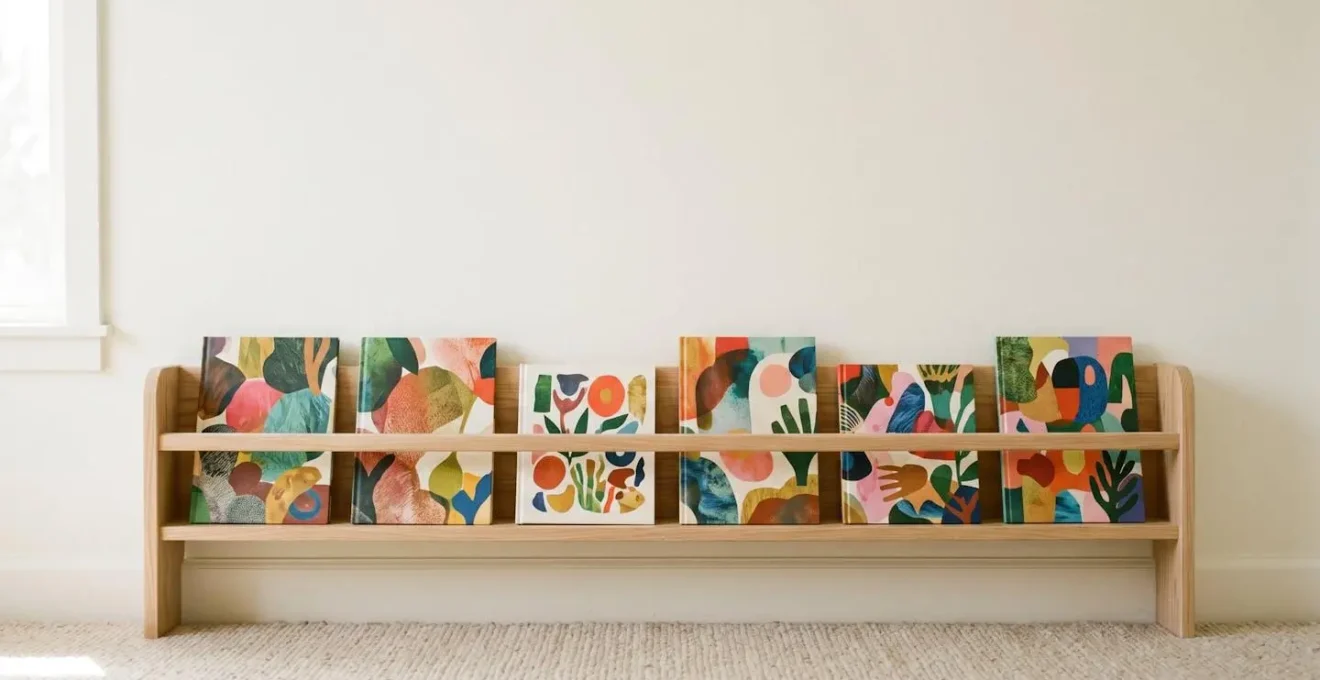
You don’t need to buy expensive furniture to achieve this at home. A few shallow picture ledges mounted on the wall at child-height work perfectly. You can prop books up on a low windowsill or even just lean a few against the wall on the floor. The key is to make the beautiful, enticing covers visible and within reach. By curating a small, rotating selection of front-facing books, you are creating an irresistible invitation to read.
Key takeaways
- True early literacy is about developing phonological awareness through rhythm and sound, not just memorising letters.
- Mark-making and scribbling are essential first steps in the physical act and symbolic understanding of writing.
- A print-rich environment is functional, not just decorative, integrating words into daily, meaningful routines.
Designing the Ultimate Reading Nook: Inspiring a Love of Books
We’ve talked about the building blocks of literacy: the sounds, the marks, and the conversations. The final step is to bring them all together in a space that celebrates books and invites quiet contemplation. Creating a dedicated reading nook is about more than just a place to store books; it’s about creating a physical manifestation of the value you place on reading. It’s a sanctuary, a low-pressure zone where a child can build a personal relationship with stories.
The “ultimate” reading nook is not about being expensive or “Instagram-perfect.” The ultimate nook is one that is co-created with your child and caters to their needs. Involve them in the design. Let them choose the cushions or a special blanket. This creates a sense of psychological ownership that is incredibly powerful. The space should be comfortable, with soft seating like beanbags or floor pillows, and the books should be accessible, ideally on the front-facing shelves we’ve discussed. Good, warm lighting is also essential.

Crucially, this space should be defined as a low-pressure zone. It’s vital to communicate that it’s okay *not* to read in the reading nook. It can be a place for looking at pictures, listening to an audiobook with headphones, or simply daydreaming. This prevents performance anxiety and ensures the space remains a retreat, not a chore. Stock it with more than just books: add puppets for retelling stories, a clipboard and paper for “writing reviews,” or a basket of their favourite story-related figurines. By rotating the books and materials regularly, you can keep the space feeling fresh and exciting.
By carving out a small corner of your home that is dedicated to the quiet magic of books, you are giving your child a profound gift. You are providing them with a safe, comfortable, and inspiring space where they can get lost in a story, discover new worlds, and let their imagination take flight. This is where a lifelong love of reading is truly cemented.