
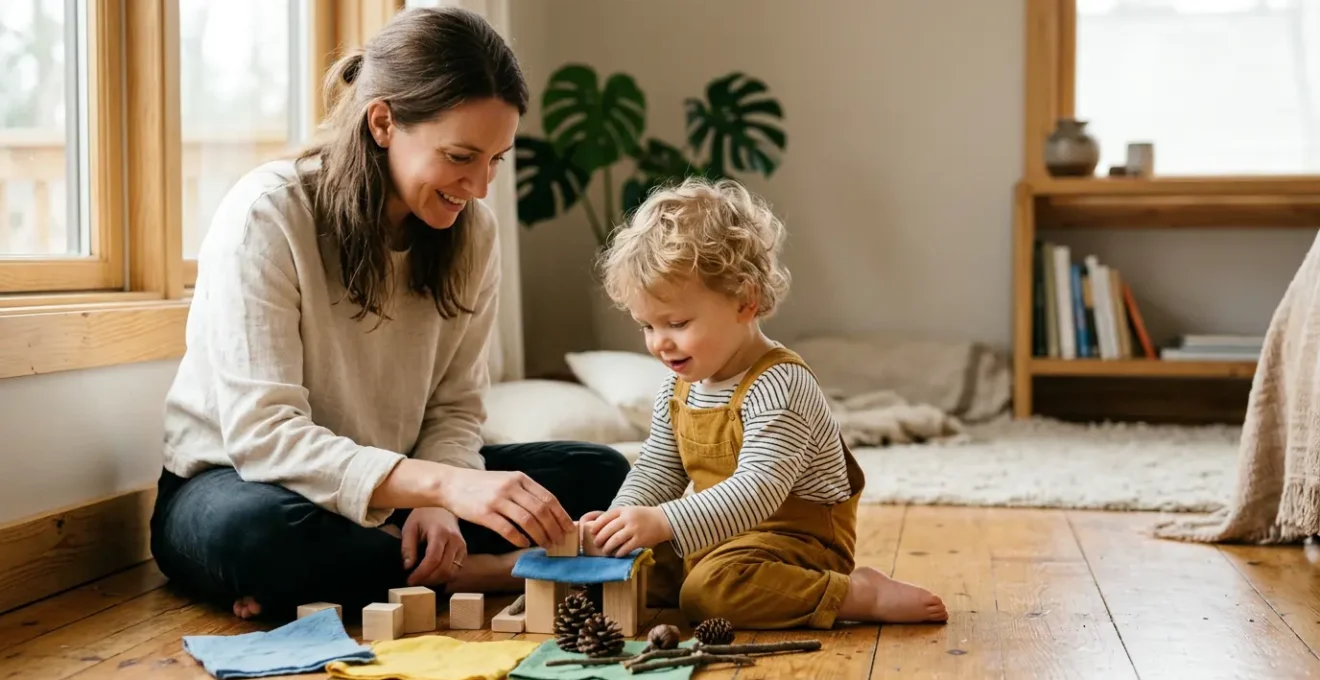
Stimulating your child’s brain isn’t about adding ’educational’ tasks; it’s about transforming your role from a teacher into a curious co-explorer.
- This approach focuses on building foundational skills like executive function and emotional literacy through joyful, everyday interactions.
- It prioritizes sparking curiosity with genuine questions over providing direct answers, fostering a love for learning.
Recommendation: Leverage your existing daily routines and follow your child’s natural lead to unlock their potential without adding any pressure.
Every parent wants to give their child the best possible start in life. In a world saturated with information about brain development, this desire can quickly curdle into anxiety. We see advertisements for educational toys, apps promising to build genius, and an endless pressure to fill every moment with structured learning. The fear is palpable: are we doing enough? But this pressure often leads to a different, equally valid fear: the dread of becoming a “pushy parent,” someone who drills their child with flashcards and turns joyful playtime into a series of stressful tests.
This creates a difficult paradox for loving, well-intentioned parents. The common advice—to read more, count more, and teach more—can feel like a tightrope walk over a chasm of parental guilt. But what if this entire framework is flawed? What if the key to nurturing a child’s incredible potential isn’t to *teach* more, but to *explore* more together? As an educational psychologist, I can assure you that the most profound learning doesn’t happen during scheduled lessons. It happens in the joyful, messy, and spontaneous moments of everyday life, when a parent shifts their role from instructor to curious co-explorer.
This guide moves beyond the platitudes and offers a new perspective. We won’t be building a curriculum; we’ll be cultivating a mindset. You will discover how simple shifts in your interactions—during storytime, cleanup, or a walk in the park—can build the deep, foundational cognitive and emotional skills that are the true bedrock of lifelong learning. It’s about seeing the world through your child’s eyes and nurturing their innate curiosity, not directing it.
In this article, we will explore practical, pressure-free strategies grounded in developmental science. You’ll learn how to transform ordinary routines into extraordinary learning opportunities that strengthen your bond and foster a genuine love of discovery in your child. The following sections break down these powerful techniques.
Summary: How to Nurture Early Learning Through Natural Exploration
- Dialogic Reading: Turning Storytime into a Conversation
- Everyday Math: Counting Stairs and Sorting Socks
- Pattern Spotting: Finding Shapes and Sequences in Nature
- The “I Wonder” Game: Encouraging Questions Instead of Giving Answers
- Following the Lead: Deep Diving into Dinosaurs or Trains
- Sink or Float: Teaching Physics in the Bathtub
- The Feelings Wheel: How to Move Beyond “Happy” and “Sad”?
- Early Literacy: Building a Foundation for Reading and Writing Before School
Dialogic Reading: Turning Storytime into a Conversation
The shared ritual of storytime is a cornerstone of early childhood, but its true power is often left untapped. Many parents approach reading as a one-way performance: they read the words, and the child listens. To truly accelerate learning, we must transform this monologue into a dialogue. This approach, known as dialogic reading, reframes the child as an active participant in the storytelling process. It’s less about getting through the book and more about using the book as a launchpad for conversation.
The method is simple. Instead of just reading the text, you prompt your child with questions about the pictures, characters, and plot. You might ask, “What do you think the bunny is feeling right now?” or “What do you see on this page?” This “serve and return” interaction is the fundamental building block of brain development. When your child points or babbles a response (the “serve”), and you respond with encouragement and a follow-up question (the “return”), you are physically building and strengthening neural connections through serve and return interactions.
This conversational turn-taking does more than just build vocabulary; it develops critical thinking, narrative skills, and emotional intelligence. Research shows the impact is profound; children can jump ahead by several months in their language development in just a few weeks of dialogic reading. You’re not just reading a story; you’re teaching your child how to think, how to relate, and how to understand the world around them, one page at a time.
Everyday Math: Counting Stairs and Sorting Socks
When parents think of “early math,” their minds often jump to flashcards and worksheets. This formal approach not only adds pressure but also misses the point entirely. The most important mathematical skills for a young child aren’t about memorizing numbers; they’re about understanding concepts like quantity, comparison, and spatial relationships. These concepts are woven into the very fabric of your daily life. The goal is to make these hidden math lessons visible through playful interaction.
Activities like counting the steps as you climb the stairs, sorting laundry into piles of socks and shirts, or asking your child to grab “the bigger” of two apples are not just chores—they are rich, hands-on lessons in numeracy, categorization, and comparison. When you cook together, you are exploring measurement, estimation, and sequence. These simple activities directly build a child’s executive function—the set of mental skills that includes working memory, flexible thinking, and self-control. It is the brain’s air traffic control system, and it is a far more powerful predictor of future success than rote knowledge. In fact, executive function has been a stronger predictor of early academic achievement than IQ.
The key is to be an intentional co-explorer. As you go about your day, simply narrate what you’re doing and invite your child to participate. “Look, we have three red socks but only two blue ones!” This isn’t a test; it’s a shared observation. By framing these moments as a game of discovery, you are building a positive, confident relationship with mathematical thinking that will last a lifetime.
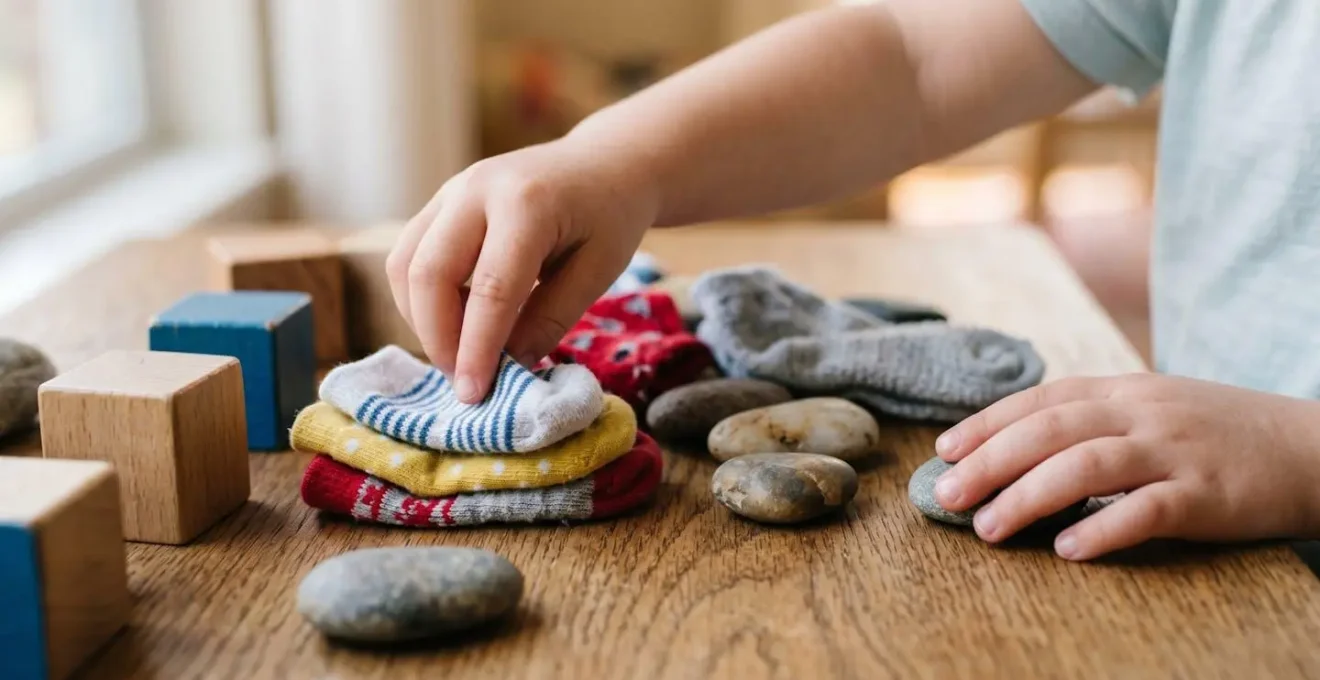
This hands-on sorting and counting is not just play; it’s the tangible work of a young mind building the foundational architecture for complex logical thought. Each sorted sock is a successful classification, and each counted step is a new connection made in the brain.
Pattern Spotting: Finding Shapes and Sequences in Nature
Beyond simple counting lies a more sophisticated and fundamental mathematical skill: pattern recognition. Our world is filled with patterns—the stripes on a zebra, the alternating colors of a beaded necklace, the cycle of day and night, the rhythm of a song. The ability to perceive, identify, and eventually predict these sequences is a cornerstone of logical reasoning, problem-solving, and higher-level mathematics.
You can cultivate this skill by becoming a “pattern detective” with your child. This is a game that can be played anywhere. On a walk, you can point out the repeating pattern of bricks in a wall or the radial symmetry of a flower’s petals. At snack time, you can arrange crackers and cheese slices in an A-B-A-B sequence and ask, “What comes next?” This simple act of noticing and naming patterns helps your child’s brain learn to organize visual information and make predictions based on observed rules. This isn’t a trivial game; research suggests that a preschooler’s ability to recognize, understand, and repeat patterns helps with math and reading skills later in life.
The goal is not to drill your child but to share in the delight of discovery. Use enthusiastic, wondering language: “Look at the pattern on this leaf! It has lines going out from the middle, over and over again.” You are modeling a way of seeing the world—not as a collection of random objects, but as an orderly, interconnected system full of beauty and logic.
The ability to identify sequences happens through exposure. The best way to encourage an understanding of patterns is to give your toddler lots of examples.
– Jennifer Weeks, Ph.D., Cognitive science researcher and STEM expert
By simply pointing out the patterns that already exist all around you, you provide the rich exposure your child needs to build this critical cognitive skill naturally and joyfully.
The “I Wonder” Game: Encouraging Questions Instead of Giving Answers
A child’s mind is a firestorm of curiosity. Their endless “Why?” is not a bug in the system; it is the very engine of learning. As parents, our instinct is often to be the “answer-giver,” to provide the correct information as quickly as possible. But in doing so, we can inadvertently extinguish the very spark of inquiry we hope to foster. A more powerful approach is to flip the script: instead of giving answers, we can model and encourage the asking of questions. This is the heart of the “I Wonder” game.
The game is simple. When your child asks a question—or even when you just notice something interesting—resist the urge to explain. Instead, respond with your own wondering. “You’re asking why the sky is blue? That’s a great question. I wonder about that too. What are your ideas?” This shift from expert to co-explorer is transformative. It validates your child’s curiosity, empowers them to form their own hypotheses, and teaches them that learning is not about receiving facts but about the process of investigation. You can model this throughout the day: “I wonder why those leaves are turning yellow,” or “I wonder how that spider builds its web.”
This technique is a cornerstone of inquiry-based learning, a pedagogical approach that places the learner’s questions at the center of the educational experience. It mirrors the scientific process itself: observation, questioning, hypothesizing, and testing.
The Power of Inquiry-Based Learning
This approach is not just a feel-good theory; it’s backed by solid research. The National Research Council found that children learn best through the same processes that guide scientists in their research practices. By encouraging children to ask questions, explore solutions, and engage in active investigation rather than receiving direct answers, we help develop critical thinking and problem-solving skills that form the foundation for lifelong learning. Instead of just learning a fact, they are learning how to learn.
When you play the “I Wonder” game, you are giving your child a gift far more valuable than a single answer. You are giving them the tools and the confidence to find their own answers for the rest of their lives.
Following the Lead: Deep Diving into Dinosaurs or Trains
At some point, many young children develop an intense, all-consuming interest in a specific topic. One month it’s dinosaurs, the next it’s construction vehicles, and then it’s all about planets. While these obsessions might seem fleeting or narrow, they are actually golden opportunities for deep, integrated learning. When a child is passionate about a subject, their mind is uniquely primed to learn. The role of the parent-as-co-explorer is not to redirect them to a “broader” curriculum, but to follow their lead and dive into that world with them.
A “dinosaur phase” is not just about memorizing names like Tyrannosaurus Rex and Stegosaurus. It’s a gateway to countless other domains. It can lead to conversations about biology (herbivore vs. carnivore), geology (fossils), and even physics (how could something so big even stand up?). It can inspire trips to the museum (history), drawing and sculpting (art), and digging in the backyard (scientific exploration). You can read books, watch documentaries, and build stories together. By honoring and feeding this intense interest, you are showing your child that their passions are valid and that learning is an exciting, self-directed adventure.
The underlying science is clear: curiosity supercharges the brain’s ability to learn and remember. Neuroscience research reveals that when a concept sparks curiosity, there is increased activity in the hippocampus—the region of the brain responsible for memory creation. This means that a child will learn and retain more information about math, literacy, and science when it is connected to their chosen passion, like dinosaurs, than they would from a disconnected worksheet.
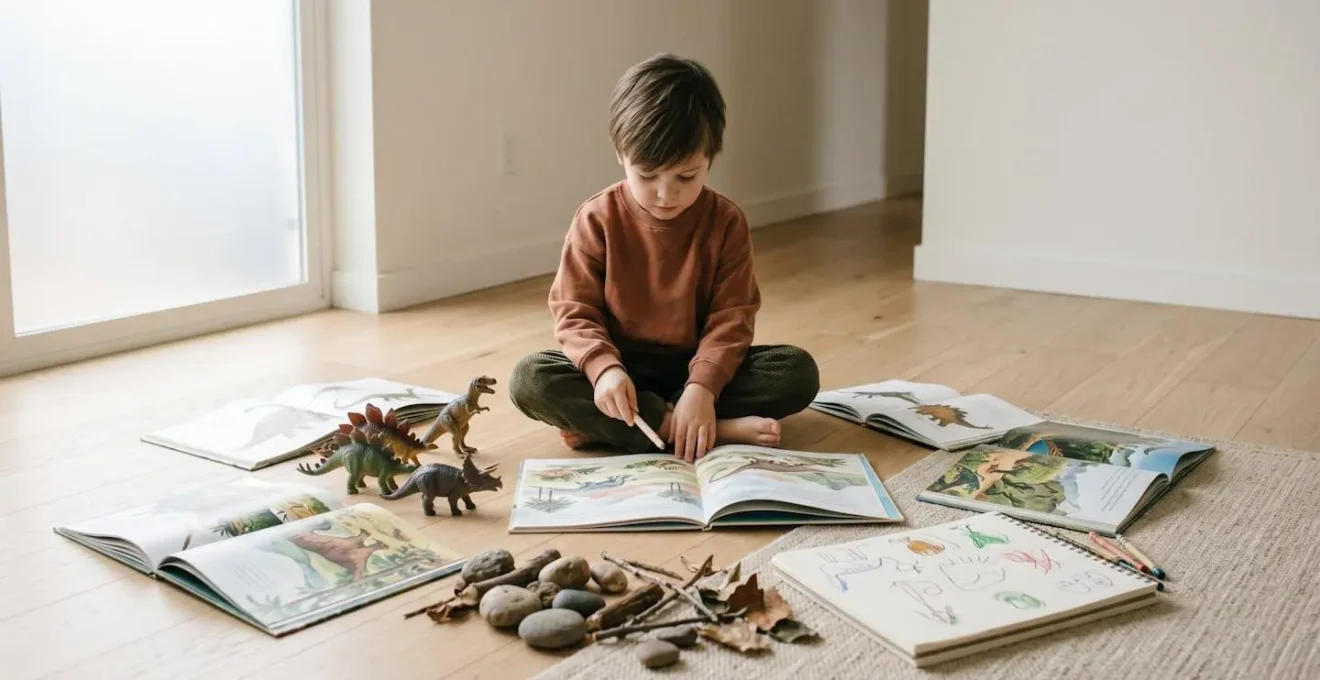
This philosophy is beautifully captured by the founder of the Reggio Emilia approach, an educational philosophy built entirely around child-led exploration.
Our task, regarding creativity, is to help children climb their own mountains, as high as possible. No one can do more.
– Loris Malaguzzi, Founder of the Reggio Emilia approach
By following your child’s lead, you are not just teaching them about dinosaurs; you are helping them climb their own unique mountain of knowledge, building their confidence and their capacity for deep, focused learning along the way.
Sink or Float: Teaching Physics in the Bathtub
Bathtime is often seen as a purely functional part of the day, a task to be completed. But with a slight shift in perspective, the bathtub can become your child’s first physics laboratory. The simple game of “Sink or Float?” is a perfect, low-pressure way to introduce the core principles of the scientific method: observation, prediction, experimentation, and conclusion.
The setup is effortless. Gather a few waterproof toys and objects from around the house—a rubber duck, a bar of soap, a plastic block, a spoon, a leaf. Before placing each item in the water, you can engage your child with the language of a scientist. “Let’s observe this spoon. What does it feel like? Is it heavy or light?” Then, you move to the hypothesis stage: “What’s your prediction? Do you think it will sink to the bottom or float on the top?” This moment of prediction is crucial; it gives your child a stake in the outcome.
Then comes the experiment: you place the object in the water and observe the result together. The most important part of this process is your reaction. Whether their prediction was right or wrong, the goal is to respond with excitement and curiosity. If they were wrong, it’s not a failure; it’s a fascinating discovery! “Wow! You thought it would float, but it sank! How interesting! I wonder why that happened?” This teaches an invaluable lesson: that science is not about being right, but about being curious and learning from results. You are modeling resilience and a growth mindset in the face of the unexpected.
Your Action Plan: A Bathtub Scientist’s Checklist
- Observe and Question: Start by examining an object. Ask your child, “What do you notice? What do you think will happen when we put it in the water?”
- Form a Hypothesis: Encourage a clear prediction. “Do you predict it will sink or float? Let’s make our scientist guess!”
- Conduct the Experiment: Test the prediction together. Place the object in the water and watch carefully.
- Analyze the Results: Discuss what happened. Use open-ended questions like, “What did you see? Was that what you expected?”
- Embrace Surprises and Iterate: Celebrate all outcomes, especially the unexpected ones. Use them as a springboard for new questions: “What if we try a bigger one? What about in a bucket of salty water?”
By engaging in this simple game, you are demystifying science and framing it as an accessible, hands-on process of discovery. You are teaching your child how to think like a scientist, all before they’ve even gotten out of the tub.
The Feelings Wheel: How to Move Beyond “Happy” and “Sad”?
A child’s emotional world is as vast and complex as their intellectual one, yet we often give them a very limited toolkit to navigate it. We tend to focus on the big, simple emotions: happy, sad, angry. This is like giving someone a map of the world that only shows three countries. To raise emotionally intelligent children, we need to help them build a more detailed and nuanced map of their own inner landscape. This is the concept of emotional granularity—the ability to identify and label emotions with precision and specificity.
Instead of just asking “Are you sad?”, you can become a feeling detective with your child. Help them connect their feelings to physical sensations and specific situations. “I see your fists are clenched and your face is getting hot. Are you feeling frustrated because your tower keeps falling down?” You are not just naming an emotion; you are giving them the context and the vocabulary to understand it. You can use metaphors, like an “Emotional Weather Report”: “It seems like it’s cloudy and a bit grumpy inside you right now. Is a storm brewing?”
The goal is to move beyond labels to understanding and regulation. A key strategy is creating a designated “Calm-Down Corner” or a “Cozy Kit.” This isn’t a punishment space, but a safe haven your child can choose to go to when their emotions feel too big. It can be filled with regulatory tools like a soft blanket, a stress ball, a quiet book, or some putty to squeeze. By creating this space, you are teaching a critical life skill: when you feel overwhelmed, it’s okay to take a break and use tools to help your body and mind feel calm again. You can model this yourself: “I’m feeling a bit frustrated because I can’t find my keys. I’m going to take three deep breaths to help my body calm down.”

By giving your child a richer emotional vocabulary and concrete strategies for regulation, you are providing the foundation for emotional resilience, empathy, and strong interpersonal relationships. This is one of the most important forms of intelligence you can nurture.
Key takeaways
- Shift Your Role: The most impactful change is moving from a “teacher” who gives answers to a “curious co-explorer” who asks questions and shares in the discovery.
- Focus on Foundations: Prioritize developing underlying skills like executive function and emotional literacy, which are built through play and conversation, not drills or flashcards.
- Leverage Daily Routines: The most powerful learning opportunities are already embedded in your everyday life—from sorting socks and setting the table to talking about feelings.
Early Literacy: Building a Foundation for Reading and Writing Before School
For many parents, the term “early literacy” conjures images of letter-of-the-day charts and practicing phonics. While these have a place later on, the true foundation of literacy is built long before a child can recognize a single letter. It is built in the richness of oral language, the joy of storytelling, and the understanding that marks on a page can carry meaning. As a co-explorer, your role is to cultivate this fertile ground, not to prematurely plant seeds of formal instruction.
All the strategies we’ve discussed are, in fact, powerful pre-literacy activities. Dialogic reading builds vocabulary and narrative skills—the ability to understand how stories work. Playing the “I Wonder” game develops the critical thinking and comprehension skills essential for reading between the lines. Following their lead into a deep interest in trains or planets provides a context and motivation for seeking out information in books. This is not an accident; extensive research confirms that children need strong oral vocabulary skills in order to become proficient readers. A child who has had thousands of rich, back-and-forth conversations has a tremendous advantage when they begin to decode words on a page.
You can further support this foundation by celebrating all forms of “writing.” The scribbles a toddler makes with a crayon are not random marks; they are an exploration of the idea that a tool can be used to make a message. This is mark making, the very first step toward writing. Likewise, you can point out “environmental print”—the words on a stop sign, a cereal box, or a store front. This helps a child understand that print is all around them and it serves a purpose. By telling family stories, singing songs, and encouraging your child to “retell” a book in their own words, you are building the narrative competence that is the heart of all literacy.
When the foundation is strong, the house is easy to build. By focusing on these joyful, language-rich experiences, you are giving your child a deep, intrinsic motivation to read and write. They will not see it as a chore to be mastered, but as a magical tool for exploring a world they are already deeply curious about.
Start today by choosing just one daily routine—storytime, cleanup, a walk outside—and approach it not as a teacher with a lesson plan, but as a curious co-explorer, ready to see the world through your child’s eyes. This simple shift is the most powerful head start you can give.