
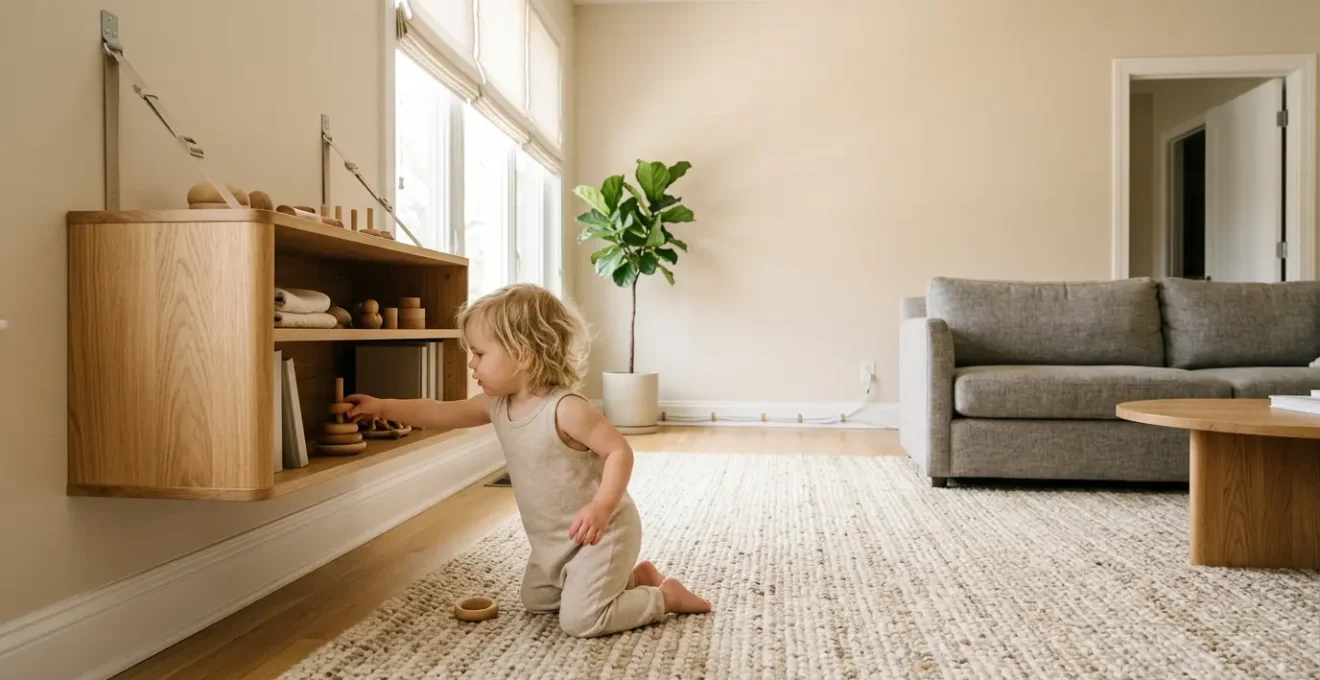
The secret to a peaceful, child-proofed home isn’t more restrictions; it’s a smarter environment designed for exploration.
- Absolute safety in hazard zones (kitchen, windows) is non-negotiable and must be secured first.
- The most effective strategy is creating “Yes Spaces” where a child’s curiosity is met with safe, engaging opportunities, not prohibitions.
Recommendation: Shift your mindset from ‘what must my child avoid?’ to ‘what can my child safely discover?’ to build both safety and independence.
The moment a baby becomes mobile, the home transforms. Every floor-level object becomes a tantalizing target, and the parent’s vocabulary shrinks to a constant refrain of “No!”, “Don’t touch that!”, and “Get away from there!”. While traditional child-proofing advice centers on outlet covers and cabinet locks, this approach often casts the parent as a perpetual guard in a fortress of restrictions. It’s an exhausting, reactive posture that can stifle a child’s innate drive to explore and learn about their world.
But what if the goal wasn’t simply to prevent disaster, but to proactively foster discovery? What if, instead of building a house of ‘No’, you could design a landscape of ‘Yes’? This is the core principle of a truly enriching and safe home. It involves a two-pronged strategy: first, identifying and neutralizing absolute hazards with surgical precision, and second, thoughtfully curating the environment to redirect a child’s curiosity toward safe, engaging, and developmentally appropriate activities. This turns the home from a potential minefield into a child’s first and best learning laboratory.
This guide moves beyond a simple checklist. We will explore how to secure the non-negotiable danger zones, from anchoring heavy furniture to managing hidden cord dangers. More importantly, we will delve into the philosophy of creating ‘Yes Spaces’ and applying principles from Montessori to cultivate your child’s independence, reduce your own stress, and finally bring a sense of calm and purposeful play back into your home.
Summary: A Guide to a ‘Yes’ Environment Home
- Tip-Over Safety: Anchoring Bookshelves and TVs to Walls
- Cable Management: Hiding Wires from Little Fingers
- The “Yes” Space: An Area Where Everything Is Safe to Touch
- Locked Cupboards: Safe Storage for Cleaning Products and Meds
- Blind Cords: The Hidden Danger in Every Window
- Blackout and White Noise: Creating the Perfect Sleep Environment
- Montessori at Home: Fostering Independence with Accessible Environments
- Playroom Design and Storage Solutions: Creating Order from Chaos
Tip-Over Safety: Anchoring Bookshelves and TVs to Walls
As babies learn to pull themselves up, any piece of furniture becomes a potential ladder. Bookshelves, dressers, and TV stands present a significant and often underestimated tip-over hazard. This is not a minor risk; an estimated 17,800 people are injured annually from furniture and TV tip-overs, with children under 18 making up 44% of these cases. A child’s weight is more than enough to topple an unsecured, top-heavy piece of furniture, especially when drawers are pulled out to create a climbing structure.
The only foolproof solution is to physically anchor all tall or heavy furniture to the wall. This isn’t a suggestion; it’s a critical safety measure. Anti-tip kits are inexpensive, widely available, and can be installed in minutes. They create a secure connection between the furniture and a wall stud, making it impossible for the item to fall forward, even under the weight of a climbing toddler. This simple action transforms a major hazard into a stable part of the environment, allowing your child to safely explore their vertical world.
To secure your home against tip-over accidents, you should:
- Anchor furniture to the wall using low-cost anchoring devices to prevent TVs, dressers, and bookcases from tipping.
- Always place TVs on a sturdy, low base and push the TV as far back as possible.
- Avoid displaying tempting items like toys or remotes on top of furniture where kids might be inspired to climb.
- Store heavier items on lower shelves or in lower drawers to improve the furniture’s center of gravity.
- Install drawer stops to prevent them from being pulled out completely.
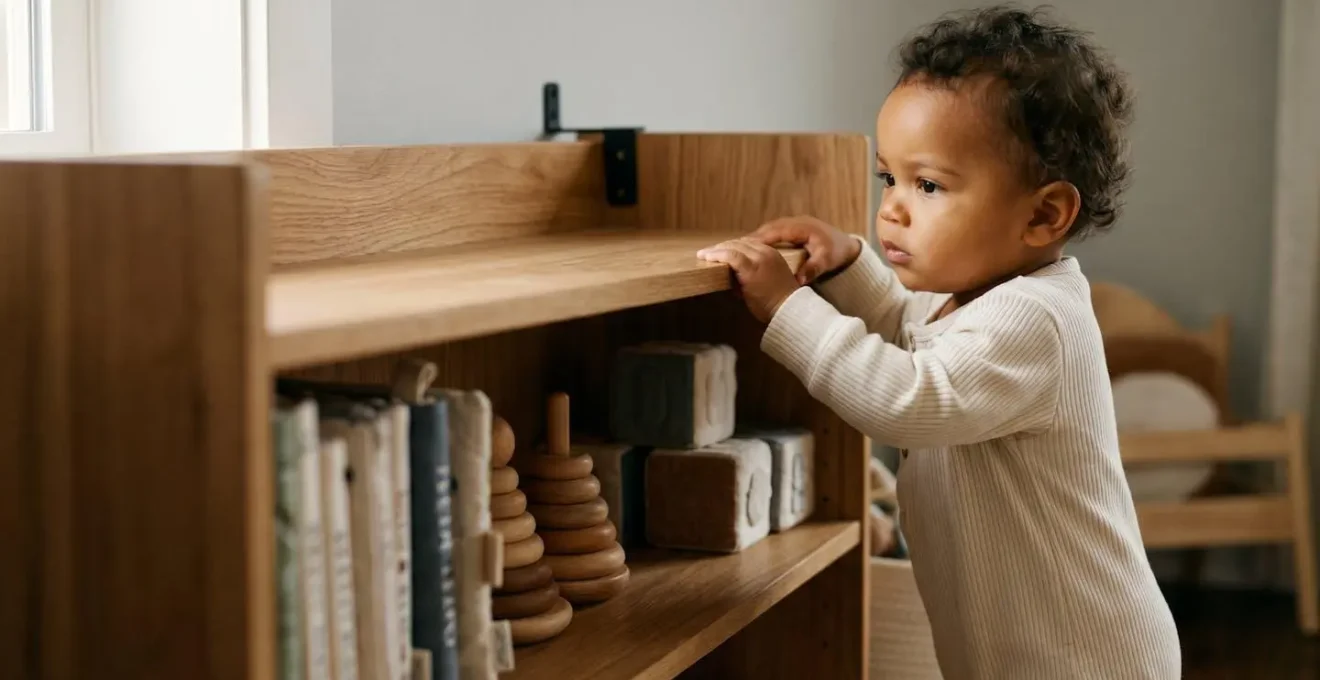
As this image demonstrates, proper anchoring doesn’t restrict a child; it liberates them. This toddler can use the bookshelf to practice pulling up, a crucial developmental milestone, without any risk. The furniture becomes part of their safe exploratory space, not a source of danger or a reason for a parent to shout “No!”
Cable Management: Hiding Wires from Little Fingers
In the modern home, wires are everywhere, and to a crawling baby, they are fascinating. A dangling phone charger, a loop from a lamp cord, or the nest of wires behind the entertainment center all represent irresistible tactile temptations. Yet, these cords pose a triple threat: a choking hazard, a strangulation risk from loops, and a tripping hazard for the whole family. The rise in home technology has unfortunately been accompanied by a staggering 732% increase in related accidents over thirteen years, with toddlers being at the greatest risk.
The goal of cable management is twofold: get cords out of reach and eliminate any loops. This isn’t just about aesthetics; it’s about removing temptation and danger entirely. Think of every loose wire as a potential problem and address it systematically. By bundling, covering, and securing all cables, you remove the object of fascination and the associated hazard, allowing your child to explore the floor space without you having to constantly disentangle them from a cord.
Effective cable management can be achieved with a few simple tools and strategies:
- Use cord winders or “turtles” to contain excess slack within a protective shell, keeping cords taut.
- Install on-floor cord covers or raceway systems along baseboards to completely conceal wires that cross walkways.
- Apply adhesive clips to pin wires tightly against walls or furniture legs so they cannot be pulled.
- Bundle entertainment center cables using flexible cord sleeves, turning a “spaghetti” of wires into one thick, uninteresting tube.
A well-managed cord system is invisible to a child. The threat is not just mitigated; it is eliminated from their perception, which is the highest form of safety design.
The “Yes” Space: An Area Where Everything Is Safe to Touch
Imagine a room, or even just a corner of a room, where you never have to say “no.” A space where every single object is safe for your child to touch, mouth, and explore. This is the concept of a “Yes” Space, and it is the single most powerful tool for creating a peaceful home with a mobile baby. It’s a foundational shift from a reactive, ‘no-based’ parenting style to a proactive, ‘yes-based’ one. The “Yes” Space is the ultimate expression of a home designed for a child’s development, not just their containment.
Creating a “Yes” Space starts with ensuring absolute safety. The area is completely free of small objects, sharp corners, unsecured furniture, and electrical hazards. Once safety is established, the space is populated with a curated selection of age-appropriate, engaging items: soft-play climbers, board books, sensory toys, or simple household objects like wooden spoons and metal bowls. It’s the child’s domain, where their curiosity leads the way without interruption.
As a Montessori educator from The Montessori Room explains, the benefits extend far beyond simple play:
The biggest benefit of the YES space is that children are given the opportunity for uninterrupted play and exploration. Since the adult no longer has to move the child away from hazards or discourage them from doing something unsafe, children can engage with their surroundings on their own terms, building focus and self-reliance.
– Montessori educator, The Montessori Room
Case Study: The Developmental Power of a “Yes” Space
The “Yes” Space is more than a playpen; it’s a developmental powerhouse. By giving children the freedom to investigate and create independently, parents nurture creativity, problem-solving skills, and self-confidence. The space evolves with the child: what starts as a soft-matted area for a crawler becomes a zone with low-level climbing challenges for a toddler, and later a “maker space” for a preschooler. Parents consistently report that implementing a “Yes” Space reduces their own anxiety and decision fatigue, allowing them to be more present and enjoy more positive interactions, secure in the knowledge that their child is in a completely safe and enriching environment.
This space becomes a sanctuary for both child and parent. For the child, it’s a place of autonomy and deep focus. For the parent, it’s a place of peace, where they can observe and connect with their child without the constant need for intervention.
Locked Cupboards: Safe Storage for Cleaning Products and Meds
While a “Yes” Space is about opening up the world, some areas require the opposite approach: creating impenetrable “No” zones. Cabinets and drawers containing cleaning products, medications, laundry pods, and sharp objects are the most significant poisoning and injury risks within the home. A child’s curiosity doesn’t distinguish between a toy and a brightly colored bottle of poison. For children under five, unintentional poisonings lead to an estimated 64,300 emergency department visits annually in the US. This is a hazard that demands an absolute, multi-layered defense.
The primary line of defense is a high-quality safety latch or lock on every single cabinet and drawer that houses hazardous materials. Do not rely on “child-resistant” packaging; it is often not truly childproof and should be considered the last line of defense, not the first. The goal is to prevent access entirely.
However, simply blocking access can increase frustration. A key strategy is to redirect curiosity. While you lock the dangerous cupboards, create an accessible “Child’s Cupboard” nearby. Fill a low, unlocked drawer with safe items that mimic what they see you using: a small dustpan and brush, their own plastic bowls, wooden spoons, or clean sponges. This gives them a safe way to participate in household activities and explore textures and objects, satisfying the very curiosity that would otherwise lead them to the dangerous cabinet.
A comprehensive locked storage strategy includes:
- Installing sturdy safety latches and locks on all cabinets containing hazardous items.
- Never leaving cleaning products or medicines out on the counter, even for a moment.
- Keeping products in their original containers to avoid confusion.
- Understanding that “child-resistant” does not mean “childproof.”
- Keeping the Poison Control hotline number (1-800-222-1222 in the US) saved in your phone and posted visibly.
Blind Cords: The Hidden Danger in Every Window
Window blind and curtain cords are one of the most deceptive “hidden hazards” in a home. They seem innocuous, but to a small child, a dangling cord or a continuous loop is a toy. The U.S. Consumer Product Safety Commission (CPSC) is unequivocal in its guidance, as the CPSC warns that children can wrap window covering cords around their neck or become entangled in loops, leading to strangulation in a matter of minutes. This risk is so severe that the industry has moved towards new safety standards, but millions of homes still have older, hazardous corded blinds.
The only truly safe solution is to go cordless. If you have corded window coverings in your home, they should be replaced. Inexpensive cordless blinds are now widely available. If replacement is not immediately possible, you must take steps to mitigate the danger. Dangling pull cords should be cut as short as possible, and continuous loop cords must be anchored tightly to the wall or floor. There is no safe way to have a loose, accessible window cord in a home with a young child.
Once the window area is secure, you can transform it from a source of anxiety into a portal of learning. This aligns perfectly with the ‘Yes’ Space philosophy: first, eliminate the hazard, then enrich the environment. A safe window offers a fascinating view of the world.
- Replace corded window coverings with cordless products. This is the safest option.
- If unable to replace, use a free repair kit to anchor continuous loops and eliminate dangling pull cords.
- Move all cribs, beds, and furniture away from windows to prevent climbing and access to cords.
- Once safe, install a bird feeder outside the window to teach about nature.
- Apply weather-themed window clings to discuss seasons and daily weather.
- Create a cushioned window seat for a cozy reading nook and a place to observe the neighborhood.
By addressing the cord hazard, you unlock the window’s potential as a valuable learning tool for observing day and night, changing seasons, and community life.
Blackout and White Noise: Creating the Perfect Sleep Environment
A dark, quiet room is the cornerstone of good sleep hygiene for a baby. Blackout curtains block external light that can disrupt melatonin production, while a white noise machine can mask household sounds that might otherwise startle a sleeping infant. Creating this optimal sleep cave is a common recommendation, and for good reason—it often leads to longer, more consolidated sleep. However, the goal is not just to create a perfect environment, but a resilient sleeper.
Sleep experts now caution against making sleep conditions so perfect that a child becomes incapable of sleeping anywhere else. A baby who can only sleep in a pitch-black room with a specific sound machine will struggle with naps at daycare, travel, or even in a different room of the house. The key is to balance an optimal home-sleep environment with opportunities for flexible sleeping.
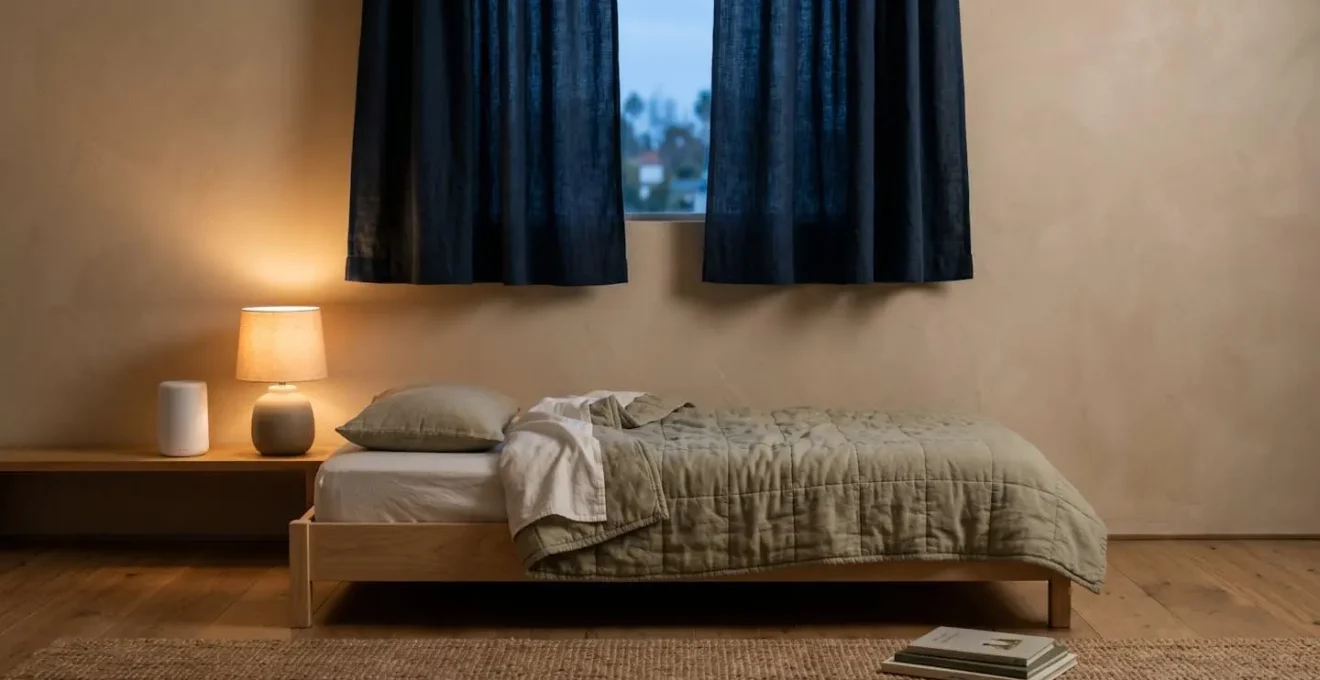
The ideal approach is nuanced. Instead of total darkness until the moment of sleep, use dimmable, warm-hued lighting (reds and oranges) during the wind-down routine to naturally stimulate melatonin. Consider pink or brown noise, which many experts believe provide deeper sleep benefits than standard white noise. Most importantly, the preparation of the room should become part of the bedtime routine. Having the child participate in closing the curtains and turning on the sleep sounds gives them a sense of predictability and control, which is just as important as the darkness itself.
Expert Insight: Building Sleep Resilience
The ultimate goal is a child who can sleep well, even in imperfect conditions. While the primary sleep space should be optimized for rest, parents should strategically plan for ‘imperfect’ naps. An occasional nap in a stroller on a walk, in a carrier, or in a brighter room at a relative’s house helps build sleep resilience. This prevents the parent from becoming a hostage to a perfect sleep environment and teaches the child that sleep can happen even when conditions aren’t 100% ideal. It’s about finding the sweet spot between providing comfort and building adaptability.
By thoughtfully designing the sleep space and routine, you can promote healthy sleep habits without creating an overly rigid dependency on perfect conditions.
Montessori at Home: Fostering Independence with Accessible Environments
The Montessori philosophy is not just about specific wooden toys; it’s a profound respect for the child as a capable individual. Bringing this philosophy home means seeing your environment through your child’s eyes and systematically removing the barriers that prevent them from participating in their own life. It’s about fostering independence, which is the root of true self-esteem. Every time a child can say “I did it myself,” their confidence grows.
This approach complements the “Yes” Space by extending the principle of accessibility to the entire home. It involves simple but transformative modifications: a low hook by the door for their own coat, a small stool in the bathroom for independent handwashing, or a “learning tower” that safely brings them to counter height in the kitchen. These changes send a powerful message: “You are a capable member of this family. Your contributions are welcome here.”
Crucially, this philosophy also embraces the concept of ‘beneficial risk’. As Montessori educators emphasize, a completely sterile, risk-free bubble is not the goal.
True Montessori is not about creating a perfectly sterile, risk-free bubble. The concept of ‘beneficial risk’—allowing a child to pour water and spill it, carry a small glass cup with care, or use a blunt knife with supervision—is essential for building competence and self-esteem.
– Montessori educators, Montessori home environment philosophy
It’s about providing the right tools and just enough support to allow children to challenge themselves safely. This builds not only practical skills but also judgment and self-regulation. To begin transforming your home into a more independent-friendly environment, audit your space with your child’s capabilities in mind.
Action Plan: Auditing Your Home for Independence
- Points of Contact: List all the daily routines your child participates in (getting dressed, meals, cleanup, hygiene). Where do they need your help?
- Collecte: Inventory the physical barriers. Are clothes in high drawers? Is the sink out of reach? Is there no place for them to put their own shoes?
- Coherence: Confront these barriers with your goal of independence. How can you modify the environment to empower them in each routine?
- Beneficial Risk: Identify one small, supervised “risky” task you can introduce this week (e.g., pouring their own water from a tiny pitcher, carrying their own plate to the sink).
- Plan of Integration: Choose one modification to implement today. It could be as simple as putting a stool in the bathroom or placing their favorite snacks on a low shelf they can reach themselves.
By observing your child’s struggles and interests (their “schemas”) and adapting the environment to meet them, you create a home that truly supports their journey toward becoming a competent and confident person.
Key Takeaways
- Absolute safety is the non-negotiable foundation: Anchor heavy furniture, lock up all chemicals, and eliminate cord hazards first.
- The most effective child-proofing strategy is to shift from a ‘no’ mindset to a ‘yes’ mindset by designing safe, accessible, and enriching environments.
- Fostering independence through an accessible, Montessori-inspired home builds a child’s competence and self-esteem far more than a restrictive environment does.
Playroom Design and Storage Solutions: Creating Order from Chaos
The playroom or play area is often the epicenter of household chaos. A floor littered with countless toys is not just messy; it’s overstimulating for a child and overwhelming for a parent. A well-designed play space, however, can be a haven of calm, creativity, and—most importantly—independence. The secret is not more storage bins, but a more thoughtful philosophy: less is more. Fewer toys, presented in an organized way, lead to deeper, more imaginative play and a manageable cleanup task for everyone.
The cornerstone of an organized playroom is a toy rotation system. Keep the majority of toys stored away out of sight, and display only 6-8 carefully chosen items at a time. This reduces overstimulation, combats boredom by making old toys feel new again, and allows a child to engage more deeply with each item. The toys on display should be housed in low, open shelving or in bins with clear fronts and large, clear picture labels. This empowers non-reading children to independently select their activity and, crucially, to know exactly where it goes when playtime is over.
Creating structure within the room and the routine is equally important.
- Define functional zones: A cozy, soft corner with pillows for a reading “nest,” an open floor space for building with blocks, and a designated small table for art or “messy” play.
- Make cleanup a positive ritual: Implement a 5-minute “closing ceremony” at the end of play. Using a specific “tidy up song” signals the transition and turns cleanup into a collaborative, predictable game rather than a chore or a battle.
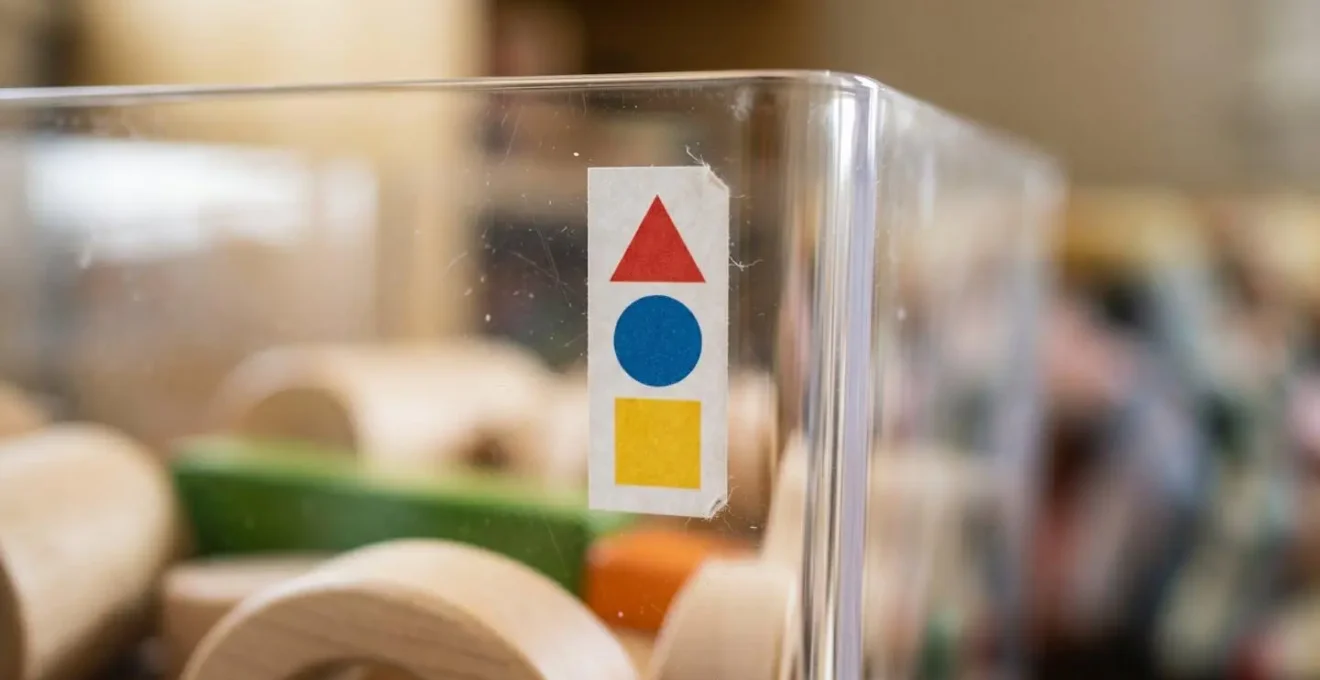
This level of organization isn’t about creating a showroom; it’s about providing the external structure that helps a young child develop their own internal sense of order. It respects their need for predictability and empowers them to be the master of their own domain, from choosing their play to participating in its completion.
Start today. You don’t need a complete overhaul. Choose one room—or even just one corner—and ask yourself: “How can I create more ‘yes’ and less ‘no’ in this space?” The journey to a safer, more enriching home begins with that single, powerful question.