
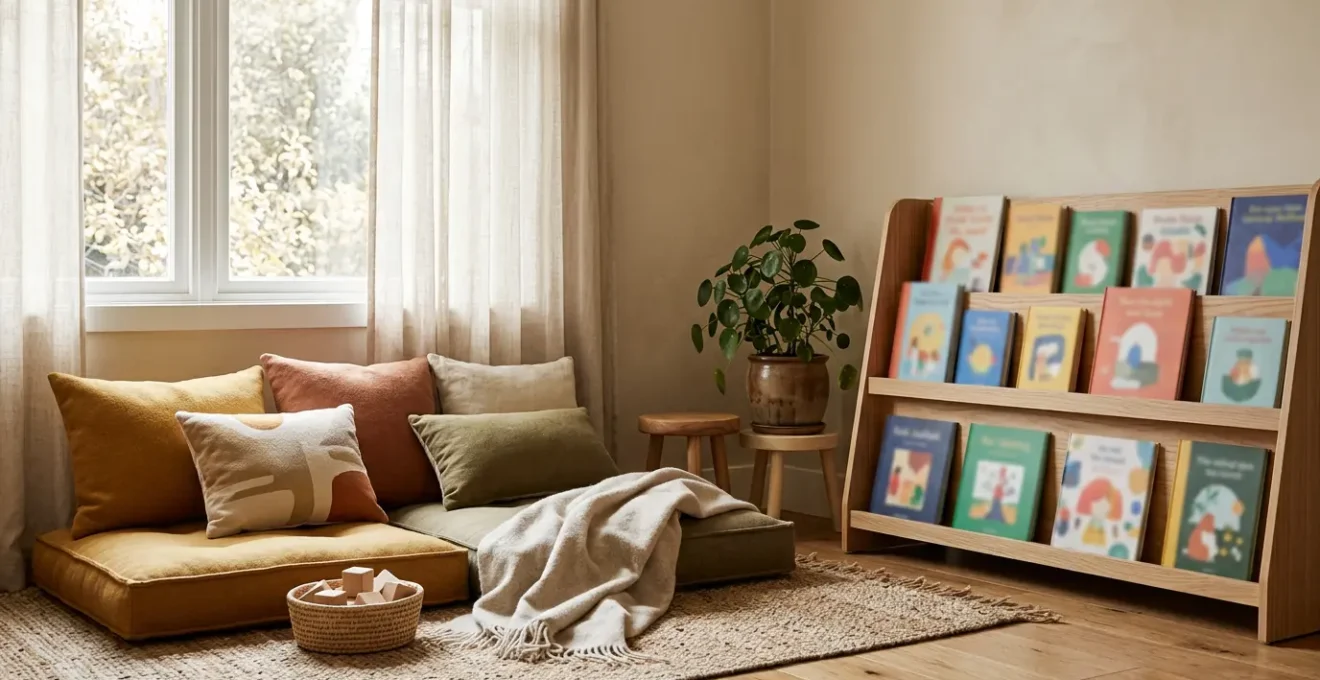
A beautiful reading nook is not enough to create a reader; the secret lies in using child psychology to design an environment that actively reduces distraction and sparks intrinsic motivation.
- Comfort means supporting focus (e.g., dynamic seating), not just softness.
- Accessibility means visual invitations (front-facing shelves) and curated choices, not overwhelming libraries.
Recommendation: Audit your space not for its ‘Pinterest-worthiness,’ but for its ability to send the right cognitive and emotional cues to your child.
As a parent, you want to give your child the world, and a big part of that world is found in books. So, you follow the advice. You buy comfortable cushions, a cute little shelf, and maybe even a personalized sign that says “Mia’s Reading Corner.” You arrange it perfectly, but after the initial novelty wears off, the corner gathers more dust than delight. The books remain untouched, and the dream of a little bookworm seems to fade. This is a common and deeply frustrating experience for so many families.
The conventional wisdom about creating reading nooks focuses almost exclusively on aesthetics. We are told to make it cozy, well-lit, and filled with books. While these are not bad ideas, they are surface-level. They treat the reading nook as a design project rather than what it truly is: an exercise in environmental psychology and literacy engineering. They address the ‘what’ but completely ignore the far more critical ‘why’.
But what if the secret to a successful reading nook wasn’t in the fluffiness of the pillows, but in the science of how a child’s brain engages with a space? What if we could design a corner that doesn’t just passively hold books, but actively invites a child to read? This guide goes beyond the decorative. We will deconstruct the reading nook and rebuild it based on principles of child development, cognitive science, and proven literacy strategies. It’s time to stop decorating a space and start engineering an invitation.
This article will walk you through the science-backed components of a truly effective reading nook. We will explore everything from the type of seating that can improve focus to the way you display books that can triple their appeal. Prepare to transform that neglected corner into the most magnetic spot in your home.
Summary: The Science of Engineering a Reading Nook That Inspires
- Bean Bags vs Floor Cushions: Creating Cozy Comfort
- Front-Facing Shelves: Why Seeing Covers Increases Reading?
- Reading Lights: creating Ambiance and Saving Eyes
- Book Rotation: Keeping the Selection Fresh and Exciting
- Canopies and Tents: Creating a Secret Hideaway
- Library Visits: Making Books Exciting and Accessible
- Zoning: Creating Distinct Areas for Reading, Building, and Art
- Early Literacy: Building a Foundation for Reading and Writing Before School
Bean Bags vs Floor Cushions: Creating Cozy Comfort
The first rule of a reading nook is comfort, but our understanding of “comfort” for a child needs an upgrade. It’s not just about soft surfaces; it’s about creating a space that supports a child’s neurological need for movement and focus. For many children, especially those who are neurodivergent, sitting perfectly still is a cognitive challenge that drains the mental energy needed for reading. This is where the concept of dynamic seating becomes a game-changer.
Instead of a static armchair, consider a bean bag chair or a stack of large, firm floor cushions. These options provide proprioceptive input—the sense of pressure and body position—which can be incredibly calming and organizing for a child’s nervous system. They allow for gentle wiggling, rocking, and shifting, which isn’t a sign of distraction, but a strategy for maintaining focus. In fact, research on dynamic seating shows that children with ADHD achieved the best results when sitting in active seats, demonstrating better in-seat behaviour.
Think of it as providing a “home base” that feels both secure and flexible. A bean bag molds to the child’s body, creating a gentle “hug,” while floor cushions can be stacked, leaned against, or laid upon, giving the child autonomy over their own physical comfort. This isn’t just about being cozy; it’s about creating an environment that removes the physical barrier of “sitting still” and frees up a child’s brain to get lost in a story.
Case Study: The ‘Wiggle Seat’ Effect
A study of preschool children highlighted the power of dynamic seating. When students were given “wiggle seats”—cushions that allow for movement while seated—teachers observed a significant increase in participation during group activities and a decrease in distracting behaviours. While not every child required this intervention, for certain children, it was a transformative tool that positively impacted their attention and effort in the classroom. This provides strong evidence that for some young readers, the ability to move is directly linked to the ability to learn.
Ultimately, the choice between a bean bag and floor cushions should be guided by your child. Involve them in the decision. Do they prefer to be enveloped or do they need the freedom to build and rearrange? Answering that question is the first step in engineering a truly personal and effective reading space.
Front-Facing Shelves: Why Seeing Covers Increases Reading?
One of the most powerful and scientifically-backed changes you can make to a child’s reading environment is deceptively simple: turn the books around. Traditional library-style shelving, with only the thin spines visible, is designed for adult-level information retrieval. For a young child, it’s an uninspiring wall of text they can’t even read. A front-facing bookshelf, by contrast, transforms a storage unit into an active and irresistible cognitive invitation.
Young children, particularly pre-readers, navigate the world visually. A book’s cover is its identity, its advertisement, and its summary all in one. The vibrant illustration of a dragon, the curious face of an animal, or the bright splash of color is what sparks curiosity. Seeing the cover reduces the cognitive load of choosing a book from an impossible-to-decipher spine to a simple, appealing choice: “That one looks exciting!” This principle is so fundamental to a child’s interaction with books.
Children, particularly those under six, navigate almost entirely by cover image rather than title. A shelf that shows covers rather than spines transforms a passive storage unit into an active invitation to read.
– Readability Research Team, Kids Book Display Shelf: Why How Books Are Shown Matters
This isn’t about having a huge, expensive shelving unit. A few narrow picture ledges installed at your child’s eye level are more effective than a towering bookcase. The goal is to make the books look like treasures on display at a gallery, not files in a cabinet. This simple shift in presentation empowers your child, giving them a clear and accessible sense of autonomy over their reading choices.
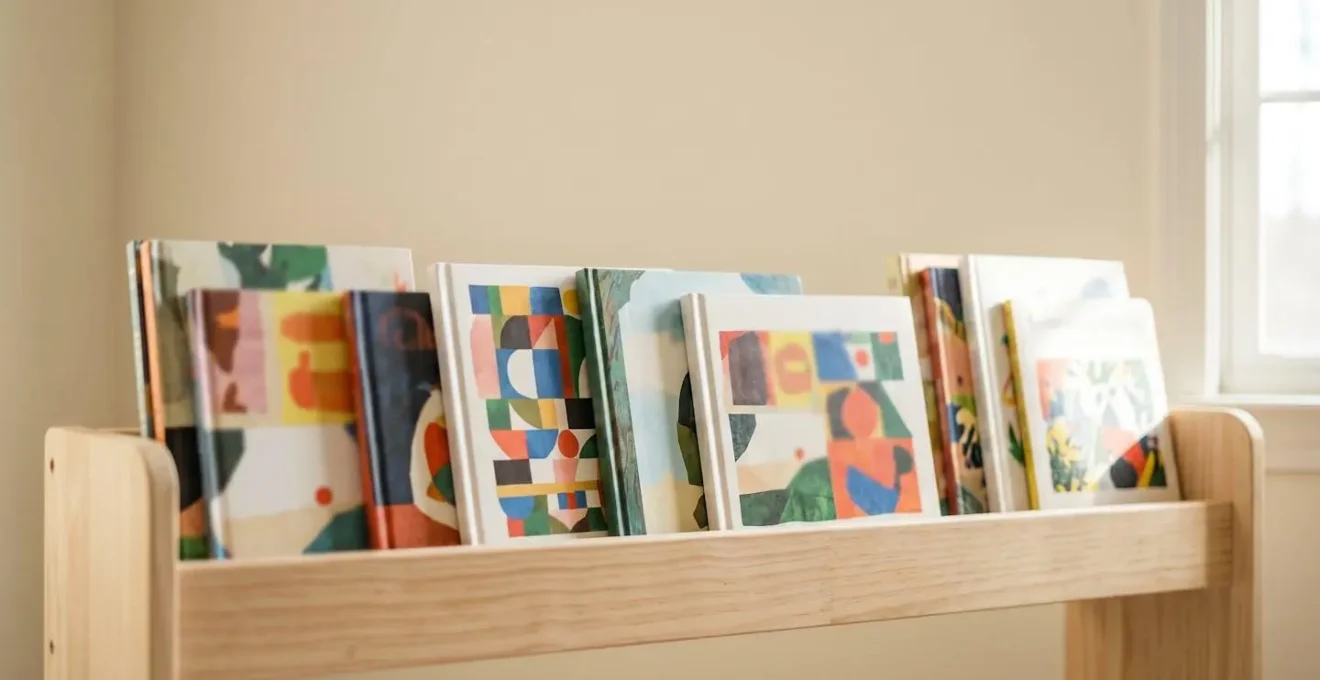
As this perspective shows, placing books at a child’s eye level and facing forward makes them part of the child’s world. The covers become windows into new adventures, easily accessible without needing to ask for help. This act of “visual marketing” for books within your own home is a cornerstone of literacy engineering, leveraging how children naturally see and interact with their environment to foster a love of stories.
By prioritizing the cover over the spine, you are speaking your child’s language. You’re communicating that books are beautiful, exciting, and, most importantly, for them. It’s a small change in furniture that can lead to a monumental change in mindset.
Reading Lights: creating Ambiance and Saving Eyes
Proper lighting in a reading nook serves a dual purpose: it protects your child’s developing eyes and helps create the magical, focused ambiance that defines a special space. Reading in dim light forces the eye muscles to work harder to focus and the pupils to dilate to let in more light, which can lead to eye strain, headaches, and fatigue. This is especially true for young children, as their eyes are still developing. In fact, children under 10 are 30% more susceptible to the effects of inadequate lighting, making the right light a health issue, not just a design choice.
The goal is to provide focused light directly on the page without creating harsh glare or casting shadows. A heavy, directional floor lamp can be a tipping hazard, so a better solution is often a clip-on lamp attached to a shelf or a small, adjustable desk lamp placed on a stable surface nearby. The key is task lighting—light that is dedicated to the specific activity of reading.
Beyond function, light shapes the feeling of the nook. A warm-toned LED bulb (around 2700K-3000K) creates a cozy, inviting glow, distinct from the brighter, cooler light of the rest of the room. This change in lighting acts as an environmental cue, signaling to your child’s brain that this is a quiet, calm-down space. Using string lights or “fairy lights” inside a canopy can add a touch of magic, but they should be considered ambient light, not a substitute for proper task lighting for the book itself.
Ensuring the reading nook has the right kind of light is one of the most practical ways to make it both safe and inviting. Here is a quick audit you can perform on your own space.
Checklist: Auditing Your Reading Zone’s Lighting
- Illumination Level: Is the light bright enough to read by comfortably? Aim for an illumination of 300 to 500 lux on the page, which mimics natural daylight.
- Light Source: Are you using a consistent, flicker-free light source like an LED bulb? Avoid old fluorescent lights which can cause imperceptible flicker and strain.
- Positioning: Is the light positioned to the side and slightly above the reading material, falling directly on the page without causing glare on the paper or shining in your child’s eyes?
- Ambiance and Mood: Does the light have a warm, calming color temperature? Consider a dimmable smart bulb to adjust brightness and even color for a more soothing environment, especially for neurodivergent children.
- Safety and Accessibility: Is the lamp stable and are the cords safely tucked away? Can your child turn the light on and off independently, fostering a sense of ownership over their space?
This thoughtful approach to lighting elevates the nook from just a corner with books to a purpose-built sanctuary for stories, protecting your child’s vision while nurturing their imagination.
Book Rotation: Keeping the Selection Fresh and Exciting
Now that you have a perfectly comfortable, well-lit nook with beautifully displayed books, the next step in literacy engineering is managing the content. It’s a common mistake to believe that more is better. We fill the shelves with every book we can find, hoping the sheer volume will inspire our child. However, for a young mind, this can lead to “choice paralysis”—a state of overwhelm where making any decision is too difficult, so no decision is made at all. The solution is a core principle of Montessori education: book rotation.
Book rotation is the practice of having a small, curated selection of books (perhaps 5-10) available at any one time and swapping them out for new ones from your larger collection every few weeks. This simple strategy has profound psychological benefits. Firstly, it keeps the selection feeling fresh and new. A book that was ignored for months can suddenly become a favorite when it reappears after a brief absence. It creates a sense of novelty and discovery.
Secondly, a limited selection encourages deeper engagement. When a child has only a few books to choose from, they are more likely to reread them. Rereading is incredibly beneficial for early literacy, as it builds vocabulary, fluency, and comprehension. They start to notice new details in the illustrations and master the rhythm of the text. It turns a book from a one-time event into a familiar friend.
Rotating the books on your bookshelf every few weeks helps build your little one’s interest in reading. Limiting the number of books reduces overwhelm and may even enhance your child’s focus.
– Piccalio Montessori Resources, Montessori Bookshelf Design Principles
The rotation process can also become a cherished ritual. Involve your child in “saying goodbye” to the old books and “welcoming” the new ones. You can theme your rotations around seasons, upcoming holidays, a recent trip, or a topic your child is currently obsessed with (dinosaurs, trains, etc.). This makes the bookshelf a living, breathing part of your family’s life, reflecting your child’s evolving interests and creating an ongoing conversation around books.
By managing the flow of books, you move from being a librarian of a static collection to a curator of exciting literary experiences. You are not just providing books; you are architecting your child’s discovery of them.
Canopies and Tents: Creating a Secret Hideaway
One of the most magical elements you can add to a reading nook is a sense of enclosure. A simple canopy hanging from the ceiling, a small pop-up tent, or even a sheet draped over a couple of chairs can transform a corner of a room into a secret world. This isn’t just about fun; it taps into a deep-seated psychological principle known as prospect-refuge theory. This theory suggests that humans are instinctively drawn to spaces where they can see out (prospect) without being seen (refuge). It creates a feeling of safety, security, and privacy.
For a child, a reading nook with a canopy or tent becomes a personal fortress, a space that is entirely their own, separate from the bustling world of the household. In this private hideaway, they are free from observation and expectation. This sense of security can be particularly important for reluctant or self-conscious readers, allowing them to stumble over words and sound things out without fear of judgment. It gives them the space to be vulnerable with a book, which is essential for learning.
This feeling of a dedicated, special space becomes increasingly important as children get older and face more distractions. Creating a strong, positive association with a specific reading spot can be a powerful anchor for the habit. Unfortunately, without this, interest can wane; recent literacy research reveals that reading enjoyment declined from 70% among 6-8-year-olds to 46% among 12-17-year-olds in 2024, with dedicated spaces noted as a key factor in maintaining engagement.
Creating this refuge doesn’t have to be complicated or expensive. The key is to define the space and make it feel enclosed. Here are some simple ways to create a prospect-refuge environment:
- Involve your child in selecting the location—an unused corner or the space under a loft bed can be perfect.
- Use soft blankets or sheets draped over furniture to create a simple ‘literary fortress’.
- For children who dislike enclosed spaces, define the zone with a distinct rug or low-hanging mobile instead.
- Fill the space with cozy elements like pillows and stuffed animal “reading buddies.”
- Ensure there is still a good task light inside the structure to protect their eyes.
By giving your child a small world of their own to read in, you are giving them the freedom and security to explore the much larger worlds contained within the pages of a book.
Library Visits: Making Books Exciting and Accessible
A beautifully engineered reading nook at home is the perfect headquarters for a young reader, but the adventure of literacy must extend beyond your four walls. Regular visits to the local public library are a critical and complementary part of inspiring a love of books. The library serves two essential functions: it makes an endless variety of books accessible to everyone, and it frames reading as an exciting community activity.
For many families, the library is an economic lifeline to literacy. The cost of new books can be a significant barrier, and a reading nook can only be effective if it’s filled with engaging material. The unfortunate reality is that statistics show that 61% of low-income families have no books at all in their homes. The library single-handedly solves this problem, providing free access to thousands of age-appropriate books, ensuring that a child’s curiosity is never limited by their family’s budget. It democratizes reading.
Beyond access, the library transforms reading from a solitary act into a shared adventure. Frame library trips as exciting excursions. Let your child get their own library card—a powerful symbol of responsibility and belonging. Give them a special book bag and the freedom to browse the shelves and make their own selections. This act of choosing is incredibly empowering. Many libraries also offer story times, puppet shows, and summer reading challenges that create positive, social associations with books and reading. It shows them that a community of readers exists outside their home.
The books borrowed from the library become the perfect fuel for your home book rotation system. It’s a constant, free source of fresh material to keep the nook exciting. The data is clear: the simple act of having and being read books has a staggering impact on a child’s future success. A landmark study found that children who were read to frequently were dramatically more likely to count to 20, write their own names, and pretend to read—all key indicators of school readiness. By leveraging the library, you are giving your child a huge academic and developmental advantage.
Integrating library visits into your family routine shows your child that books are so important they have their own special building in town. It elevates reading to the status of a community value, a public good, and a lifelong adventure.
Zoning: Creating Distinct Areas for Reading, Building, and Art
For a reading nook to be truly effective, it needs to be respected as a space for reading. This can be challenging in a child’s room or a playroom, where a dozen different activities compete for attention. The solution is a design strategy called zoning. Zoning is the practice of using environmental cues to create distinct, psychologically separate areas for different activities within a single room. It’s about sending a clear, non-verbal message to your child’s brain: “This is the place for quiet reading,” “That is the place for noisy building,” and “Over there is the place for messy art.”
You don’t need physical walls to create effective zones. The cues can be subtle but powerful. A specific rug that only sits under the reading nook furniture can define the space. A change in flooring, the placement of a low bookshelf acting as a soft barrier, or even a line of tape on the floor can be enough to signal a transition. As Montessori practitioners have long observed, this act of zoning helps a child’s brain switch gears and understand the expected activity for that space, reducing the “cognitive clutter” of a multi-purpose room.
This is particularly important for maintaining the nook as a calm-down space. If Lego creations are constantly spilling into the bean bag chair and art supplies are cluttering the bookshelf, the nook loses its identity as a peaceful refuge. By creating clear zones, you help your child understand and respect the purpose of each area, which is a foundational skill for organization and focus. Even in a very small room, flexible zoning is possible. A portable “reading cart” on wheels can create a mobile zone, or a dedicated “book bag” hung on a doorknob can signal the start of reading time.
Action Plan: Auditing Your Reading Zone
- Points of Contact: Identify all potential quiet corners in your home. Consider unused spaces under stairs, a corner of the living room, or a section of your child’s bedroom away from the main toy area. List 2-3 potential locations.
- Collecte: Inventory your existing materials. Gather all the age-appropriate books, pillows, blankets, and potential lighting you already own. This helps you see what you have before you buy anything new.
- Coherence: Confront your setup with your child’s needs. Is the seating supportive of focus? Is the lighting adequate and safe? Are the shelves low enough for independent access? Check for comfort, safety, and autonomy.
- Mémorabilité/Émotion: Assess the “invitation factor.” Are the book covers visible? Does the space feel special and distinct from the rest of the room? Is it a generic corner or a magical hideaway?
- Plan d’intégration: Create a simple plan for book rotation (e.g., “swap 5 books every 2 weeks”) and schedule a monthly “tidy-up” with your child to maintain the zone’s integrity and keep it a respected space for reading.
By thoughtfully zoning your child’s space, you provide them with an external structure that helps them build internal focus, a skill that will serve them far beyond the reading nook.
Key Takeaways
- The nook is a tool for focus, not just comfort; dynamic seating that allows for movement can be more effective than static furniture.
- Presentation is paramount; front-facing shelves and curated rotation make books more appealing than a massive, overwhelming library.
- The reading habit is built both inside and outside the home; the parent’s role as a reading model and library guide is as important as the nook itself.
Early Literacy: Building a Foundation for Reading and Writing Before School
The ultimate purpose of a reading nook is not just to get your child to read a book today, but to build a foundation for a lifetime of literacy. The habits and associations formed in this special corner before a child even enters school are incredibly powerful. This is the heart of early literacy: creating a rich environment where a love for stories, language, and print can flourish organically. It’s about a culture of reading in the home, for which the nook is the physical anchor.
This work has never been more critical. We are facing a crisis in reading enjoyment. A stark 2024 literacy survey found that only 34.6% of children aged 8 to 18 said they enjoyed reading in their free time, the lowest level ever recorded. The battle for our children’s attention is fierce, and the reading nook is our dedicated space to fight for the quiet, deep focus that reading requires.
The single most important factor in this battle is you. Research from Scholastic shows that having adults who prioritize and model reading is the key differentiator. Children who are frequent readers are overwhelmingly more likely to report that people in their lives enjoy reading (80% of frequent readers vs. just 26% of infrequent readers). When your child sees you using the nook to read your own book, it sends the most powerful message possible: reading is a valuable and enjoyable activity for grown-ups, too.
Finally, the nook is the perfect stage for “dialogic reading,” an interactive reading style where the parent encourages the child to become a storyteller. It’s less about reading *to* your child and more about reading *with* them. You can use simple techniques like pausing to let them fill in a word, asking open-ended questions about the characters, or connecting the story to their own life. This makes reading an active, engaging conversation rather than a passive performance, building critical thinking and comprehension skills right from the start.
Your reading nook is more than furniture; it’s a statement of your family’s values. It says, “In this house, we treasure stories. We make time for quiet wonder. We are a family of readers.” By investing your time and thought into creating this space, you are giving your child one of the greatest gifts of all: the foundation for a rich and literate life.