
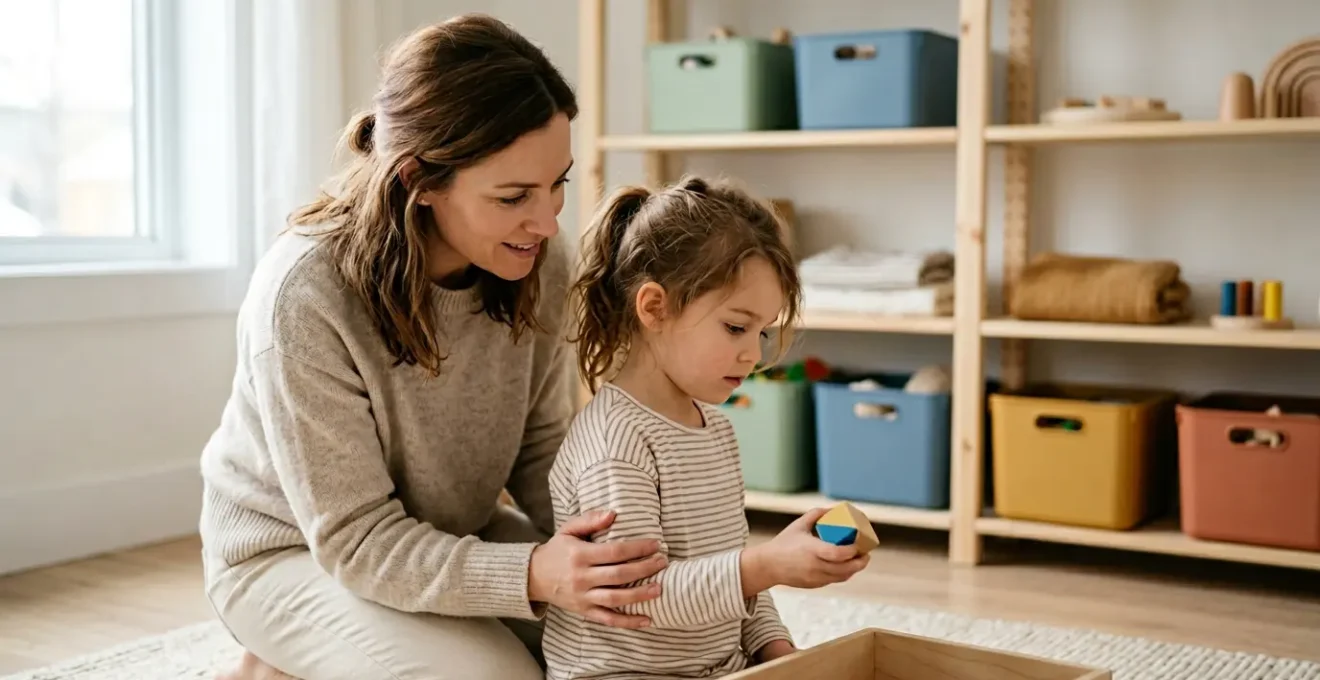
Teaching a child to let go of their things isn’t about tidiness; it’s a crucial life lesson in intentionality and emotional literacy.
- Focus on positive language like “passing the fun on” instead of “getting rid of” to frame donation as a joyful act.
- Establish clear, physical boundaries for toys using a “space budget” to make limits concrete and understandable.
Recommendation: Start with one small category of toys and give your child full, unhurried autonomy over the decisions to build trust and confidence in the process.
If your living room floor has become a graveyard for forgotten Happy Meal toys and your child’s closet is a bulging testament to every birthday party they’ve ever attended, you are not alone. As parents, we often find ourselves caught in a cycle of acquiring, tidying, and ultimately surrendering to the overwhelming tide of stuff. The common advice is practical but often falls flat: make them clean their room, try the three-box method, or lead by example. But these approaches often miss the core of the issue. For a child, a broken plastic figurine isn’t just trash; it’s a memory, a moment, a piece of their story.
The resistance you face isn’t defiance; it’s a sign of emotional attachment. This is where most organizational systems fail. They treat decluttering as a logistical problem of sorting objects, when it is fundamentally an emotional process of learning to let go. What if we shifted our goal from a perfectly tidy room to raising a child who understands value, practices intentionality, and finds joy in a space that breathes? This is not a guide to tidying. It’s a minimalist mum’s framework for teaching your children the invaluable skill of releasing what no longer serves them, making space for what truly matters.
This article will guide you through practical methods that respect your child’s feelings, explore the psychology of giving, and help you build a sustainable family system for organization that empowers everyone, all without leading to parental burnout. We will break down proven strategies into manageable steps that turn a potential battleground into a powerful teaching moment.
Summary: Decluttering with Kids: How to Teach Letting Go of Stuff
- Keep, Donate, Trash: The 3-Box Method for Kids
- The Charity Shop: Teaching Where the Toys Go
- The “One In, One Out” Rule: Managing Toy Volume
- Art Portfolios: Digitizing vs Keeping Physical Drawings
- The 10-Minute Tidy: Making Cleanup a Daily Ritual
- Buying Time: When Is It Worth Paying for a Cleaner or Ironing Service?
- Reward Charts: Do They Work or Do They Kill Intrinsic Motivation?
- How to Build Work-Life Balance and Family Organization Without Burnout?
Keep, Donate, Trash: The 3-Box Method for Kids
The 3-Box Method is a cornerstone of decluttering, but applying it with children requires a crucial shift in perspective. It’s not just about sorting; it’s an exercise in decision-making and emotional literacy. For a child who gets overwhelmed, the process needs to feel safe and empowering, not punitive. As organizing expert Julie Stobbe notes, this method works because it simplifies an otherwise daunting task. The key is to adapt the language and the rules to a child’s developmental stage, transforming it from a chore into a game of self-discovery.
Instead of “Donate,” try “Pass the Fun On” or “Give to a New Friend.” Instead of “Trash,” use “Broken” or “Recycle.” This reframing removes the sense of loss and replaces it with purpose. Start with a single, small area, like one shelf or one toy bin, to prevent overwhelm. Pull everything out so the child can see the full scope, then handle each item once. The rule is simple: it goes in a box immediately. The dreaded “maybe” pile is the enemy of progress. For items that cause genuine indecision, a fourth “Pause Box” can be a temporary solution, stored away for a month. If the child doesn’t ask for the item in that time, it’s ready to be passed on.
With kids, you can always make the four-box-method into a game. But I’d perhaps encourage parents to leave out the ‘store’ box if they’re decluttering with younger children. This could start to create a pattern where they don’t learn to let go of items and instead choose to store them away.
– Mary Jo Contello, Certified Professional Organizer, Living Etc
Ultimately, by giving your child control over the process and using positive, empowering language, you teach them that they are the curators of their own space, a foundational skill for an intentional life.
The Charity Shop: Teaching Where the Toys Go
The concept of “donating” can be abstract for a child. To make it meaningful, you must build a story around it. It’s not about an item disappearing; it’s about that item beginning a new adventure. This is the concept of the Legacy of Joy. We can teach our children that a toy’s purpose is to be played with, and when we are done playing with it, its greatest honor is to be passed on to another child who will love it next. This narrative shift is profoundly powerful and is supported by science.

In fact, research on toddlers has shown that children exhibit greater happiness when giving treats to others than when receiving them. A study published in PLoS ONE found that this positive feeling was strongest when the act of giving involved a personal cost, suggesting that the joy of giving is an intrinsic human trait. By teaching our children about donation, we aren’t just cleaning out a playroom; we are tapping into a deep, pro-social instinct that fosters cooperation and empathy. To make this tangible, talk specifically about where the toys might go. The context becomes even more powerful when children understand that in 2023, over 11 million children in the United States were living in families below the poverty level, for whom a new-to-them toy is a significant gift.
Make the trip to the charity shop a special ritual. Let your child place the items in the donation bin themselves. This physical act closes the loop and solidifies the lesson: they are not losing a toy, but creating happiness for someone else.
The “One In, One Out” Rule: Managing Toy Volume
Once you’ve done the hard work of an initial declutter, the next challenge is maintenance. This is where a simple, non-negotiable family rule becomes your best ally: the “One In, One Out” rule. It’s a foundational principle of minimalist living, and it’s the most effective way to prevent the slow creep of clutter from undoing all your progress. The need for such a rule is stark when you consider that, according to toy industry research, the average child receives 70 new toys per year but only plays with about 12 of them regularly. This policy directly addresses that imbalance.
The rule is simple: for every new toy that comes into the house, a similar existing toy must go out. The key is to establish this before the influx of birthdays and holidays. Frame it as “making space” for new treasures. This proactive approach gives the child agency. To make it work, you need a few ground rules. First, apply a ‘Like-for-Like’ strategy: a new doll replaces an old doll, a new car replaces an old car. Second, give the child full autonomy over choosing the outgoing item. This reinforces their decision-making skills and sense of ownership. Third, define the “Space Budget” together. Show them the specific bin, shelf, or cupboard where their toys belong. When it’s full, it’s full. This makes the physical limit of their space a concrete, visible teacher, rather than an arbitrary rule from a parent.
Communicating this boundary to well-meaning relatives is also part of the process. Suggesting experience gifts or contributions to a savings account can help manage the inflow, making the “One In, One Out” rule a sustainable practice rather than a constant battle.
Art Portfolios: Digitizing vs Keeping Physical Drawings
There is a special kind of clutter that tugs at a parent’s heartstrings more than any other: the endless, beautiful, and overwhelming pile of children’s artwork. Each piece feels like a precious milestone, yet keeping them all is physically impossible. This is where technology offers a brilliant, guilt-free solution: creating a digital portfolio. By digitizing their creations, you honor their work, preserve the memory, and reclaim your physical space—a true minimalist win.
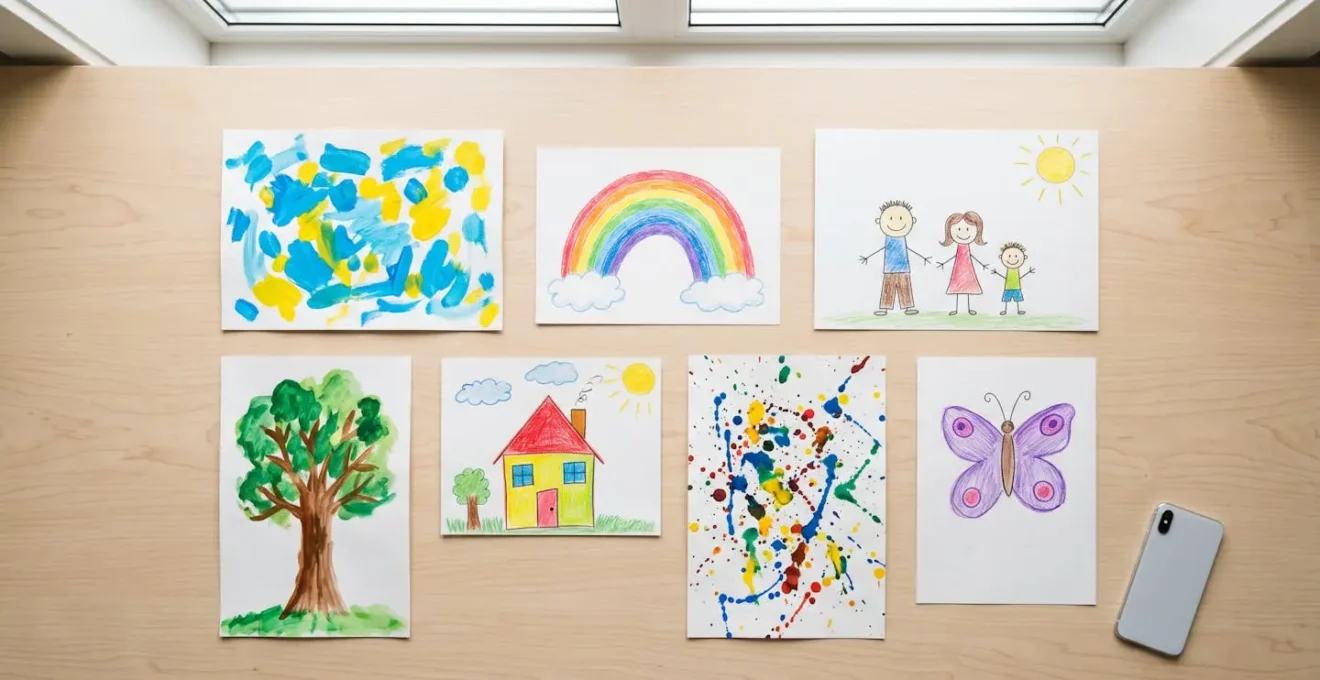
The process can be a lovely ritual. Set aside time to go through the artwork with your child, letting them choose the “masterpieces” to be preserved. You can photograph them, scan them, and organize them into digital folders by year or age. This act of curating teaches them about value assessment. For a more streamlined approach, several apps are designed specifically for this purpose, offering features that go beyond simple storage. Some allow you to create professional keepsake books, while others let you add voice notes of your child explaining their art, capturing a precious moment in time. The following table provides a comparison of some leading options:
| App Name | Platform | Key Features | Pricing Model | Unique Emotional Feature |
|---|---|---|---|---|
| Artkive | iOS, Android | Photo upload, organize by child/age/grade, professional book service available | $33/year for unlimited cloud storage; Box service starts at $39 | Professional photography service allows guilt-free disposal of originals after creating keepsake books |
| Keepy | iOS, Android | Photo/video upload, voice recordings, family commenting feature, cloud sync to Dropbox | $7.99/month to $99.99/lifetime | Audio/video story recording captures the child’s voice explaining their art, preserving the memory alongside the image |
| Artsonia | iOS, Android, Web | Online public gallery, art contests, customizable keepsake products | Free (revenue from product sales) | Creates a ‘virtual museum’ where children can exhibit work publicly, validating their creativity |
By embracing a digital solution, you send a powerful message: the art is valued for the creativity it represents, not the paper it’s on. You’re preserving the memory, not just the object.
The 10-Minute Tidy: Making Cleanup a Daily Ritual
The secret to a consistently organized home isn’t a massive, weekend-long cleaning blitz; it’s small, consistent, daily habits. The “10-Minute Tidy” is a game-changer for families because it’s short, manageable, and prevents mess from ever reaching an overwhelming state. The goal isn’t perfection; it’s a daily “reset” that puts the space back to a neutral, ready-for-play state. This small habit has a surprisingly large impact, not just on the room, but on a child’s brain. In fact, compelling research from the University of Toledo shows that with fewer toys in their environment, children’s play becomes twice as long and significantly more complex. A quick daily tidy helps maintain that less-cluttered, more creative environment.
Making this ritual stick requires a strategy called “habit stacking”—linking the new habit to an existing one. For example, “We tidy the playroom while the bathwater is running” or “We put things away right after dinner, before we can have dessert.” This creates an automatic trigger. Making it a team effort is crucial; parents should participate alongside their children to model the behavior and show that it’s a shared family responsibility, not a punishment. A visible timer helps children understand the commitment is finite, and playing upbeat music can turn a chore into a fun, energetic burst of activity.
Your 10-Minute Tidy Action Plan
- Link the Tidy-Up: Anchor the cleanup to an established routine, like just before bed or after a meal, to make it automatic.
- Define the Goal: Reframe the objective from “perfectly clean” to “resetting the space for tomorrow’s play,” reducing conflict over small missed items.
- Create a “Job Jar”: Write simple tasks (“Collect all books,” “Line up shoes”) on slips of paper. Each family member draws a job to make it fair and fun.
- Set a Visible Timer: Use a 10-minute kitchen timer or a phone so children can see the endpoint and understand the task is brief.
- Praise the Effort: At the end of the 10 minutes, focus on acknowledging the progress made and the effort put in, not the perfection of the result.
By praising effort over perfection, you foster a positive association with tidying. Over time, this small daily investment pays huge dividends in both home organization and your child’s sense of competence and responsibility.
Buying Time: When Is It Worth Paying for a Cleaner or Ironing Service?
As a parent striving for a more intentional, less cluttered life, your most precious and finite resource isn’t money; it’s your time and emotional energy. This brings us to a critical, often overlooked aspect of family organization: strategic outsourcing. The question of whether to pay for a cleaner or an ironing service isn’t one of luxury; it’s a question of value exchange. Are you willing to trade money to buy back the time and patience needed for the more important work of parenting?
Think of your energy as a budget. Every hour spent nagging about chores, scrubbing floors, or battling an ironing pile is an hour you can’t spend patiently guiding your child through the 3-Box Method or engaging in a 10-Minute Tidy as a team. Burnout is the enemy of consistent, gentle parenting. When you’re exhausted and stressed, your ability to be the calm, intentional guide your child needs is severely compromised. The power struggles over who cleans what can create a negative atmosphere that undermines the very sense of peaceful order you’re trying to build.
Therefore, paying for help isn’t an admission of failure; it can be a brilliant strategic move. By outsourcing low-value, high-drain tasks, you free up your personal bandwidth. You are literally “buying time”—not for leisure, but for high-value parenting. That hour a cleaner spends mopping is an hour you can now invest in teaching your child how to care for their own space, a lesson that will last a lifetime. It’s a minimalist approach to time management: eliminate the non-essential to make room for what truly matters.
So, before dismissing the idea, do the math. What is the cost of your stress? What is the value of your patience? Sometimes, the smartest organizational tool you can have is the phone number for a good cleaning service.
Reward Charts: Do They Work or Do They Kill Intrinsic Motivation?
In the quest to encourage good behavior, reward charts often seem like a logical tool. A sticker for every box of toys put away, leading to a new toy at the end of the week. It’s a simple system of transactional logic. However, from a minimalist and intentional parenting perspective, they are a dangerous trap. While they may produce short-term results, they risk destroying the very thing we are trying to build: intrinsic motivation. The goal is not to raise a child who tidies their room for a prize, but one who values and enjoys a clear, organized space for its own sake.
Reward charts teach children that basic responsibilities are transactional chores deserving of payment. This externalizes their motivation. They are no longer cleaning because it feels good to have a calm space or because they are contributing members of the family; they are cleaning for the sticker. What happens when the stickers stop? The cleaning often stops, too. The system undermines the development of an internal sense of satisfaction and competence.
This contrasts sharply with the lessons we’ve already explored. We know from research that children have a natural, intrinsic happiness that comes from giving. Reward charts threaten to corrupt this innate drive by teaching them to always ask, “What’s in it for me?” Instead of a chart, the “reward” should be the natural consequence of the action itself: the peace of a tidy room, the ease of finding a favorite toy, the pride of contributing to the family, and the joy of passing on an old toy to a new friend. These are the real, lasting rewards that build character and an internal sense of purpose.
So, do they work? Yes, if your goal is temporary compliance. Do they help you raise an intrinsically motivated, responsible, and intentional human? Absolutely not. Ditch the chart and focus on fostering the inherent satisfaction of a job well done.
Key Takeaways
- Shift your focus from the logistics of sorting to the emotions of letting go; this is an educational process, not a cleaning project.
- Use positive, purpose-driven language. “Passing the fun on” is more motivating than “donating,” and a “space budget” is more concrete than “too many toys.”
- Consistency with small, daily habits like the 10-minute tidy is far more effective and less stressful than massive, infrequent purges.
How to Build Work-Life Balance and Family Organization Without Burnout?
The ultimate goal of all these strategies is not a showroom-perfect house or a life devoid of possessions. The goal is balance. It’s about creating a family culture of intentionality that reduces stress, minimizes conflict, and makes space for connection. This system doesn’t happen overnight, but is built through the consistent application of clear boundaries and shared values. It’s about moving from a state of reactive crisis management—constantly battling clutter—to a proactive state of mindful living.
Building this balance requires recognizing that decluttering is not another item on your to-do list; it is the process that makes the rest of the list manageable. By teaching your children to manage their own belongings, you are not just outsourcing a chore; you are giving them essential life skills that will serve them forever. The long-term result is less work for you and more competence for them. This creates a virtuous cycle: the less time and energy the family spends on managing “stuff,” the more time and energy is available for playing, learning, and simply being together.
The 20-Toy Rule: A Family’s Long-Term Minimalist Approach
In 1995, one mother, overwhelmed by toy clutter, implemented a strict 20-toy limit per child. After the initial sorting, where children were given full control to choose their 20 keepers, the family noticed a profound shift. Children discarded trendy, single-function toys in favor of open-ended classics like LEGOs, art supplies, and a play kitchen. The long-term results were remarkable: the children became more inventive, self-directed in their play, and spent more time drawing and crafting. Maintaining the rule required discipline and clear communication with relatives about gift-giving, but the case demonstrates that firm physical boundaries on toys can dramatically reduce family stress while actively enhancing children’s creativity and the quality of their play.
Start today. Choose one small shelf, one small box of toys, and begin the conversation. The journey to a more intentional, balanced, and organized family life starts not with a massive purge, but with a single, mindful choice.